




Exactly one cartridge code is stocked for Lexmark’s E450dn and E450dtn monochrome lasers, and it is not the code a reader of the newer Lexmark families would predict. Where the modern shelves in this store stock Return Program part numbers, the E450 shelf stocks the Regular high-yield cartridge instead — E450H21A, rated at about 11,000 pages — offered as a single, a 2-pack and a 4-pack, each configuration listed once and only once. Nothing divides the platform: every cartridge Lexmark makes for these two printers fits both of them, so there is no fit fence to decode. The family’s one genuine complication sits in the store’s own labeling, which calls the printers “E450D” — a badge Lexmark never used — and leaves the E450dtn out of every sentence it writes. This guide prices the three boxes at the prices actually charged, puts the second printer back on the roster on Lexmark’s authority, and shows its working.
If the badge on your printer reads E450dn or E450dtn, the cartridge sold on this page is documented for your machine — whichever of the two you own. Begin with the flagship 2-pack at $248.98, roughly 22,000 rated pages at 1.13¢ apiece, unless your monthly volume makes a case for the 4-pack’s marginally cheaper page or the single’s smaller outlay. Two facts are worth carrying into the cards. The listings are named for an “E450D” that appears in no Lexmark document; treat the name as the store’s shorthand, because the fit underneath it is real. And the long cartridge is the only cartridge here: Lexmark’s standard-yield editions and the Return Program twin of this code are stocked in no size at all, so the depth of this shelf is decided by pack size alone.
The whole shelf: three boxes, one code
What follows is not a shortlist. Three listings make up this family and all three are carded — one part number in the three pack sizes a buyer would expect, each present a single time, so no deduplication stands between the shelf and an honest price. The flagship opens, and the other two boxes sit in the grid beneath it. Where a SAVE badge shows, on the multi-packs only, it is always the same subtraction: what the pack’s cartridges would cost bought singly at the sale prices printed here, minus the pack’s own sale price. The product pages measure their badges from list prices instead; the note closing this guide puts the two sets of figures side by side.

The pair leads because the rest of the shelf barely argues against it: the 4-pack below trims three hundredths of a cent from each page but asks for close to twice the money up front, and the single keeps the commitment smallest at the shelf’s highest rate. Bought one at a time, the same two cartridges would come to $265.06. For a single-printer office the arrangement is the familiar one — a cartridge in the machine and a cartridge in reserve — and for two printers it splits without waste, one cartridge to each.
Shop the E450H21A 2 Pack →THE OTHER TWO BOXES
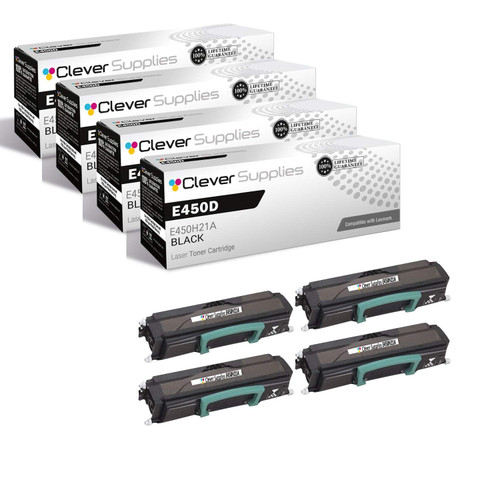
The lowest per-page figure on the shelf inside its largest box — about 44,000 rated pages, enough to carry a hard-worked E450dn through a heavy year and beyond. The same four cartridges bought singly would total $530.12.
Shop the E450H21A 4 Pack →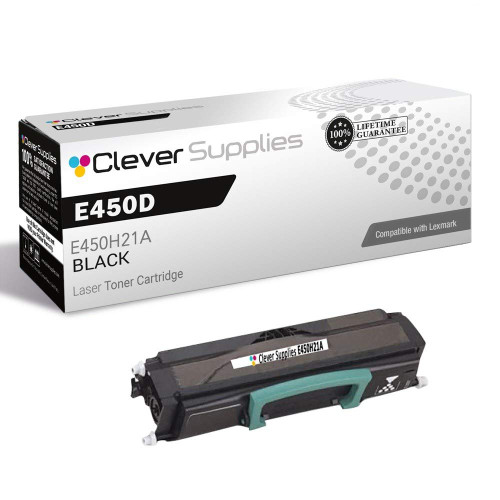
The least money committed on this shelf, at its most expensive page — the sensible box for a lightly used machine, or for a first order before pack sizes have earned their place. It still carries the full 11,000-page high-yield rating.
Shop the E450H21A Single →All three cards serve the same two printers, so the only choice the shelf puts to a buyer is how much toner to hold at once. The table that follows prices that choice in cents.
Three boxes, three rates
Each rate divides what a box costs at its sale price by the rated pages of every cartridge inside it. With a single code stocked there is no tier step for the table to price; the ranking is a pack-size ranking from top to bottom, and the last column repeats because both printers take every box on the shelf.
| Offer | Sale price | Rated pages per box | Per-page cost | Fits |
|---|---|---|---|---|
| E450H21A 4 Pack | $481.88 | 4 cartridges · ~44,000 pages | 1.10¢ | Both models — E450dn and E450dtn |
| E450H21A 2 Pack — the flagship | $248.98 | 2 cartridges · ~22,000 pages | 1.13¢ | Both models — E450dn and E450dtn |
| E450H21A Single | $132.53 | 1 cartridge · ~11,000 pages | 1.20¢ | Both models — E450dn and E450dtn |
Eleven hundredths of a cent separate the dearest row from the cheapest — a gentle slope, not a cliff. Counted per cartridge, the packs hold their cartridges at $124.49 inside a pair and $120.47 inside a four, against $132.53 bought singly, and those are the only discounts this family knows. With the spread that narrow, the honest grounds for choosing are cash committed today and changeovers avoided over the year; no row in the table is a bad buy for either printer it serves.
Four codes in Lexmark’s ladder — one on this shelf
Lexmark built this platform’s toner as two rungs, each rung sold two ways. The standard rung, rated at about 6,000 pages, is the E450A11A in the Return Program and the E450A21A sold outright as the Regular cartridge. The high-yield rung, rated at about 11,000 pages, is the E450H11A in the Return Program and the E450H21A as the Regular. Of the four, this store stocks the last one only — the Regular high-yield — in the three pack sizes carded above. The standard rung has no listing in either program, and neither does the Return Program twin of the stocked code, in any configuration.
That choice of code runs against the grain of the store’s newer Lexmark shelves, where the stocked part numbers are the Return Program twins and the Regular editions are the ones missing. Here the pattern is inverted, and the inversion has one practical consequence worth stating. The single-use license language Lexmark attaches to its Return Program cartridges — use once, then send the empty back — belongs to that program and to Lexmark’s own cartridges in it; the code stocked here is the outright one, to which those terms do not attach in Lexmark’s scheme, and the compatibles above are in any case sold under this store’s own terms whichever code they carry.
The label on the cartridge you are replacing settles which card is yours. A label reading E450H21A is this shelf exactly. A label reading E450H11A names the Return Program twin — same rating, same two printers — and the stocked Regular code is its replacement here, since no Return Program edition is sold. A label reading either standard code means the machine has been running 6,000-page cartridges; the stocked cartridge is the step up from there, at close to double the rating, and it fits the same printers.
Fit: two printers, no fence — and one the store forgets
Lexmark’s platform has exactly two models, both filed under the Lexmark E Series: the E450dn and the E450dtn. The dtn is no variant invented by a catalog — it is Lexmark’s own model (its part number is 53A3639), the dn with a 550-sheet drawer added, and the supplies table on its Lexmark page is the dn’s table word for word: the same standard cartridges, the same high-yield cartridges, the same photoconductor kit. Every code in the ladder above fits both machines. There is no model restriction anywhere in this family to warn a buyer about, and both names above are links, each to that model’s own category page in this store.
Against that two-model record, the store’s pages tell a shorter story, and tell it the same way everywhere. The category filing, the “For use in the following printers” paragraph in each description, the Compatible Printers link blocks and the fit answers in the questions all read “E450D, E450DN” — two entries, of which the first is not a Lexmark model at all. No Lexmark source uses the token “E450D”; it is shorthand the store coined, and it rides in all three listing names, all three SKUs and all three fit paragraphs. The second real printer, the E450dtn, is named by no store surface at all: the listings are not filed under the category page this store keeps for it, and no paragraph, block or answer admits that the cartridge fits it.
Nothing the store says is wrong about the printers it does name — the cartridge fits the dn, and the token points at the same platform — so this is understatement, not overstatement, the reverse of the defect found on several other shelves in this series. Its cost falls on one group: an E450dtn owner who browses their own model’s category finds none of this family filed there and no listing that names their machine. On Lexmark’s record the fit is theirs as much as the dn’s, and this guide follows Lexmark: two models, both linked above, both served by every card on this page.
The 11,000-page rating, confirmed on every surface
On the stocked code’s yield there is nothing to reconcile. The page-yield field on all three listings reads 11,000 pages for black; their texts repeat the number and multiply it honestly into pack totals, 22,000 pages for the pair’s box and 44,000 for the four’s; and Lexmark’s own cartridge page declares the same rating for this code, in the words “Average Cartridge Yield 11,000 standard pages,” declared in accordance with ISO/IEC 19752, the measurement standard behind every figure in this guide. Its printer pages repeat the ladder in their supplies tables on the same ISO footing.
The one figure in this family that rests on a single witness is the absent rung’s. No listing states the standard cartridge’s 6,000-page rating or names either of its codes; that number is Lexmark’s alone, taken from its cartridge pages and supplies tables, and it is printed here only to size the step up to the cartridge that is actually sold.
Against Lexmark’s own list price
Every genuine figure quoted in this guide traces to a single source: the Texas DIR document — the price list Lexmark publishes for US institutional buyers, hosted on lexmark.com — so each is a list price (MSRP), and each is flagged as such wherever it appears. No checkout price exists to set beside them: Lexmark’s US retail store returned none for this code, the platform is discontinued, and Lexmark’s own printer pages show these supplies out of stock or on back-order. On that basis the genuine E450H21A lists at $404.78 against $132.53 for the compatible single — about a third of the list price — or 3.68¢ a genuine page against 1.20¢. The unstocked rungs carry list prices of their own in the same document, quoted here for the record under the same label: the Return Program high-yield twin at $374.78, the Return Program standard at $246.48 and the Regular standard at $276.48.
Worked in blocks of ten thousand pages, the compatible shelf runs about $120 bought as singles, about $113 in the 2-packs and about $110 in the 4-packs, where the same block at the genuine list price comes to roughly $368. At ten thousand pages a month, a year of genuine cartridges at list would total roughly $4,416; the same pages at the compatible 4-pack rate total about $1,314 — on the order of $3,100 saved across the year.
One caution before setting any of this beside the product pages: the savings and per-page figures printed there are worked from list prices, not from what a buyer is charged at checkout. The single’s text, for instance, lands at about 1.39¢ a page because it starts from the $152.41 list price; start from the $132.53 actually charged and the rate is the 1.20¢ used here. The closing note works through the family’s figures in full.
The second consumable, and the cartridge in the box
Toner is not the only supply these printers consume. Forming the image takes a separate photoconductor kit, Lexmark’s E250X22G, one part shared across the E250, E35X and E450 lines. The cartridges above contain no drum, so the kit’s lifespan enters neither their ratings nor their prices. Lexmark puts that lifespan at up to 30,000 pages, measured its own way — at about five percent coverage, not on the ISO basis behind the toner numbers — which works out to the better part of three cartridges’ rated lives. The kit is not sold in this store. Its $78.02 Texas DIR list price (MSRP) is printed here so the platform’s second consumable can be budgeted for ahead of time, not met as a surprise.
What a new machine starts with is also on Lexmark’s record, and it is the same for both models: Lexmark’s pages for the E450dn and the E450dtn both list an up-to-6,000-page Return Program starter cartridge in the box, alongside the photoconductor kit. That starter rating is the standard retail rung’s rating, so the first replacement on either printer arrives at a standard cartridge’s life — well short of the 11,000 pages the stocked tier then delivers.
Chips and firmware: a boilerplate line and a blank
No chip specification field exists on this shelf, so anything said about chips lives in the descriptions’ prose — and here, unusually, the prose is uniform. All three descriptions carry the same boilerplate passage: units manufactured 100% brand new with all new parts, a smart chip listed alongside the OPC drums and wiper blades, and the assurance that using these cartridges does not void the printer’s warranty. No listing in the family is missing the passage, and none adds to it. Firmware goes unmentioned everywhere: nothing is promised about it and nothing is warned against it.
The one licensing mechanism worth naming belongs to Lexmark’s program, not to these cartridges. Lexmark’s own cartridge pages describe its Return Program cartridges as licensed for a single use and engineered to stop once a fixed amount of toner has been delivered. That language, by its terms, covers Return Program cartridges — the unstocked E450H11A among them — while the code stocked here is the Regular twin, sold outright. This platform has no dynamic-security regime to describe, and none is invented for it here.
What backs each cartridge
Choosing by volume, and by the label you are replacing
Answers for the E450dn and E450dtn owner
Both of Lexmark’s models on this platform: the E450dn and the E450dtn. Lexmark’s printer pages carry identical supplies tables for the two machines, and its cartridge pages name the same fit — every code in the platform’s ladder, the stocked high-yield included, serves both printers with no restriction. The store’s pages name the pair differently, as the next answers explain, but the fit itself is not in dispute anywhere.
Yes, on the manufacturer’s record. The E450dtn is a real Lexmark model — the dn with a 550-sheet drawer — with a supplies table identical to the dn’s, yet no surface on these product pages admits it: not the category filing, not the fit paragraphs, not the printer link blocks, not the fit answers — all of them stop at “E450D, E450DN” — and the listings are not filed under the category page this store maintains for your model. The surfaces are consistent with one another and one model narrower than Lexmark. The defect is understatement, the guide follows the manufacturer, and your machine takes the cartridge.
Shorthand the store uses, not a printer Lexmark sells. No Lexmark source — not a printer page, a cartridge page or a supplies table — uses the token “E450D”; the badges on the actual machines read E450dn and E450dtn. The token rides in all three listing names, their SKUs and their fit paragraphs, and the fit claim underneath it is platform-correct, so read it as the store’s compression of the model line rather than as a third model. A buyer matching their badge letter for letter will not find it in any listing name, which is a naming defect, not a fit defect.
In Lexmark’s catalog, both. The standard rung — the E450A11A in the Return Program and the E450A21A sold outright — is rated at about 6,000 pages and fits the same two printers, and the stocked cartridge has a Return Program twin, the E450H11A, at the same 11,000-page rating. In this store, neither: no listing exists for any of the three codes, in any pack size. The Regular high-yield cartridge carded above is the only cartridge this store sells under this platform’s codes, which is why depth here is bought with pack size.
No. The kit is a printer-side part in its own right — Lexmark’s E250X22G, common to the E250, E35X and E450 lines — rated by Lexmark at up to 30,000 pages at about five percent coverage. The toner cartridges contain no drum, so none of that life is inside their ratings or their prices, and the two parts wear out on independent schedules. The kit is not stocked here; its $78.02 Texas DIR list price (MSRP) is given so the expense can be anticipated rather than discovered at the printer’s insistence.
Because the two sets of sums start from different prices. The listings reckon from list prices; this guide reckons from what a buyer actually pays at checkout. On the 2-pack’s page, two singles at list ($304.82) are set against the pack’s list price ($286.33) to report an $18.49 saving and $143.17 per cartridge; at sale prices — $265.06 against $248.98 — the saving is $16.08 and the cartridge costs $124.49. The 4-pack’s page reports its cartridges at $138.54 with $55.48 saved; at sale prices the figures are $120.47 and $48.24. The pattern runs through all three listings, and the note below documents each instance.
Price and disclosure note: The prices in this guide are the sale prices charged on each product’s own storefront page, verified against its listing title by title on November 17, 2026, and re-checked live immediately before publication. Above every sale price here sits a higher list price on the same listing; if a sale ends, the product page governs. A pack’s SAVE figure is the gap between its sale price and what its cartridges cost bought singly at sale prices — $265.06 for two singles, $530.12 for four — giving badges of $16.08 and $48.24. Wherever a genuine Lexmark figure appears, its source is named with it: $404.78 for the genuine E450H21A, $374.78 (E450H11A), $246.48 (E450A11A) and $276.48 (E450A21A) for the unstocked ladder codes, and $78.02 for the photoconductor kit — every one a list price (MSRP) taken from Lexmark’s official US price list, the Texas DIR list dated July 25, 2024 and hosted on lexmark.com. Lexmark’s US retail store gave no checkout price for the stocked code, so none is printed. Yields need no choosing between sources: listing fields, listing texts and Lexmark’s ISO/IEC 19752 declarations coincide at about 11,000 pages for the stocked code, while the standard rung’s 6,000 pages rest on Lexmark’s record alone. Fit follows Lexmark’s printer and cartridge pages. Measured against that record, the store’s surfaces depart in four recorded respects. First, reach: the E450dtn — a real Lexmark model with an identical supplies table — is named in none of the places fit is stated, not the category filing, not the fit paragraphs, not the printer link blocks, not the fit answers, and the listings are not filed under the category page this store keeps for it; the bare E450 category is likewise unfiled and unnamed. Second, naming: all three listings are named, keyed and described under the token “E450D”, which appears in no Lexmark source; the models Lexmark sells are the E450dn and the E450dtn. Third, price basis: every savings and per-page sum in the listings is computed on list prices — the single at about 1.39¢ a page from its $152.41 list price, against 1.20¢ at the $132.53 sale price; the 2-pack’s $18.49 saving ($304.82 against $286.33) and $143.17 per cartridge, against a $16.08 saving ($265.06 against $248.98) and $124.49 per cartridge at 1.13¢ on sale prices; the 4-pack’s $55.48 saving and $138.54 per cartridge, against $48.24 and $120.47 per cartridge at 1.10¢. The list-price arithmetic itself checks out in every instance verified; the basis is the defect. Fourth, a minor formatting artifact: the printer link block stored on each listing opens a list it never closes — identical on all three, and no fit claim turns on it, since both of its links render.
The three cards above are the family entire — three listings in three pack configurations, no duplicates among them, each carded a single time. Nothing else from Lexmark’s ladder for this platform is stocked, in any size: not the standard codes E450A11A and E450A21A, and not the Return Program high-yield twin E450H11A. The photoconductor kit (E250X22G) is background only, since it is not sold here; its rating of up to 30,000 pages and its $78.02 figure are Lexmark’s, the second a list price from the same Texas DIR list. Both printers ship with an up-to-6,000-page Return Program starter cartridge, per Lexmark’s own printer pages. On chips, no listing carries a specification field; the boilerplate smart-chip line appears in all three descriptions, and firmware is mentioned nowhere. The family’s three SKUs are clean, and no “genuine” or “authentic” product wording appears anywhere in it. Behind every offer stands the cover the listings themselves promise: a year of warranty against defects in materials and workmanship, with returns free throughout that year.