




Nine Lexmark machines anchor this family — the C746dn, C746dtn and C746n, the C748de, C748dte and C748e, and the X746de, X748de and X748dte multifunctions — and every one of them is a color printer. Yet the shelf below holds a single cartridge: Lexmark’s C746H2KG, the Regular black high-yield, rated at about 12,000 pages and sold here as a single, a 2-pack and a 4-pack. That is the whole story of this store and this platform, and this guide will not dress it up: no cyan, magenta or yellow cartridge for these machines is listed anywhere in this store, so an owner whose color runs dry cannot be supplied from this page. What the page can do is price the black cartridge honestly — at the sale figures buyers actually pay — and record that fit, at least, needs no detective work: every surface the store publishes names exactly the nine models Lexmark names, the cleanest fit record in this guide series.
Own any of the nine printers on this platform and black toner asks almost nothing of you: a single cartridge code covers every model, so the decision shrinks to quantity. The recommended quantity here is two — the 2-pack at $151.56, close to twenty-four thousand rated pages working out at 0.63¢ apiece — since it spaces reorders twice as far apart as singles without tying up the money a 4-pack asks. Busier offices can push the rate to 0.60¢ with the 4-pack carded below; a lightly worked machine is better served by one cartridge at $83.82. Two things deserve saying before any card, not after. First, these printers print in color, yet this store carries no color cartridge for them at all — Lexmark sells cyan, magenta and yellow for the platform, but none of it is listed here, and this shelf is black-only. Second, black offers no lower rung to save toward: Lexmark never made a standard-yield black for these machines, and the Return Program version of this same cartridge is absent too. Pack size is the only dial there is.
The whole shelf: three boxes, one black code
The shelf is short enough to show in full, once one piece of bookkeeping is explained. Behind these three cards stand twenty-seven listings: every printer name in the family carries the identical trio of configurations, so the cards use the C746DN listings — the stem every SKU in the family is derived from — and display each box a single time; the remaining twenty-four listings repeat those offers under the other eight names. The recommended pair leads, with the single and the 4-pack in the grid after it. Only the multi-packs wear a SAVE badge, computed the same way throughout: what the enclosed cartridges would cost bought singly at this page’s sale prices, less what the pack itself costs. Product pages compute the identical badge from list prices and so print a larger one; the note at the end of this guide sets the two calculations side by side.

The recommendation rests on the numbers. Bought separately, two singles total $167.64; the pair therefore returns $16.08 before the first page prints, and puts each enclosed cartridge at $75.78 rather than $83.82. Moving on to the 4-pack trims roughly three hundredths of a cent more off each page — real money at volume, yet hardly a reason for a quiet office to warehouse four cartridges. Most owners of these machines run one cartridge in the printer and keep one in reserve; this box is precisely that arrangement.
Shop the C746H 2 Pack →THE OTHER TWO BOXES
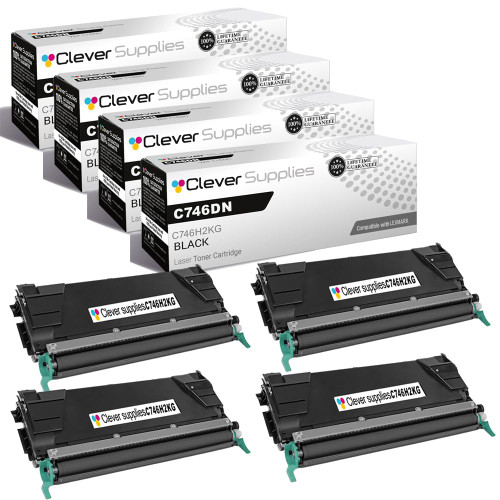
The cheapest page the store sells for this platform, at the price of the biggest single payment: close to forty-eight thousand rated pages, months of output for a busy department between orders. The same four cartridges purchased individually would come to $335.28.
Shop the C746H 4 Pack →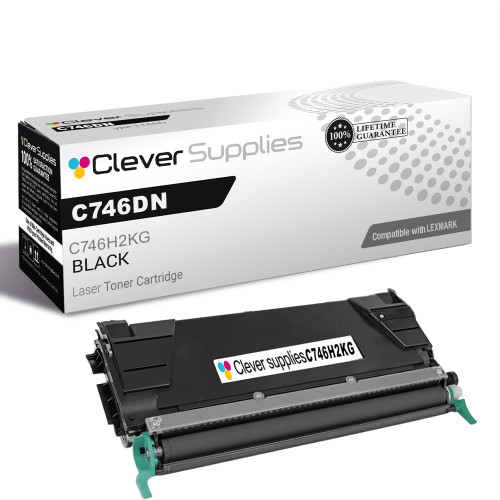
The least money down and the most expensive page on the shelf — suited to a machine that prints occasionally, or to a first purchase before committing to packs. It carries the identical 12,000-page cartridge; buying one at a time buys convenience, not a smaller supply.
Shop the C746H Single →Since every box serves the identical nine printers, choosing between them comes down to reorder cadence — how frequently the office cares to think about black toner at all. The table that follows prices each one by the page.
Three boxes, priced by the page
Each row divides a box’s sale price by the combined rated yield of the cartridges inside it. Because only one code is stocked, no tier comparison exists to tabulate — the steps are pack steps — and the fit column repeats itself, Lexmark having attached no model condition to the cartridge.
| Offer | Sale price | Rated pages per box | Per-page cost | Fits |
|---|---|---|---|---|
| C746H 4 Pack | $287.04 | 4 cartridges · ~48,000 pages | 0.60¢ | All 9 platform models |
| C746H 2 Pack — the flagship | $151.56 | 2 cartridges · ~24,000 pages | 0.63¢ | All 9 platform models |
| C746H Single | $83.82 | 1 cartridge · ~12,000 pages | 0.70¢ | All 9 platform models |
Before rounding, the spread from top row to bottom is a tenth of a cent — 0.70¢ versus 0.60¢ — and the bulk of it is captured by the first step up, single to pair. Per cartridge the arithmetic reads $75.78 within the 2-pack and $71.76 within the 4-pack, against $83.82 standalone. The rows are close enough that none of them punishes a buyer; pick by the office’s printing volume between orders rather than by anxiety over a fraction of a cent.
Nine printers take it — and the records all say so
Lexmark’s compatibility record for this cartridge runs to nine models. Six sit under the Lexmark C Series: the C746dn, the C746dtn, the C746n, the C748de, the C748dte and the C748e. Three are multifunctions under the Lexmark X Series: the X746de, the X748de and the X748dte. Every name links to its model category page in this store, and the family’s listings are filed under all nine of them. No restriction footnote attaches to the black cartridge for any of them — the one fence in Lexmark’s ordering table for this platform guards the high-yield color cartridges, which are C748-only, and this store stocks no colors in any case — leaving no restriction on this shelf for anyone to trip over.
The family earns a remark for the completeness with which the store’s paperwork backs that roster — the most consistent fit record this guide series has met. Filing covers all nine models. Each listing’s Compatible Printers link block points at precisely those nine category pages. Descriptions open by enumerating the same nine, and their fit answers repeat the set in full. Elsewhere in this series at least one such surface typically drifts; here none has, and cross-checking any two surfaces yields the identical answer.
One quirk of naming deserves a line, because it can mislead at a glance. Each listing is named for a single printer — the cards above carry the C746DN listings — although the cartridge inside fits all nine machines. The store’s own texts correct the impression themselves: each listing’s fit answer says plainly that the listing is named for one model but the C746H2KG is the shared black cartridge for the entire family. The name is a shelf label, not a restriction.
One rating everyone states — and a ladder with one black rung
Yield, too, arrives without controversy. Every listing’s structured field gives 12,000 pages for black; description prose repeats it and extends it faithfully to the pack totals — 24,000 pages for the pair, 48,000 for the four — and Lexmark’s cartridge page declares the identical 12,000, explicitly under ISO/IEC 19798, the color-laser standard (a separate document from the ISO/IEC 19752 basis behind the monochrome families elsewhere in this series). With field, prose and manufacturer in agreement, there is nothing to reconcile: roughly 12,000 pages is the rating.
Beyond the stocked code, Lexmark’s ladder for the platform is largely a color ladder — and none of it is stocked. Black stands alone: the ordering table in Lexmark’s own user’s guide lists black in a single high-yield row, sold as the C746H1KG in the Return Program and as the stocked C746H2KG outright. No standard-yield black cartridge exists in that table at all, so there is no cheaper black rung to miss. The colors run two deep — standard cartridges at about 7,000 pages (C746A1CG, C746A1MG and C746A1YG in the Return Program; C746A2CG, C746A2MG and C746A2YG sold outright) fitting all nine models, and high-yield colors at about 10,000 pages (the C748H1 and C748H2 color sets) that Lexmark restricts to the C748 models alone. Lexmark also sells parallel X-prefixed codes for the multifunction models, X746H2KG black among them. Of every one of those companion codes, this store lists none — not a color in either rung, not the Return Program twin, not an X-prefixed cartridge in any pack.
When the spent cartridge comes out, its label identifies what replaces it. C746H2KG on the label means the cards above, directly. C746H1KG means the Return Program twin — unstocked, but identical in rating and in the nine printers it serves, with the stocked Regular code standing in for it here. An X-prefixed code belongs to the multifunctions’ parallel supply line; since Lexmark’s page for the stocked code counts those X models among its compatible devices, the same three cards cover them.
What the genuine cartridge lists for
Every genuine figure in this guide traces to a single document, and is flagged as such wherever it appears: Lexmark’s Texas DIR list — the price schedule the company publishes for US institutional buyers and hosts on lexmark.com, dated July 25, 2024. There the genuine C746H2KG is priced at $332.49, an MSRP rather than a checkout price, Lexmark’s US retail store having returned no price of its own for the part. Against the compatible single’s $83.82 that is very nearly four times the money — 2.77¢ a page against 0.70¢. The same schedule carries the unstocked Return Program twin, the C746H1KG, at $286.79 (MSRP), quoted here as a reference only.
In ten-thousand-page units, the shelf costs roughly $70 as singles, $63 in pairs and $60 in fours; the identical unit at genuine list runs to about $277. An office printing ten thousand pages monthly would therefore pay some $3,325 a year for genuine cartridges at list, against roughly $718 at the compatible 4-pack rate — a gap of around $2,600 annually.
A caution before comparing any of this with the product pages: their savings and per-page figures are computed from list prices, not from checkout prices. The single’s copy, to take one case, starts at $96.39 and arrives near 0.80¢ a page; begin at the $83.82 actually charged and the result is the 0.70¢ this guide uses everywhere. Each listing’s figures are worked through individually in the closing note.
The other consumables, and the starter in the box
Black toner is not this platform’s only running cost — on a color machine it is not even the only imaging cost. The images are formed on separate photoconductor units, Lexmark’s C734X20G sold singly and C734X24G as a multi-pack, one unit serving any color position; Lexmark rates each at about 20,000 pages and directs that all four be replaced at the same time. A waste toner bottle, the C734X77G, is rated at about 25,000 pages, and the platform’s fuser (40X8110, 40X8111 or 40X8112 by voltage) and transfer module (40X8307) complete the list of parts that wear. This store stocks none of them — no photoconductor, no waste bottle — so they are named here for budgeting only: the photoconductors carry Texas DIR list prices (MSRP) of $54.67 for the single unit and $201.33 for the multi-pack, and the waste bottle $14.36 (MSRP), figures printed so those parts can enter the budget from the outset rather than announcing themselves as an unexplained warning on the display.
What each machine starts life with depends on which side of the platform it sits. The C746 models ship with reduced starters: a Return Program black cartridge rated at up to 6,000 pages — exactly half the stocked cartridge’s rating — alongside 6,000-page color starters, so on a C746 the first black replacement arrives early. The C748 models ship with the full-size black cartridge in the box: a 12,000-page Black High Yield Return Program cartridge, the stocked code’s own twin at its full rating, with 10,000-page high-yield color starters beside it. For the three X multifunction models, no Lexmark source retrieved for this guide states a ships-with figure, so none is printed here.
Chips and firmware: the listings say nothing at all
On this shelf there is no chip story to untangle, because the listings never raise the subject. No product in the family carries a chip specification field, and the words chip and firmware appear nowhere in any of the twenty-seven descriptions — no smart-chip boilerplate of the kind other families in this series carry, no claim made and none withdrawn. This guide reports that silence exactly as found rather than filling it in.
What can be reported is Lexmark’s documented position, from the platform’s own user’s guide, in three parts. First, its genuine-parts section recommends only genuine Lexmark parts and supplies, and states that Lexmark’s warranty does not cover damage caused by non-Lexmark parts and supplies. Second, its warranty notice warns that as part of warranty service Lexmark may update the printer’s firmware to the latest version, and that firmware updates may cause counterfeit and/or unauthorized products, supplies, parts and materials to stop working — while authorized use of genuine Lexmark products will not be impacted. Third, the guide’s own message list includes a “32.xx cartridge part number unsupported by device” error: the platform validates the part number of the cartridge installed. Beyond those three statements, the record documents no dynamic-security apparatus of the sort some newer platforms employ — and this guide describes none, there being nothing in the record to describe.
What backs each cartridge
Choosing by volume — the only choice there is
Answers for the C746, C748, X746 and X748 owner
Nine models, and only nine: the C746dn, C746dtn and C746n; the C748de, C748dte and C748e; and the X746de, X748de and X748dte multifunctions. Lexmark’s own page for the cartridge names exactly those nine as compatible devices, and no restriction attaches to the black cartridge for any of them. The store’s paperwork matches that roster on each surface checked for this guide — filing, printer link blocks, description introductions, the listings’ own answers — making this the most consistent fit record in the series. Each listing is named for a single model, but that is a shelf label; the listings’ own answers say the cartridge is the shared black supply for the whole family.
Not in this store. Lexmark makes both color rungs for these printers — standard colors rated at about 7,000 pages that fit all nine models, and high-yield colors at about 10,000 pages restricted to the C748 models — but not one color code has a listing here, in any pack size. This page’s shelf is black toner only. An owner whose color has run dry will have to source those cartridges elsewhere; nothing carded above should be mistaken for a color supply.
In Lexmark’s catalog, only half of that. Black has no standard rung on this platform: the ordering table in Lexmark’s user’s guide lists black in a single high-yield row. That row was sold two ways — the C746H1KG in the Return Program and the C746H2KG, sold outright as the Regular, which is the code stocked here. The Return Program twin has no listing in this store, and neither do Lexmark’s parallel X-prefixed codes for the multifunction models. So on this shelf, how deep you stock is settled by pack size alone — tier and program offer no second route.
Lexmark’s own pages answer differently by model. A C746 leaves the factory with a Return Program black starter rated at up to 6,000 pages — half the stocked cartridge’s rating — so its first black replacement comes early, alongside 6,000-page color starters. A C748 ships with the full-size article: a 12,000-page Black High Yield Return Program cartridge, the stocked code’s twin at full rating. For the X746de, X748de and X748dte, no Lexmark source retrieved for this guide states a ships-with figure, so none is given here.
No. The photoconductors are separate, printer-side parts — Lexmark’s C734X20G, or the C734X24G multi-pack — one unit per color position, each rated at about 20,000 pages, with all four replaced at the same time. The toner cartridges carry no photoconductor inside them, so none of that service life is contained in the cartridges’ 12,000-page rating or their prices; the two wear out on separate clocks. This store does not stock the units, and no listing refers to them; Lexmark’s Texas DIR list prices the single unit at $54.67 (MSRP) and the multi-pack at $201.33 (MSRP), quoted here so the cost can be planned for instead of arriving unannounced. The platform’s waste toner bottle, the C734X77G, is rated at about 25,000 pages and lists at $14.36 (MSRP) on the same schedule.
Because the two calculations start from different prices: the listings work from list, this guide from the amount charged at checkout. The 2-pack’s page presents the pair at its $174.29 list price — $87.15 per cartridge, an $18.49 saving, roughly 0.73¢ a page. Reckoned at sale prices — the pair at $151.56, two singles totaling $167.64 — each cartridge comes to $75.78, the saving to $16.08 and the rate to 0.63¢. The single’s and 4-pack’s questions and About sections follow the identical pattern; the note below records every instance.
Price and disclosure note: All prices in this guide are the sale prices taken from the products’ own storefront pages, checked title by title on November 17, 2026 and re-confirmed live immediately before publication. Each listing also shows a higher list price; should a promotion end, the product page is what governs. A pack’s SAVE figure is the gap between its sale price and the cost of its cartridges bought singly at sale prices — $167.64 for two singles and $335.28 for four — which produces badges of $16.08 and $48.24. Genuine figures carry their source with them: the $332.49 for a genuine C746H2KG is the MSRP in Lexmark’s official US price list (the Texas DIR schedule of July 25, 2024, hosted on lexmark.com), and that schedule also supplies the unstocked twin’s $286.79 and the photoconductor and waste-bottle figures ($54.67, $201.33 and $14.36, all MSRP) quoted in this guide. Lexmark’s US retail store yielded no checkout price for the stocked code, so none is quoted. Yields required no adjudication: listing fields, listing prose and Lexmark’s ISO/IEC 19798 declaration all coincide at roughly 12,000 pages for the stocked code, while the color rungs’ 7,000 and 10,000 pages rest on Lexmark’s record alone, no color listing existing to state them. Fit follows Lexmark’s own page for the cartridge, backed by the ordering table in the platform user’s guide. Measured against that record, the store’s fit surfaces depart in no respect this guide could find: filing, printer link blocks, introductions and fit answers all enumerate exactly Lexmark’s nine models. The one departure recorded is price basis, the listings performing every savings and per-page calculation from list prices. The single is reckoned at about 0.80¢ a page off its $96.39 list price, where the $83.82 actually charged gives 0.70¢. The 2-pack asserts an $18.49 saving with $87.15 a cartridge at roughly 0.73¢; at sale prices the figures are a $16.08 saving, $75.78 a cartridge and 0.63¢. The 4-pack claims $55.46 saved and $82.53 a cartridge at about 0.69¢, where sale prices produce $48.24, $71.76 and 0.60¢. Throughout, the arithmetic is internally sound — the misleading element is the price it starts from.
The cards above omit nothing, though the shelf behind them runs wider than three listings: twenty-seven in total — the same three configurations re-listed under each of the nine printer names, at identical prices — and the cards use the C746DN set, one per configuration, each carded exactly once. No other supply for this platform is stocked in any configuration — neither the Return Program twin C746H1KG, nor the standard or high-yield colors, nor Lexmark’s X-prefixed parallel codes. The photoconductors (C734X20G and C734X24G) and the waste toner bottle (C734X77G) appear as background only, being unstocked; Lexmark rates the units at 20,000 pages apiece and the bottle at 25,000 pages, and their figures above are Texas DIR list prices. Ships-with figures derive from Lexmark’s printer pages and spec sheets: 6,000-page Return Program starters in the C746 models, the full 12,000-page black cartridge in the C748 box; no figure was retrieved for the X models, so none is printed. Three blemishes ride on the family’s SKUs: the flagship 2-pack’s own SKU misprints the pack word as “2Balck”, the 4-pack’s suffix breaks the family’s pattern as “-4Black”, and every SKU in the family is built on the C746DN stem whatever model the listing is named for. No listing names any cartridge code but its own, so neither the platform’s ladder nor its Return Program split can be discovered from the product pages. On chips, no listing carries a specification field, and the words chip and firmware appear nowhere in the family’s twenty-seven descriptions. Each offer carries exactly the cover its own listing promises: a twelve-month warranty against defects in materials and workmanship, with returns free throughout that first year.