




Ten departmental machines — the LaserJet Pro M501dn, the Enterprise M506 printers and the M527 multifunctions, Flow and Managed models included — all run on the high-yield 87X black cartridge, the CF287X, which HP rates at about 18,000 pages. This store carries the 87 family as the single high-yield offer below: one compatible cartridge, sold singly, with no pack sizes and no second configuration standing beside it. A shelf of one sounds thin until the rating is read — a single box carries roughly eighteen thousand pages, three times what these machines start life with. What follows prices that one offer, sets it against HP’s genuine cartridge, walks the ten-model roster, and reports the chip position in the listing’s own limited terms.
There is exactly one buying decision on this page, and it is barely a decision: the compatible 87X single at $23.02, rated at about 18,000 pages, fitting all ten machines HP assigns to this cartridge. No ladder of pack sizes competes with it, and no genuine cartridge stands on this shelf — HP’s own $441.99 price for the same cartridge appears further down, for scale only. The rating needs no adjudication, because the listing, its specification field and HP’s product page all state the same 18,000. What remains worth a buyer’s attention is the surrounding detail: the roughly 6,000-page starter cartridge these machines ship with, the six roster models this store has no category page for, and a chip claim that amounts to a single sentence in a parts list.
A shelf of one — the 87X single, complete
Most pages in this series weigh tier against tier and box against box. This one cannot, because the store’s 87 shelf holds a single product: the high-yield cartridge, on its own. That narrows the page’s work to verification — is the rating sound, does it fit the machine in front of you, what stands behind it if it fails — and on the first of those the evidence is unusually tidy. The 18,000-page figure appears in the listing’s prose, in its structured specification field, and on HP’s own cartridge page, three sources in agreement.
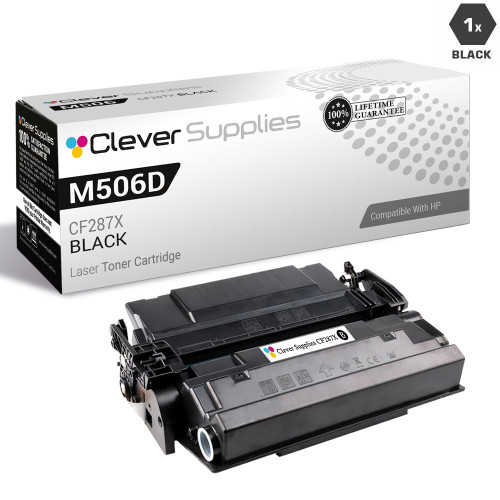
For scale, HP’s US store sells the genuine CF287X at $441.99 and shows it in stock. The cartridge above is this store’s compatible build of that same cartridge, carrying the same published rating; the two prices sit side by side in the table further down, stated as they stand.
Shop the 87X Single →The same cartridge also appears elsewhere in the store under listings named for individual models — the M506n, the M506x, the M527 and the M527dn. Those are the identical product wearing model names, at the identical price, and under this page’s one-card-per-distinct-offer rule they are carded once, here. A buyer who arrived through one of those listings is looking at the same box.
Every figure on this page begins at the sale price, the amount checkout charges. The product page’s own text does its sums from the $26.47 list price instead, which is why its per-page number lands a shade higher than the one printed here; the closing note sets out both bases.
The offer, the genuine cartridge, and the starter
With one product on the shelf, a comparison table has a different job: it sets the offer against the two cartridges a buyer might otherwise be pricing — HP’s genuine 87X, and the introductory cartridge already inside a new machine. Yields are HP’s published averages under ISO/IEC 19752, and real output shifts with the coverage on the pages printed. There is no fit column, because fit does not vary: all three rows concern the same ten machines.
| Cartridge | Price | Rated yield | Cost per page | Standing |
|---|---|---|---|---|
| 87X Single (compatible) — the offer above | $23.02 sale | ~18,000 pages | 0.13¢ | The cartridge this store sells |
| Genuine HP CF287X (reference) | $441.99 at HP’s US store | ~18,000 pages | 2.46¢ | Quoted for scale; not sold here |
| Starter cartridge (ships inside the machine) | Not sold separately | ~6,000 pages | — | The introductory unit a new machine starts on |
Read the first two rows together and the page’s whole pricing story is there: the same rated yield at two very different prices, with the rates following by simple division. The third row explains the first replacement order — a machine leaves its starter behind at roughly six thousand pages, a third of the way into what one full cartridge carries.
One division: how the page rate is reached
The 0.13¢ figure is nothing more than the live sale price spread across the rated yield: $23.02 divided by roughly 18,000 pages. It is printed as arithmetic, not as a boast — the number moves the moment either input does, and if the markdown on the cartridge ends, the rate rises with the price. The product page’s own arithmetic starts from the $26.47 list price and lands near 0.15¢, which is the honest figure for the undiscounted transaction.
In working terms, an office printing two thousand pages a month spends about $2.56 a month on toner at the sale rate and draws one cartridge down over roughly nine months. The same volume at the genuine cartridge’s rate runs to about $49 a month. Between those two numbers sits the entire economic argument of this page — no pack ladder, tier step or bundle discount complicates it, because none exists here.
The 18,000-page rating — and the 6,000-page start
HP rates the CF287X at approximately 18,000 pages, an average drawn from ISO/IEC 19752 testing; HP’s own footnote cautions that actual yield varies considerably with the content of the pages printed. Dense, toner-heavy work will land below the rating and light correspondence above it. On this shelf the figure at least needs no referee: the listing’s description states 18,000 pages, its specification field records the same, and HP’s cartridge page agrees — three tellings of one number.
A new machine does not start there. HP’s specification data for this family lists a starter yield of about 6,000 pages for the cartridge supplied in the box — an introductory unit, rated at a third of the replacement’s figure. That is stated at family level, as HP states it; this page makes no claim about the box contents of any individual model. The practical consequence is simple: the first replacement order on an M506 or M527 arrives sooner than the 18,000-page headline might suggest, and every cartridge after the starter is a full one.
There is no second cartridge in the platform’s upkeep. The imaging drum is built into the 87X itself — the listing’s own questions-and-answers text says the same — so a cartridge change is the whole maintenance event: toner and drum are renewed in the one swap, and no drum unit is stocked, priced or needed for these machines.
What 18,000 pages means at a desk depends on throughput. At five hundred pages a week it is roughly eight months of printing; at two hundred a week, the better part of two years. Either way, this is a cartridge bought infrequently and lived with for a long while — which is why the warranty and returns terms further down matter more here than they do on a small, fast-cycling cartridge.
Ten Enterprise machines on the one cartridge
HP’s compatibility documents assign this cartridge to ten models, and they fence none of them off: every machine on the roster takes the 87X, with no model restricted to a lesser cartridge or excluded from the high-yield one. HP’s own answer to the fit question on its cartridge page is that the toners fit the printer and differ only in page yield.
The printers: the LaserJet Pro M501dn and the LaserJet Enterprise M506dh, named here without store pages of their own, alongside the LaserJet Enterprise M506dn, the LaserJet Enterprise M506n and the LaserJet Enterprise M506x — the platform’s five single-function machines.
The multifunctions: the LaserJet Enterprise MFP M527dn, and — named from HP’s roster, as this store keeps no category pages for them — the LaserJet Enterprise MFP M527f, the LaserJet Enterprise Flow MFP M527c, the LaserJet Enterprise Flow MFP M527z and the LaserJet Managed MFP E52545dn.
One gap deserves plain statement. The product page’s own fit list names only five of these ten machines, so an owner of an M501dn, an M527f or a Flow M527z will find no mention of their model there. HP’s roster is the fuller document and this guide follows it: the cartridge is rated for all ten. The spent cartridge settles any remaining doubt — if the unit coming out of the machine reads CF287X, the offer at the top of this page is its replacement.
Chips: a single sentence in a parts list
The listing raises the subject of chips exactly once, inside an inventory of what the cartridge is built from: brand-new parts throughout, it says, including the OPC drum, wiper blades, a smart chip and the remaining internals. That is a statement about components, not a promise about recognition — the text says nothing about firmware, and nothing about how any given machine will respond to the cartridge.
HP’s side is equally restrained. Its cartridge pages for this family speak of JetIntelligence and anti-fraud technology, and attach no dynamic-security wording to the M501, M506 and M527 platform on the pages checked — so this guide asserts no blocking behaviour and no guaranteed acceptance in either direction. The store’s HP monochrome toner chip compatibility page covers CF287 within the wider monochrome range, and the practical protection here is the one the listing itself undertakes: the warranty and returns cover set out below.
The cover standing behind the cartridge
One offer — the only question is timing
Questions the M506 and M527 platform raises
Yes. HP’s compatibility documents rate the CF287X for all ten models on this platform, the two Flow multifunctions and the M527f among them, and no model is restricted to a different cartridge. The product page’s own fit list names only five of the ten — an incomplete list, not a restriction — and this guide follows HP’s roster.
An introductory one. HP’s specification data for this family gives a starter yield of about 6,000 pages for the cartridge supplied with the machine — a third of the replacement’s rating. That figure is stated at family level, as HP states it; expect the first low-toner warning well before an 18,000-page rhythm sets in.
No. On this platform the imaging drum is built into the cartridge — the listing’s own text makes the same point — so one swap renews toner and drum together. There is no drum on this shelf to buy, and none to price into the running costs.
It divides a different price. The product page’s text works from the $26.47 list price and arrives near 0.15¢ a page; this guide divides the $23.02 that checkout currently charges and arrives at 0.13¢. While the markdown lasts, the sale-based figure describes the transaction; if it ends, the list-based figure takes over.
The listing says so once, in a sentence listing the cartridge’s new components — OPC drum, wiper blades, a smart chip and other internal parts. It makes no claim about firmware or recognition beyond that parts statement, and HP attaches no dynamic-security language to this platform on the pages checked, so nothing further is claimed here in either direction.
It goes back. The listing carries a year of warranty cover and free returns across the same twelve months, and support is staffed on weekdays, 9 AM to 5 PM Central, while a return is arranged. Keep the carton until the replacement has printed cleanly — on a cartridge rated for this many pages, the proof period matters.