




When the whole printer is due, take the four-color set: $264.86 restocks all four bays with about 93,000 rated pages, pools to 0.285¢ a page, and undercuts the four singles bought apart by $48.25 — and the four genuine HP singles by $2,211.10. When only black is running down, which on these document-heavy machines is the usual case, the black 2-pack at $133.32 is the family’s best arithmetic: two CF460X cartridges at 0.247¢ a rated page. Single slots are filled singly — $74.70 for black, $79.47 for each color. Two warnings before the cards. The product pages argue from two sets of numbers that are both wrong for a buyer: prices quoted at list rather than at the sale figure actually charged, and page counts quoted below the ratings in their own spec fields. All the arithmetic here divides a sale price by the field rating. And the five-cartridge set at $323.48 is the one box whose contents cannot be fully pinned down from its listing — its card explains, and prints no page total for it.
The two color sets
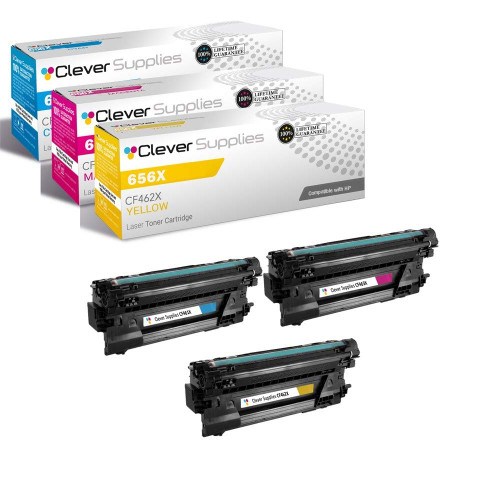
Eight products make up this family, and eight cards cover them — each shown a single time, carrying its own photograph, its own live sale price and its own link to order from. A SAVE badge identifies a box priced below the sum of its cartridges bought singly, by the amount shown; three boxes in the family earn one, and the two below are the first of them. The full four-color set leads, because a complete refresh is the purchase this platform most often calls for; beside it sits the colors-only set for printers whose black still has thousands of pages left in it.
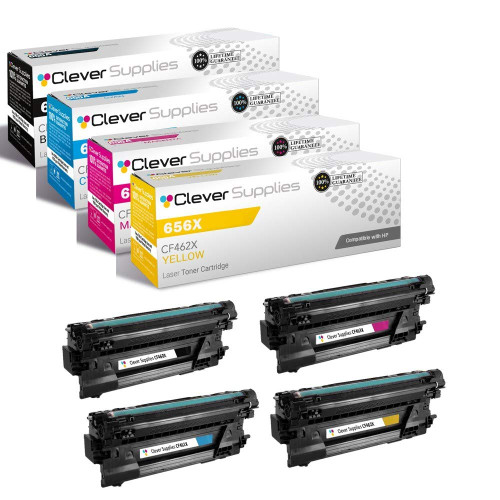
Enterprise color machines rarely fade one bay at a time for long, and this box is priced for the full reset: every slot refilled at the family’s best pooled rate for a mixed set. Each cartridge in it arrives with the current-generation chip already fitted at sealing, so the swap is the ordinary one — spent cartridge out, fresh cartridge in, no chip carried over. Nothing about the set ties its contents to one printer, either; the four cartridges can be split between an M652 and an M653 that share an office.
The singles, and the two black-and-spare packs
Underneath the two sets sit four single cartridges and two further boxes. The three color singles are priced to the cent identically — $79.47 apiece — so among them the only decision is which bay is empty. Black stands apart twice over: its single is the cheapest of the four at $74.70, and its rating is the highest, which together give it the lowest per-page figure of any single cartridge here. Read the code order before ordering from the digits alone: this row runs black, cyan, yellow, magenta, so CF462X is the yellow and CF463X the magenta — not the sequence the numbers suggest to most buyers.
THE FOUR SINGLES — BLACK $74.70, EACH COLOR $79.47

The hardest-working cartridge on this platform, and the cheapest single page among the four singles: 27,000 rated pages at 0.277¢. Against HP’s genuine CF460X at $471.99, it is also the family’s widest single-cartridge price gap in dollars saved per box.
Shop the 656X Black →
Cyan carries the code ending in 1, the first of the three colors. Priced exactly like its two color siblings and rated exactly like them, it needs no case beyond the printer’s own low-toner message naming the cyan bay.
Shop the 656X Cyan →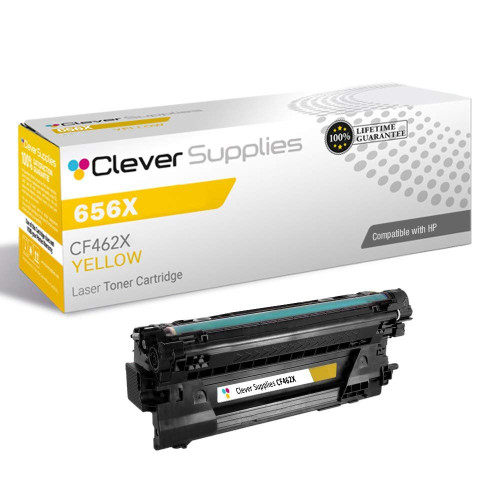
Yellow is CF462X — the code ending in 2, which HP assigns to yellow in this row even though magenta follows it in the rainbow. The pairing is HP’s own, confirmed on HP’s product pages; match the code to the color name here, not to the order you would guess.

Magenta closes the code run at CF463X while sitting third in the machine’s color sequence. Bought alone, it puts reds and skin tones right without touching three cartridges that still have pages in them.
Shop the 656X Magenta →THE TWO REMAINING BOXES — A BLACK PAIR, AND THE FIVE-CARTRIDGE SET

The best pure arithmetic in the family: two CF460X cartridges for $16.08 less than the pair bought singly, working out to 0.247¢ a rated page — cheaper per page than any other box here, the sets included. For a printer whose output is documents first and color second, this is the box that does the heavy lifting.
Shop the 656X Black 2 Pack →
This card carries a disclosure the others do not need. The box holds five cartridges, yet its listing names only the four codes of the row and nowhere says which of them appears twice; its text frames the fifth as a reserve for whichever bay runs dry first, without identifying what actually ships. Because the contents cannot be stated exactly, this page prints no page total and no saving for it — any per-page figure would depend on the unknown cartridge. A buyer who wants every cartridge accounted for gets that from the four-color set plus a single of the code they expect to need.
Shop the 656X 5-Color Set →Eight boxes, priced per rated page
One method throughout: the sale price on each product’s own page, divided by the rated pages the box holds — 27,000 for a black cartridge, 22,000 for a color. Rows for sets are marked pooled, because their totals add several bays together; that is the honest way to price a box, while the cost of a single printed page is a separate question the notes under the table take up. One row carries no per-page figure at all, for the reason its card states. The order is by per-page cost, lowest at the top.
| Configuration | Sale price | Rated pages | Cost per page | Printer fit |
|---|---|---|---|---|
| 656X Black 2-Pack | $133.32 | 2 cartridges · ~54,000 pages | 0.247¢ | All 5 models |
| 656X Black Single | $74.70 | 1 cartridge · ~27,000 pages | 0.277¢ | All 5 models |
| 656X 4-Color Set — the flagship | $264.86 | 4 cartridges · ~93,000 pages | 0.285¢ pooled | All 5 models |
| 656X 3-Color Set | $206.24 | 3 cartridges · ~66,000 pages | 0.312¢ pooled | All 5 models |
| 656X Cyan Single | $79.47 | 1 cartridge · ~22,000 pages | 0.361¢ | All 5 models |
| 656X Yellow Single | $79.47 | 1 cartridge · ~22,000 pages | 0.361¢ | All 5 models |
| 656X Magenta Single | $79.47 | 1 cartridge · ~22,000 pages | 0.361¢ | All 5 models |
| 656X 5-Color Set | $323.48 | 5 cartridges · contents not fully specified | Not printed — see the note on its card | All 5 models |
Two readings of the same figures are worth separating. The pooled column prices whole boxes, and on that measure the black 2-pack wins outright — black is both the cheapest cartridge and the highest-rated, so a box of two blacks beats every mixed set. A printed page is different: a full-color page draws on all four bays at once, so its toner cost adds the four single rates together — 0.277¢ of black plus 0.361¢ in each color, about 1.36¢ in total, at the coverage the ratings assume. Real documents lay down far less color than that assumption, so treat the sum as the ceiling the ratings imply rather than a running cost.
Against genuine HP, the comparison needs no pooling at all, because HP’s US store sells this row as singles only: CF460X black at $471.99 and each of CF461X, CF462X and CF463X at $667.99, for a four-cartridge total of $2,475.96. Per cartridge, genuine black runs about 6.3 times the compatible single’s price and each genuine color about 8.4 times. The flagship set’s $264.86 is, near enough, what HP charges for a single genuine black cartridge with $207.13 left over.
Fit: five Enterprise printers, every code in every one
HP states this row’s compatibility at series level — Color LaserJet Enterprise M652 and M653 — and the models under those series are five: the M652dn, the M652n, the M653dh, the M653dn and the M653x, each name linked to the category this store keeps for that model. All four 656X codes fit all five printers. There is no model that accepts the black but not the colors, and no code reserved for the faster M653 machines — the row is one row, everywhere on the roster.
Per-slot freedom follows from that. A printer can run a fresh CF460X beside three part-worn colors, take one cartridge from a set this month and the rest next quarter, or share a set’s contents between two machines on the same floor. A set is a way of pricing cartridges, not a kit the machine checks for completeness; no cartridge here needs to be purchased, installed or swapped as part of a group.
Two boundaries deserve plain statements, because both neighbors share this row’s shape. The standard-capacity cartridges for these same five printers form a separate row, the 655A line (CF450A–CF453A): same machines, smaller fills, a different family that this guide does not card. Owners can choose either row for any slot — there is no fence between the tiers — but the codes are not interchangeable on an order form, so order by the family you mean. In the other direction, the multifunction branch of this Enterprise generation, the MFP M681 and M682, takes the 657X row (CF470X–CF473X); a 656X cartridge fits none of those machines, and a 657X cartridge fits none of these. When the code on the cartridge and the code in a listing disagree, the cartridge wins.
The ratings — and the lower numbers the listings quote
This family carries a disagreement inside its own listings, and it is the reverse of the usual kind. HP declares about 27,000 pages for the CF460X black and about 22,000 for each color, the color figure being the composite cyan-yellow-magenta average HP bases on ISO/IEC 19798. The listings’ spec fields repeat those numbers exactly. But the listings’ descriptive text — the paragraphs and answers a shopper actually reads — quotes 23,500 pages for black and 18,000 for the colors, and builds its own per-page figures on those smaller counts. Nothing in the listings explains the gap. Every division on this page uses the spec-field figures, because they are the figures HP publishes and the figures the products’ own data fields carry; the understated prose numbers are named here and in the closing note so that a reader comparing this page against a product page can see both and know which one the arithmetic follows.
What the ratings mean in practice depends on the mix a machine prints. Black’s 5,000-page edge over the colors is real but modest next to the difference in how fast the bays empty: a fleet printing mostly text and forms will cycle two black cartridges against one set of colors, while a marketing-heavy machine can invert that. The pack totals follow the single ratings directly — 54,000 pages in the black 2-pack, 66,000 across the three-color set, about 93,000 in the flagship. The one total this page will not print belongs to the five-cartridge set, whose fifth cartridge is unidentified; a range could be guessed, and a guess is not a rating.
The chip, on an Enterprise platform
Enterprise machines live managed lives — fleet firmware is updated on a schedule, and supply levels feed reporting tools — so the chip question matters more here than on a desktop printer, and it deserves the plain version. Every cartridge carded here is sealed with the newest chip generation the supplier fits — that is the standing specification the supplier works to across the compatible range — and no chip problem has been reported to Clever Supplies on any cartridge it has sold. Fitting stays mechanical: the spent cartridge comes out, the new one goes in, and no chip is moved from the old cartridge to the new one.
The limit that travels with that answer everywhere in this program travels here too: it speaks to the cartridges as they are supplied now and to the record so far. It is not — and no seller can honestly make it — a promise about firmware HP has not yet released. The listings in this family are themselves silent on chips and firmware, so the position printed above is the store’s settled one, set out on the page because the question deserves an answer where the cartridges are sold.
Warranty, returns and support
One set of terms covers all eight products in this family, from the flagship set down to a single color cartridge, so the terms are printed once here rather than repeated under every card.
Which box, when
Questions M652 and M653 owners ask
Not under this family’s name. HP sells the 656 row only in the high-yield X form carded here; there is no CF460A-series standard cartridge in the 656 family. The standard-capacity cartridges for these same five printers belong to a different row — the 655A line, CF450A through CF453A — which fits the identical roster and is a legitimate alternative for lighter-use machines. The two rows are separate families with separate codes; this guide covers the 656X row.
CF462X is yellow and CF463X is magenta. That pairing is HP’s own, taken from HP’s product pages for this row, and the store’s cartridge names agree with it. The full run is CF460X black, CF461X cyan, CF462X yellow, CF463X magenta — the colors sit in the order cyan, yellow, magenta, not the rainbow order most buyers expect. Use the code-and-color pairs on the cards above when ordering, and match the code on the cartridge you pull out against the code on the box that turns up.
Because the listings disagree with themselves. Each product’s spec field carries the figures HP declares — about 27,000 pages in black and 22,000 per color — while the descriptive text on the same page quotes 23,500 and 18,000, and works out its per-page costs from the smaller numbers. No explanation is offered on the listings. This guide does its arithmetic on the spec-field figures, since those are HP’s published ratings; the discrepancy itself is recorded in the note at the foot of the page.
The listing does not say, and this page will not guess. The set is named with the row’s four codes — CF460X, CF461X, CF462X, CF463X — for a box of five cartridges, and no store surface identifies which code is doubled; the text describes the fifth as a reserve for whichever bay drains first. That is why its card prints no page total and no saving: both would depend on the unknown cartridge. If the spare’s identity matters to you, the four-color set plus a chosen single specifies every cartridge exactly.
No. The multifunction branch of this Enterprise generation takes the 657X row — CF470X through CF473X — and the two rows do not cross-fit in either direction: a 657X cartridge is just as wrong for an M652 or M653 as a 656X cartridge is for the MFPs. The printers look like relatives and the codes look like neighbors; the cartridges are not interchangeable.
One year for the warranty, one year for returns. Every compatible cartridge carded here is warranted for twelve months, and a return inside twelve months of delivery costs nothing — the same terms the family’s listings themselves state. Questions reach a person on weekdays between 9 AM and 5 PM Central, and parcels leave from the warehouses in Illinois, Pennsylvania, Georgia and California.
Price and disclosure note: All prices here are the sale prices from the carded products’ own pages, taken from the live catalog and checked against it again on November 18, 2026; if one moves later, the figure on the product page governs. The distinction matters in this family because each listing also carries a higher list price — $85.91 and $91.39 on the singles, $153.32 to $372.00 on the packs and sets — and the listings’ own text quotes those list figures, so all of the arithmetic on this page starts from sale prices. A SAVE badge means one thing only: how far a box sits below the combined sale prices of the cartridges inside it, when those cartridges are bought one at a time. The badges are $48.25 on the four-color set, $32.17 on the three-color set and $16.08 on the black 2-pack; the five-cartridge set wears none, because its contents are not fully specified and no exact subtraction exists for it. Page counts rest on HP’s declared ratings — about 27,000 pages for the CF460X black and 22,000 for each color, the color figure being HP’s ISO/IEC 19798 composite — and those same figures stand in the listings’ spec fields; set totals are labeled pooled wherever they are printed, since no printed page draws four bays down evenly. The genuine prices quoted are HP’s own US store prices for the four singles — CF460X at $471.99 and CF461X, CF462X and CF463X at $667.99 each, $2,475.96 for the four — retrieved from HP’s product pages on November 18, 2026, where all four stood in stock; HP’s US store sells this row as singles only, so no genuine set price exists to quote. Fit follows HP’s published compatibility: the M652dn, M652n, M653dh, M653dn and M653x, every code in every model. The rest of this note lists the places where the store’s catalog departs from that picture.
First, the prose does its price arithmetic at list: the price-bearing answers on the product pages quote the list figures named above while buyers pay the sale prices, and the per-page figures in the same answers are computed from the list prices, so every cost figure in the listings’ text overstates what a buyer actually pays per page. Second, the yield split: the listings’ descriptive text quotes 23,500 pages for black and 18,000 for the colors, below both the products’ own spec fields and HP’s declarations of 27,000 and 22,000, and the prose per-page math compounds the first defect by dividing its list prices by these understated counts. Third, the two larger sets’ spec fields are wrong in themselves: the four-color set and the five-cartridge set both carry a yield field reading “Black: 22000” — the color figure sitting in the black slot, against a true black rating of 27,000 — and neither set carries a color yield line at all; this page’s math uses the correct per-code figures throughout. Fourth, the M653dh gap: a visible store category exists for the M653dh, yet none of the eight products in this family is filed under it, and the listings’ compatibility text names only four printers, omitting the M653dh from the roster HP publishes; this guide’s roster follows HP’s five models, and the model’s category is linked above like the other four. Fifth, the five-cartridge set’s composition: it is named with four codes for five cartridges, no store surface states which code is doubled, and its text frames the fifth cartridge as a reserve without identifying it — which is why its card prints neither a pooled page total nor a badge. Sixth, stock figures: four of the family’s eight listings — the black single, the black 2-pack, the four-color set and the five-cartridge set — carry an inventory figure of zero while staying visible and orderable, and not one listing in the family has a recorded sale — the reason no card here says anything about stock levels or how well a box sells. Seventh, every SKU in the family contains a space (“CS-HP 656X-BK” and its siblings) — a cosmetic quirk, consistent across all eight, recorded because it is there. Eighth, there is no family shelf to browse: no “HP 656X” category exists in the store, so the products file under the brand, the color series and the five model categories only; and no listing in the family carries custom fields — the yield figures quoted in this guide live in the products’ spec strips.
The shelf above holds eight cards, and eight is the complete family: there are no duplicate listings in this census family to leave out and no second tier to square, so everything the family contains is on the page. Nothing carded here claims a printer beyond HP’s five-model roster, and every yield printed follows the figures HP declares and the spec fields carry, in neither direction. The chip statement keeps its standing boundary: cartridges arrive with the newest chip generation fitted, the record to date shows no chip problem, and nothing here reaches forward to firmware that does not yet exist. Underneath every card sit the terms the listings themselves publish — twelve months of warranty, twelve months of free returns, support from a person on weekdays, 9 AM to 5 PM Central, and dispatch from warehouses in Illinois, Pennsylvania, Georgia and California.