




Two enterprise color printers — the Color LaserJet CP4025 and CP4525 — draw their black toner from a pair of cartridges HP filed under separate family names: the standard CE260A, called the 647A, and the high-yield CE260X, called the 649X. This guide covers the black shelf for both machines: eight configurations, carded below. The color cartridges belong to a third name, the 648A, and already have a guide of their own; this page points there rather than repeating it. Three listings here need watching as much as buying. One four-pack is dressed, in its name and every paragraph of its text, as a single cartridge. One color set claims printers its black cartridge cannot physically enter — including one model that does not exist. And one five-cartridge set declines to say what its fifth cartridge is. Every price on this page is the sale price.
Start by separating the names, because HP’s numbering splits one platform three ways: 647A is the standard black, 648A is the three colors, 649X is the high-yield black. This guide’s eight cards are the black configurations the other guide leaves behind — the standard black in two-, three- and five-packs and as a five-cartridge color set, the high-yield black as a single, two-pack, four-pack and color set. The standard single and the color singles themselves are carded in the 648 guide, and are not repeated here. One boundary governs everything below: the standard CE260A enters all six printers on the roster, while the high-yield CE260X enters only the four CP4525 models — a CP4025 owner has no high-yield option from HP at all. Within that boundary, the flagship is the standard five-black pack: it fits every machine this guide serves and carries the family’s largest honest saving. CP4525 owners who print heavily can do better on rate alone — the high-yield four-pack undercuts everything — but its listing is the shelf’s most misleading page, and it is carded with that warning attached rather than given the flagship’s place.
Five standard blacks in one carton — the pack every printer here can use
Five CE260A cartridges pool 42,500 rated pages: $184.38 at 0.434¢ a page, each cartridge inside costing $36.88 against $49.74 bought alone. Five singles would total $248.70, so the carton keeps $64.32 — the largest saving on this shelf. It leads the guide because it is the deepest offer with no asterisk on fit: CP4025 and CP4525 alike take it, and its own page describes the contents and the pooled total correctly. The one deeper pool in the family sits in the panel beside it, carrying two asterisks of its own.

This is the reorder-avoidance box: a department running a CP4525dn through monthly reports, or a CP4025n that cannot pause mid-job, draws down five identical cartridges before anyone shops again. Each unit is the complete consumable — toner and imaging surface in one body — so every swap renews both at once.
Shop the 647A 5-Black →A flagship card is the one a hurried reader acts on without reading further; that place belongs to a listing whose page tells the truth about itself. The four-pack is carded in its tier below, where the caveat travels with the card.
The high-yield black, for CP4525 machines alone — CE260X
HP built the bigger black for one of the two printer lines: every offer in this section fits the CP4525, CP4525n, CP4525dn and CP4525xh, and none of them fits a CP4025. Credit where it is due — the black line’s own pages respect that boundary. The single’s text names the CP4025 as incompatible outright, and the pack texts address CP4525 models only. The one text in this tier that breaks the boundary is the color set’s, and its card below corrects the claim where the claim was made. The tier step itself is generous: $12.56 over the standard single doubles the rated pages and drops the per-page cost from 0.585¢ to 0.366¢.
THE 649X TIER — CP4525 ONLY
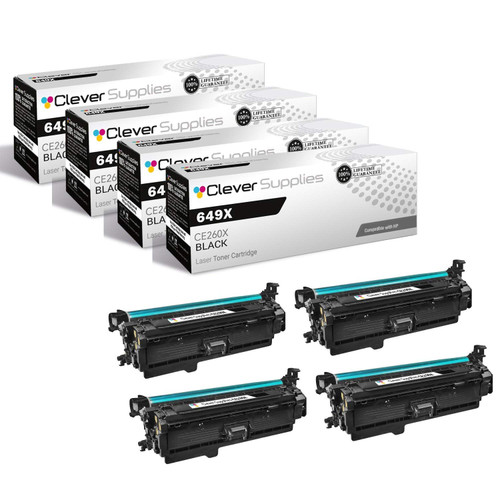
Read this card, not the listing’s headline: despite a name and a description written throughout for one cartridge, the SKU (ending 4BK) and the price are the four-black pack — four CE260X cartridges at $50.24 apiece, pooling 68,000 rated pages at the family’s best black rate. Four singles total $249.20; the pack keeps $48.23. The panel beside the flagship lays out the listing’s disguise in full.
Shop the 649X 4-Black →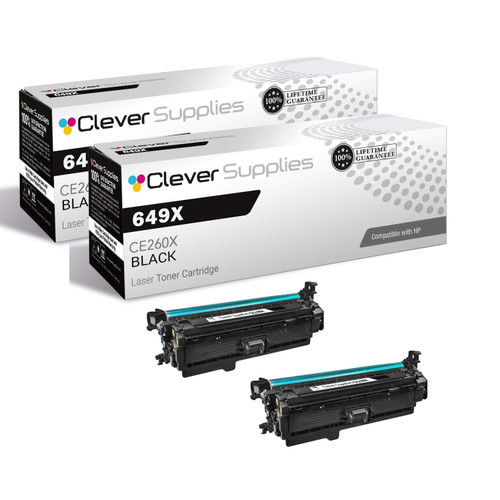
The honest middle of the X ladder: two high-yield cartridges, contents stated plainly on its own page, pooling 34,000 rated pages at $54.26 a cartridge. Two singles come to $124.60; the pair keeps $16.08. For a single CP4525 that prints steadily, this is the depth that keeps a spare on hand without committing to four.
Shop the 649X 2-Black →
One high-yield black with the three platform colors — the full refresh for a CP4525 in a single order. Bought apart, the four cartridges total $229.04; the set keeps $48.23. Buy it for a CP4525 only: the set’s own page also claims the CP4025, the CM4540 and a “CP4225”, and its black cartridge fits none of them — the fit section below takes the claim apart.
Shop the 649X 4-Color Set →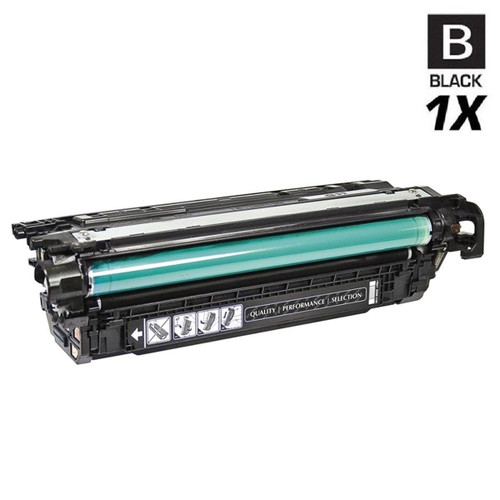
The tier’s reference point, and the family’s most candid page: its text states the CP4525 fit and then names the CP4025 as incompatible in so many words — the exclusion most listings would rather leave vague. Against the standard single, $12.56 more buys exactly twice the rated pages. Every X badge above is measured against this cartridge.
Shop the 649X Single →The standard black at three more depths — CE260A
The standard cartridge is the only black both printer lines share, and its ladder here runs two, three and five deep beneath the flagship, plus one color set built on it. Two members of the tier are absent by design: the standard single and the four-color set are already carded in this store’s 648 guide, under the same stock pools these listings draw on — one product gets one card, so they are not repeated here. What remains is depth: the per-page rate eases from 0.491¢ down to the flagship’s 0.434¢ as the boxes grow, and every configuration fits all six printers on the roster.
THE 647A TIER — BENEATH THE FLAGSHIP

Three standard cartridges pool 25,500 rated pages — one in the machine, two behind it — at $39.02 a cartridge. Three singles total $149.22; the pack keeps $32.16. Its own page quotes the $134.62 list price in its answers; the figure charged is the $117.06 shown here.
Shop the 647A 3-Black →
The pair pools exactly the 17,000 rated pages one high-yield cartridge carries — delivered in the cartridge a CP4025 can actually take. Each unit inside costs $41.70; two singles come to $99.48, so the pair keeps $16.08. For mixed fleets running both printer lines, this is the deepest small box that serves either machine.
Shop the 647A 2-Black →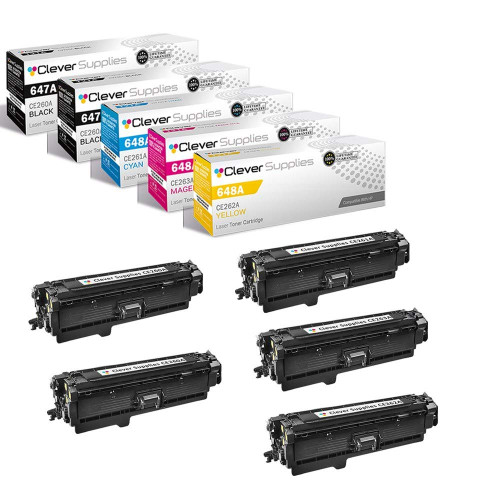
The four platform cartridges plus a fifth — and there the listing’s information ends: which color is doubled is, in its own words, “printed on the box label”. Because the fifth cartridge is never identified, no honest savings figure exists for this set, and this card carries no savings badge. Buy it only if any doubled color serves you equally.
Shop the 647A 5-Color Set →One genuine row, eight compatible ones
The genuine row covers the standard cartridge only, because that is the only genuine price HP’s US store states: the CE260X is a current HP product, but no offer for it could be retrieved from HP’s store, and this guide prints genuine prices only where HP publishes them. The two configurations already carded in the 648 guide — the standard single at $49.74 and the four-color set at $168.25 — are left off deliberately; their cards live there.
| Configuration | Price | Rated pages | Cost / page | Printer fit |
|---|---|---|---|---|
| Genuine HP 647A Single — CE260A | $242.99 | 1 cartridge · 8,500 pages | 2.859¢ | All 6 models |
| 647A 5-Black — the flagship | $184.38 | 5 cartridges · ~42,500 pages | 0.434¢ pooled | All 6 models |
| 649X 4-Black | $200.97 | 4 cartridges · ~68,000 pages | 0.296¢ pooled | CP4525 line only |
| 649X 4-Color Set | $180.81 | 4 cartridges · 17,000 black + ~33,000 color pages | — | CP4525 line only |
| 647A 5-Color Set | $201.91 | 5 cartridges · 8,500 black + ~33,000 color pages + 1 unstated | — | All 6 models |
| 649X 2-Black | $108.52 | 2 cartridges · ~34,000 pages | 0.319¢ pooled | CP4525 line only |
| 647A 3-Black | $117.06 | 3 cartridges · ~25,500 pages | 0.459¢ pooled | All 6 models |
| 647A 2-Black | $83.40 | 2 cartridges · ~17,000 pages | 0.491¢ pooled | All 6 models |
| 649X Single | $62.30 | 1 cartridge · 17,000 pages | 0.366¢ | CP4525 line only |
Read the fit column before the rate column: the three cheapest black rates on this table all belong to the high-yield tier, and all three are closed to CP4025 owners. For them, the flagship’s 0.434¢ is the floor. And set the genuine row against the flagship beneath it — one genuine standard cartridge costs $58.61 more than five compatible ones.
Six printers, one bright line through the middle of the roster
HP’s roster for this cartridge family runs to six models. The CP4025 line contributes the CP4025n and CP4025dn; the CP4525 line contributes the CP4525, CP4525n, CP4525dn and CP4525xh. The standard black and the three colors enter all six. The high-yield black enters the four CP4525 models and stops there — no HP source lists the CE260X for any CP4025. The whole shelf files under the HP 647A & 648A category; no category carries the 649X name, so the high-yield listings shelter under the standard family’s heading.
Against that roster, one listing’s fit line fails three times in a single sentence. The high-yield color set’s page claims compatibility with the CP4025, the CM4540 and a “CP4225”. The set’s black is the CE260X, which no CP4025 accepts. The CM4540 takes neither that black — its high-yield black is a different cartridge, the CE264X — nor this set’s colors, which belong to a different family on that machine. And the CP4225 does not exist. The set’s own answers, to be fair, describe its contents correctly and frame it around the CP4525dn; the claim lives in its fit line, and it is corrected here and on the set’s card, nowhere else — the rest of the high-yield line never made it.
A neighboring machine deserves one paragraph so its owners are not misled in the other direction. The Color LaserJet CM4540 genuinely does take the standard CE260A black — HP’s own datasheet for that machine lists it. But the CM4540 is the 646 family’s printer: its high-yield black and its colors are different cartridges entirely, covered by that family’s guide, and no CE260X offer on this page fits it. It stays outside this guide’s six-model roster for that reason.
The listings’ own fit text errs by omission in the opposite direction: no carded description names the base CP4525 at all, addressing only its n, dn and xh variants, though HP’s roster includes the plain model and every cartridge here fits it. A base-CP4525 owner reading only product pages would find no page that names their machine.
Finally, the two shelves of this platform divide cleanly. The color singles — cyan, yellow and magenta — and the standard black single are carded in the 648 guide for this same platform; everything black in depth, and both sets built on the blacks, is carded here. Between the two guides, every unique product on the platform has exactly one card.
Every rating on the shelf is HP’s figure, unembellished
HP declares its yields for this platform under ISO/IEC 19798: 8,500 pages for the standard black, 17,000 for the high-yield black, and a composite 11,000 for each color. All eighteen listings swept for this guide repeat those numbers exactly — no listing adds pages, invents a tier, or rounds a rating upward — and the pooled totals the texts state multiply out correctly: 34,000 in the high-yield pair, 42,500 in the flagship. Each rate on this page divides the sale price by HP’s rating, scaled for the cartridges in the box.
Ratings assume standard document coverage, so dense color work spends them faster — but the relationships hold at any coverage: the high-yield cartridge prints roughly twice what the standard prints, and depth in either tier lowers the per-page cost without changing the cartridge.
One catalog note for genuine buyers: HP’s own catalog data also carries the high-yield black in a two-cartridge pack. No genuine price for that pack — or for the single X — could be retrieved from HP’s US store, so neither appears in the table; the compatible two-black above is the stocked way to buy the X in pairs.
No drum hides behind these cartridges — and a word about chips
These are all-in-one cartridges in HP’s platform design: the imaging surface lives inside the cartridge body and is renewed at every change, so no separate drum unit exists for these machines and no second consumable waits behind any card here. No listing claims otherwise — on drums, this family’s texts are accurate by silence.
On chips, the listings are silent too — not one description in this family mentions one. The store’s position, stated as its own: every compatible cartridge ships with a current-generation chip already fitted, so installation is drop-in — seat the unit, close the door, and the printer recognizes it and tracks its toner as it would a genuine cartridge’s. The spent cartridge keeps its chip; nothing is transplanted from the old unit. That describes the printers as they run today; no seller can honestly warrant firmware that has not been written yet.
The terms read the same on every page in this family
Warranty language is where this catalog often contradicts itself; here it does not. Every carded listing states the same operative terms in its own answers — a one-year warranty and one year of free returns — with no competing lifetime promise anywhere in the family. The tiles below print that set.
Matching the box to the printer on your floor
The first question is not how much you print — it is which printer you own, because that answer closes half the shelf to one group of readers:
Questions from CP4025 and CP4525 owners
No. HP assigns the CE260X to the CP4525 line only, and no HP source lists it for any CP4025 — the high-yield slot simply was not built for that line. The cartridge’s own listing agrees: the single’s text names the CP4025 as incompatible outright. The one page suggesting otherwise is the high-yield color set’s fit line, which also claims a printer that does not exist; treat that line as the error it is. CP4025 owners’ deepest black option is the standard five-pack carded as this guide’s flagship.
In this store’s 648 guide, which covers the same two printer lines from the color side: the cyan, yellow and magenta singles are carded there, and so is the standard CE260A single at $49.74 — the cartridge every standard-tier saving on this page is measured against. The split follows HP’s own numbering, in which the colors carry their own family name. One product, one card: nothing carded there is repeated here, and the fit section above links the two guides together.
Nobody can tell you from the listing. The set holds the four platform cartridges — standard black, cyan, yellow, magenta — plus one extra cartridge that doubles one of the colors, and the page’s own answer is that which color is doubled is “printed on the box label”: knowable after purchase, not before. That gap is also why the set carries no savings badge here — its contents are worth somewhere between $64.31 and $70.15 more than its price depending on which cartridge the fifth turns out to be, and a figure that cannot be pinned down does not get printed as one.
No — it is the four-black pack, and only two pieces of evidence say so. Its SKU ends in 4BK, and its price sits on the ladder the rest of the tier builds: $62.30 for one high-yield cartridge, $108.52 for two, $200.97 here, which works out to $50.24 a cartridge. Everything else about the page argues for one: the name omits any count, and the description is written for a single cartridge from first line to last — even pricing the story at the pack’s $231.12 list figure. The card above sells it as what the SKU and the arithmetic establish: four cartridges.
The cartridge does; this guide’s roster does not. HP’s datasheet for the CM4540 lists the CE260A as that machine’s standard black, so the physical fit is real. But the CM4540 is the 646 family’s printer — its high-yield black is a different cartridge (the CE264X) and its colors are different again — so its supplies are covered by that family’s guide, and the six-model roster here stays with the CP4025 and CP4525. Nothing else on this page fits the CM4540: in particular, no high-yield offer here is a CM4540 cartridge, whatever the color set’s fit line suggests.
The product pages do their arithmetic from list prices; this guide works from the prices at checkout. The pattern runs through all eighteen listings swept for this family: the flagship’s page reasons from $212.04 where the charge is $184.38, the four-black’s from $231.12 where the charge is $200.97, the standard single’s from $57.20 where the charge is $49.74. Every figure on this page — prices, per-cartridge costs, per-page rates, badge savings — is computed from the sale price a buyer actually pays.
Price and disclosure note: Prices throughout are sale prices, taken from the carded listings on November 18, 2026 — where a product page disagrees today, the product page wins. The descriptions themselves never quote those figures; they work from list: $71.65 for the high-yield single, $124.80 for the high-yield two-pack, $231.12 for the high-yield four-pack, $207.93 for the high-yield color set, $95.91 for the standard two-pack, $134.62 for the standard three-pack, $212.04 for the standard five-pack and $232.20 for the five-color set. Badge savings compare sale with sale: within the standard tier against the $49.74 single carded in the 648 guide (two-pack $83.40 vs $99.48; three-pack $117.06 vs $149.22; five-pack $184.38 vs $248.70), within the high-yield tier against its own $62.30 single (two-pack $108.52 vs $124.60; four-pack $200.97 vs $249.20), and for the high-yield color set against its four cartridges bought apart ($180.81 vs $229.04). The five-color set carries no badge, for the reason its card states. The genuine row is HP’s US store price for the CE260A, $242.99 and in stock when read on November 18, 2026; no genuine CE260X price could be retrieved from HP’s store, so none is printed. Yields are HP’s ISO/IEC 19798 declarations — 8,500 pages for the standard black, 17,000 for the high-yield black, a composite 11,000 for each color. Fit follows HP’s published six: CP4025n, CP4025dn, CP4525, CP4525n, CP4525dn, CP4525xh — with the high-yield black limited to the four CP4525 models. What the catalog itself gets wrong follows.
(1) Three family names for one platform, scrambled in the selling: HP’s split is 647A for the standard black, 648A for the colors, 649X for the high-yield black — yet the standard black is sold under the 647A name on one page, under the 648A name on another, and inside “649X & 648A” set names, while the same products repeat across model-named storefronts on shared stock pools: one standard single under four storefronts, one four-color set under six. Ten of the eighteen listings in these two census groups are such duplicate storefronts; each unique product is carded exactly once across this guide and the 648 guide. (2) The high-yield four-pack’s hidden count: named and described throughout as a single cartridge — its answers say so in words — while its SKU ends in 4BK and its $200.97 price is the four-pack’s; its closing text even attaches the pack’s $231.12 list price to the single-cartridge story. (3) The high-yield color set’s fit line claims the CP4025, the CM4540 and a “CP4225” that does not exist: the set’s black fits neither of the first two and its colors do not fit the CM4540 either. The over-claim is confined to that one listing; the high-yield black line’s own texts respect the boundary, and the single’s states the CP4025 exclusion explicitly. (4) The five-color set’s fifth cartridge is identified nowhere in its text — which color is doubled is left to the box label — so its exact saving is indeterminate, somewhere between $64.31 and $70.15, and no badge is printed for it. (5) List-price arithmetic in all eighteen listings: every in-text price is the list figure while checkout charges the lower sale figure, and every derived number inherits the basis. (6) Fit under-naming in every carded text: the base CP4525 is named in no description, though HP’s roster includes it and every cartridge here fits it. (7) A shared boilerplate introduction on the newer listings names pseudo-models “CP4000” and “CP4500” as series in the lineup and credits these print-only machines with scanning, copying and faxing. (8) Broken markup debris — a stray “<p> />” fragment — opens the four older-template descriptions, two of them carded here. (9) HP’s genuine marketing copy pasted into a compatible listing: the color set’s page carries HP’s cartridge-intelligence and ColorSphere language and HP’s genuine-cartridge warranty line alongside its own one-year terms, and files the set’s yield type as “Standard” despite the high-yield black inside it. (10) Weight fields that describe nothing: 2 on the older listings for a single and a color set alike, 3 on the newer ones from a single to a five-pack — HP’s genuine standard package alone weighs 4.06 lb. (11) Inventory figures that echo across different products: the four-color set’s pool figure is also read by a different three-color set, and the high-yield single and the high-yield color set share one figure — the numbers are pool echoes, not per-listing counts. (12) Filing anomalies: the family category is named for the 647A and 648A only, and no 649 category exists; the standard black packs are not filed in that category, and the high-yield packs sit in only five categories; the high-yield single is additionally filed under Brother categories — the Brother brand root and its DCP series; the category tree carries up to four parallel buckets per model plus invented CP4000 and CP4500 buckets; the 648 guide’s products are filed only in a hidden “Home” category; and the series page above the family returns a server error live and is not linked here. Two silences belong on the record as well: no description in this family mentions a chip at all, so the chip paragraph above states the store’s position rather than any listing’s claim; and the five-color set’s page links across to a duplicate storefront of the standard single, which this guide does not reproduce. The negative results belong on the record too: every yield in the family is exactly HP’s, with pooled totals that multiply correctly; no tier or code is invented anywhere in the family; no description claims a separate drum; warranty and returns terms are uniform and uncontradicted; every listing carries an image; and each of the six roster models has a live category.
The buyable shelf rides on eight cards — the black configurations of this platform that the 648 guide leaves behind. Two more unique products, the standard single and the four-color set, are carded there; ten further listings are duplicate storefronts and are handled in prose, never offered. Underneath sit the terms from the listings’ own answers: one year of warranty, one year of free returns, support on weekdays from 9 AM to 5 PM Central, and shipping out of Illinois, Pennsylvania, Georgia and California.