




HP’s Color LaserJet 4700 series dates from 2005, and its toner story has never grown more complicated than the day it launched: four cartridges — Q5950A black, Q5951A cyan, Q5952A yellow, Q5953A magenta — every one of them badged 643A, black included. HP never added a high-yield row, so the black station carries the same badge as the colors, and the ratings have been stable for two decades: about 11,000 pages from the black, about 10,000 from each color, the identical numbers in the store’s listings, in their yield fields and in HP’s own documents. Each cartridge is an all-in-one unit with its imaging drum inside, so a toner swap is the whole maintenance story at the cartridge level. Nine offers are carded below: the full set, a colors-only set, four singles, two black packs and one five-cartridge set whose listing never identifies its fifth cartridge. Two cautions ride along. A few listings in this store wear “643X” codes that HP never issued, and none of them can actually be ordered — they are not carded here, and the FAQ near the foot of the page explains why. And where a genuine comparison helps, HP still sells all four cartridges itself: $338.99 for the black and $478.99 for each color, $1,775.96 for a full genuine change.
Start with the four-color set at $361.47: the listing spells out its contents code by code, it undercuts the four singles’ $409.71 total by $48.24, and it works out to 0.88¢ a page across a 41,000-page change. When only the colors are spent, the tri-color set at $280.67 trims $32.17 off the three color singles. Black is where the depth discounts live — a single costs $96.87, the two-pack $177.66, and the three-pack $258.46 carries the cheapest black page in the family at 0.78¢. Two things to keep straight while shopping: the “5 Color Set” at $442.26 never says which cartridge it doubles, so it is quoted here with no saving and no rate; and there is no HP 643X at all — the X-coded listings in this store use codes HP never printed and cannot be bought, so nothing wearing them appears below.
Nine offers on a single-tier shelf
With only one genuine tier in existence, the shelf organizes itself by job rather than by cartridge size: renew everything at once, renew the colors, top up one station, or stock up on black. Savings printed on a card are computed from the sale prices of the singles named in that card’s contents — counted cartridges, not marketing. The one set whose contents trail off mid-description is carded last, plainly labeled, with no saving and no per-page figure attached. Every rating below traces to the same pair of numbers: roughly 11,000 pages for the Q5950A black and 10,000 for each color.
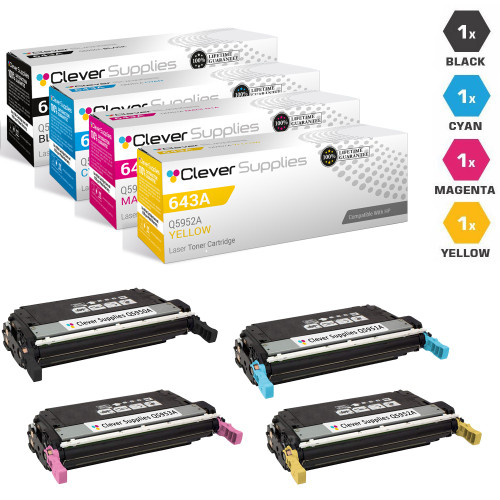
On a workgroup printer of this vintage, stations tend to be renewed together rather than nursed along one at a time, and this is the box for that job. Set it against HP’s own shelf and the gap is the story: the four genuine singles total $1,775.96, so the compatible set covers the same four stations for $1,414.49 less at the same published ratings.
Shop the 643A 4-Color Set →THE REST OF THE 643A SHELF

The colors travel together here, and the listing says so in as many words — one cartridge of each color, black deliberately left out. It undercuts the three singles by $32.17 and drops the color page from 1.04¢ to 0.94¢, the right box when the black still has thousands of pages in it.
Shop the Tri-Color Set →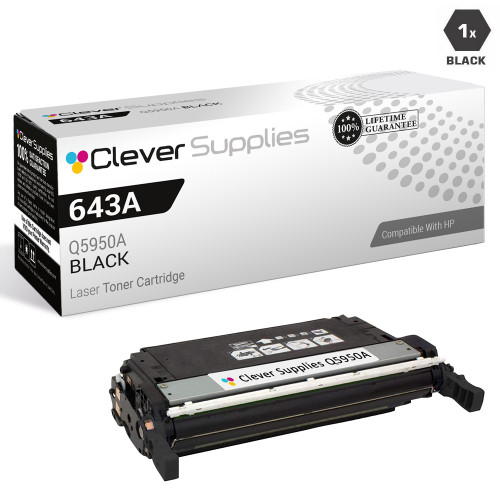
The hardest-working cartridge in the family is also its least expensive single: $96.87 buys the highest rating of the four, which is why a lone black page costs less than a lone color page here. Both black packs below are built from this unit.
Shop the Black Single →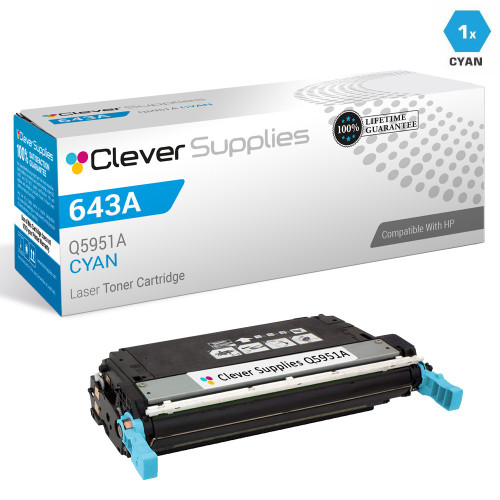
Cyan on its own, at the flat $104.28 every color carries in this family. The usual errand for it is a single station fading ahead of its neighbors — the cartridge the printer asks for while yellow and magenta still show healthy levels.
Shop the Cyan Single →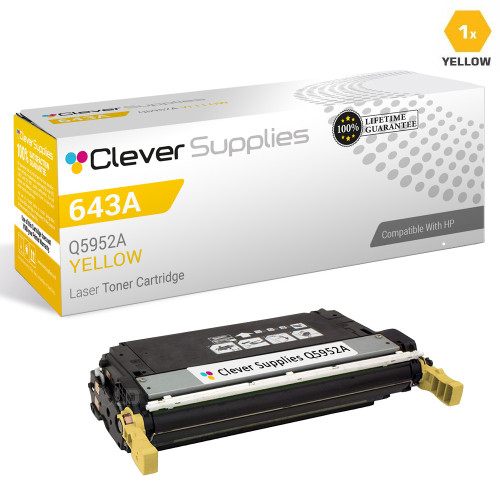
The standard yellow, carrying HP’s real Q5952A code — the same code printed on the genuine cartridge. It is also the station with no counterpart anywhere else on the shelf: every color in this family is sold singly or inside the two documented sets, and nowhere else.
Shop the Yellow Single →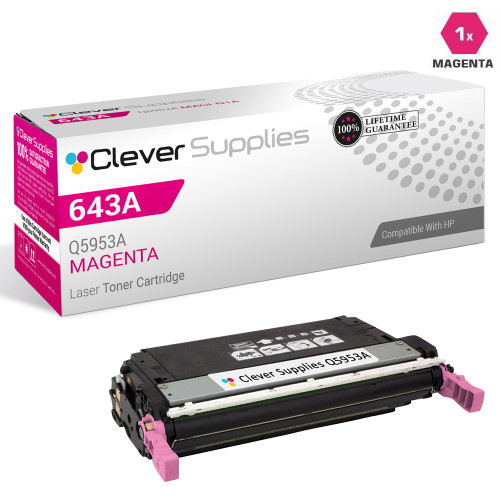
Magenta rounds out the color row at the identical price and rating as cyan and yellow. Parity this complete takes the arithmetic out of single-station refills: whichever color the printer calls for next, the line in the budget is already written.
Shop the Magenta Single →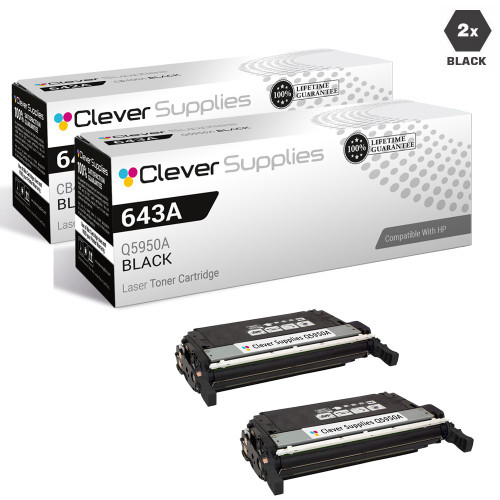
The first rung of the black ladder: two cartridges for $16.08 less than the same pair bought singly, easing the black page from 0.88¢ to 0.81¢. A working cartridge plus its successor in one box is the natural stock level for a shared office printer.
Shop the 2 Black Pack →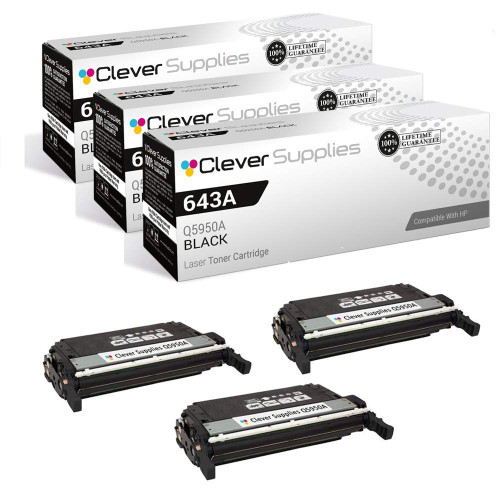
Three blacks deepen the discount to $32.15 against singles and post 0.78¢ a page — the cheapest black rate, and the cheapest rate of any kind, on this shelf. For a 4700 that lives on reports and documents, this is the box the math keeps pointing at.
Shop the 3 Black Pack →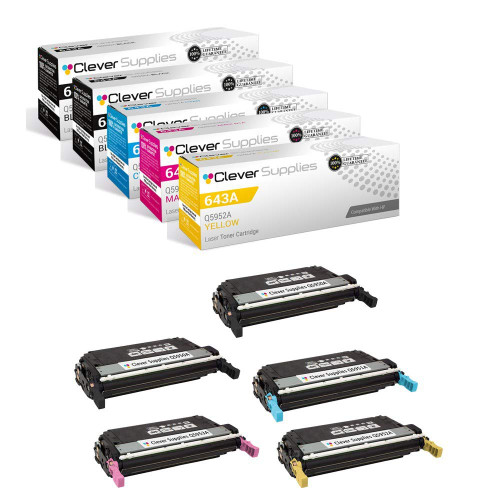
Approach this one with the listing open. Five cartridges are promised by the name, but the listing’s FAQ won’t identify the fifth — the exact mix, it says, is printed on the carton rather than in the family name, and buyers are invited to ask before ordering. A doubled black and a doubled color are very different purchases at this price, so this page attaches neither a saving nor a per-page rate to the set until the mix is confirmed; the documented four-color set above remains the full change with nothing left to guesswork.
Shop the 5 Color Set →Read as a whole, the shelf asks very little of a buyer: one tier, one rating per station, colors priced in lockstep. The judgment calls are confined to the black ladder — how deep to stock — and to the one set whose contents need a question asked before money moves.
The nine offers in one view
Nine rows, and one of them deliberately has holes in it. The “5 Color Set” shows no rate and no saving because its contents cannot be confirmed from its listing — every other row is straightforward division of the sale price by the rated pages in the box, using the agreed 11,000 for black and 10,000 per color. Fit gets no column: all nine rows serve the same five printers named further down.
| Offer | Sale price | Box contents | Cost per page | Saving against singles |
|---|---|---|---|---|
| 643A 4-Color Set — the flagship | $361.47 | Black, cyan, yellow and magenta, one each · ~41,000 pages | 0.88¢ blended | SAVE $48.24 |
| 643A Tri-Color Set | $280.67 | Cyan, yellow and magenta · ~30,000 pages | 0.94¢ | SAVE $32.17 |
| 643A Black Single (Q5950A) | $96.87 | 1 black · ~11,000 pages | 0.88¢ | Bought one at a time |
| 643A Cyan Single (Q5951A) | $104.28 | 1 cyan · ~10,000 pages | 1.04¢ | Bought one at a time |
| 643A Yellow Single (Q5952A) | $104.28 | 1 yellow · ~10,000 pages | 1.04¢ | Bought one at a time |
| 643A Magenta Single (Q5953A) | $104.28 | 1 magenta · ~10,000 pages | 1.04¢ | Bought one at a time |
| 643A 2 Black Pack | $177.66 | 2 black · ~22,000 pages | 0.81¢ | SAVE $16.08 |
| 643A 3 Black Pack | $258.46 | 3 black · ~33,000 pages | 0.78¢ | SAVE $32.15 |
| 643A “5 Color Set” | $442.26 | Named as five cartridges; the doubled cartridge is not identified in the listing | Not quoted — mix not fully stated | Not quoted |
Two patterns repay a second look. The flagship set blends to exactly the black single’s rate — the set effectively prices the color stations at black’s cheaper page. And the rates narrow quickly: the whole documented shelf lives between 0.78¢ and 1.04¢, so no choice here is an expensive mistake; the empty cells in the last row mark the one purchase that deserves a question first.
The page-rate ladder, and the genuine yardstick
Black wins this family’s arithmetic twice over: the Q5950A is the lowest-priced single and it carries the highest rating. Alone it prints at 0.88¢; paired, 0.81¢; in threes, 0.78¢. A color page runs 1.04¢ as a single and 0.94¢ through the tri-color set, while the flagship’s four-station blend lands on 0.88¢. Translated into volume: 10,000 black pages cost roughly $88 in singles, about $81 from the two-pack and about $78 from the three-pack; 10,000 pages of one color cost about $104 singly or about $94 through the tri-color set.
Unlike some older HP families, this one still has a living genuine benchmark. HP’s US store sells all four cartridges today: the black at $338.99, which works out to about 3.08¢ a page, and each color at $478.99, about 4.79¢ a page. A genuine four-station change built from those singles totals $1,775.96 — against $361.47 for the compatible set carded at the top of this page, a difference of $1,414.49 at identical published ratings. HP offers no genuine multipack for the family, so the singles are the only genuine comparison there is.
One habit of the listings is worth knowing before comparing numbers elsewhere on the site: their descriptive texts do their arithmetic from list prices — the two-black pack’s text, for instance, works from its $204.31 list price — while every figure in this guide is divided from the sale price the store actually charges. The closing note sets out the basis in full.
Ratings nobody disputes — and one figure HP never published
The yield story here is unusually quiet. The black is rated at about 11,000 pages and each color at about 10,000, on HP’s standard basis of roughly 5% average page coverage — and that is the figure in the listings’ prose, in their structured yield fields, and on HP’s own product pages, three tellings in complete agreement. No conversion or correction stands between the product pages and this guide: every rate above divides by numbers all sources share.
The one number this guide cannot give you is a starter-cartridge rating, because none exists to give. HP’s documentation for the 4700 platform — user guide, getting-started material and datasheets alike — names no reduced introductory cartridge and publishes no in-box yield; its supplies table carries a single replacement interval per cartridge. Rather than assert that new machines shipped with full cartridges, which no retrieved document states either, this guide simply prints no starter figure.
Nor is there a drum line hiding in the running costs. HP describes the 643A as its all-in-one cartridge design: the imaging drum sits inside the cartridge and is renewed every time the cartridge is changed, and the listings make no separate drum claim of their own. The platform’s longer-lived service parts sit outside a toner decision — an image transfer kit rated around 120,000 pages and image fuser kits around 150,000 pages in HP’s user guide, plus a stapler cartridge on the 4700ph+ — and this store stocks none of them, so they appear here as context only, with no prices attached.
Five printers, one series, one answer
HP’s Declaration of Conformity for the platform lists the family as five product variants of a single machine, and every cartridge page’s compatibility list tells the same story. All five take the same four 643A cartridges with no exceptions, restrictions or model-specific variants to keep track of.
The five: the Color LaserJet 4700 in its base form, the networked Color LaserJet 4700n, the duplexing Color LaserJet 4700dn, the tray-heavy Color LaserJet 4700dtn and the paper-handling flagship Color LaserJet 4700ph+. The letters after the number describe networking, duplexing and paper capacity — the print engine, and therefore the toner, never changes.
One neighboring machine deserves a boundary line: the Color LaserJet CP4005, which looks like a close relative, feeds from a different family entirely — the 642A cartridges — and takes nothing on this page. As always, the cartridge that slides out of the machine settles any doubt: a Q5950A through Q5953A label means this family, and only this family.
On chips, a complete and genuine silence
Read every listing in this family end to end — all twenty-eight of them, carded and uncarded alike — and the word “chip” never appears. Not in a headline, not in a specification, not in a single FAQ. HP’s own pages for the platform are equally quiet: this is a 2005 design, built years before HP began fitting its printers with cartridge-recognition security, and its cartridge pages carry no dynamic-security wording. There is, in short, no chip claim in existence for this family to repeat, endorse or dispute.
So this guide does the only honest thing available: it reports the silence and stops there. What a buyer can actually lean on is the cover set out in the next band — the warranty, the returns window and the support hours that stand behind every cartridge carded above.
Warranty, returns and support — what stands behind the shelf
Picking the box that fits the workload
Questions the 4700 platform raises
No. HP’s range for these printers is 643A only — Q5950A through Q5953A — and HP’s catalog contains no X version of any of the four codes. A handful of listings in this store wear X-suffixed codes (Q5950X and its siblings) that the store assigned itself; every one of those listings is currently unavailable for purchase, and one color was never listed in that form at all. Because the codes are not HP part numbers and the cartridges cannot be ordered, none of them is carded or linked in this guide.
Five: the Color LaserJet 4700, 4700n, 4700dn, 4700dtn and 4700ph+. All four cartridges fit all five models. The similar-looking Color LaserJet CP4005 is not on the list — it uses the separate 642A family.
Nobody can tell you from the listing. The FAQ there explains that the precise mix appears on the carton label instead of in the product name, and suggests asking before you order. With the contents unconfirmable in advance, this page attaches no saving and no per-page figure to the set — the four-color set, its contents spelled out code by code, is the full change you can verify before paying.
There isn’t one. Each 643A cartridge is an all-in-one unit with the drum sealed inside it, so a cartridge change is a drum change too. HP’s 4700 documentation lists no standalone drum for the series, and the store sells none. The transfer and fuser kits in the manual are long-life service assemblies, rated in the hundreds of thousands of pages, and are not stocked here.
Yes — unusually for a platform of this age, HP’s US store still lists all four codes, in stock: the black at $338.99 and each color at $478.99. What HP does not offer is a genuine multipack, so a full genuine change means four single purchases totaling $1,775.96. This store sells compatible cartridges only for the family.
The two sets of arithmetic start from different prices. The listings work from list — the two-black pack’s text divides its $204.31 list price — while this guide divides the $177.66 the checkout charges. While the markdown runs, the sale-based figures describe the transaction; if it lapses, the product pages’ figures govern again.