




Departmental printers lead a different life from desk machines. The LaserJet Enterprise M806 and the flow MFP M830 were built to stand in a print room and absorb a whole department’s paperwork, and HP fed them from exactly one cartridge: the CF325X (25X), rated at 34,500 pages. No smaller standard version waits underneath it — the X is the entire genuine range — so the only decision here is how many cartridges a department orders at once, at prices running from $147.21 into four figures. Three blemishes sit on an otherwise orderly shelf: the single listing’s own text gestures at a standard cartridge that was never sold, the single is offered from four separate pages, and a four-pack wears a grander label than its twin. Prices throughout are sale prices.
Begin with what this shelf does not contain: a standard-capacity 25A. HP cataloged one supply for these machines and stopped there; every box below holds that same cartridge in a different count. Depth behaves differently at this scale than it does on small cartridges — the page rate barely stirs, moving from 0.427¢ for a single to 0.385¢ in the ten-pack, while the price of each cartridge inside the box falls from $147.21 to $132.74. What bulk buying earns here is dollars per unit, not fractions of a cent per page. Against the genuine shelf the arithmetic is stark: HP’s store charges $439.99 for one CF325X, which is $292.78 more than the compatible single and within $1.64 of three compatible singles bought apart. Three cautions before the cards: the single listing’s text implies a standard tier that never existed (the panel beside the flagship card corrects it); the single is sold from four pages at once; and the four-pack exists under a second, grander label — both are set out in panels beneath the grid.
The ten-pack — 345,000 rated pages in a single carton
Ten cartridges at 34,500 rated pages apiece pool some 345,000 pages for $1,327.36. The page rate, 0.385¢, is the lowest this family offers, though not by much — the ladder below is compressed. The clearer gain sits in the unit price: each cartridge in this carton costs $132.74, against $147.21 for the cartridge bought alone, and ten singles rung up separately come to $1,472.10, so the carton keeps $144.74 of that total. Beside the card sits this family’s one piece of fiction — a standard cartridge that exists only inside another listing’s sentences.
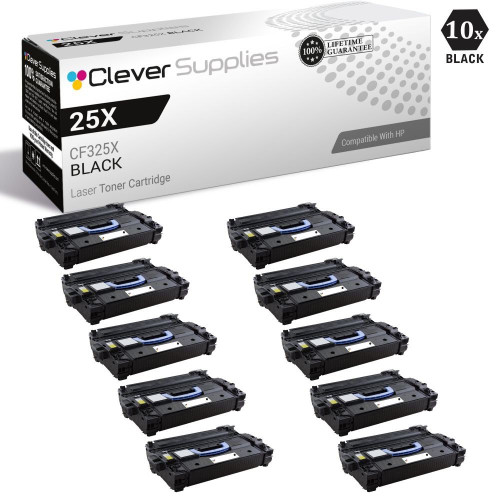
This is the facilities order: for a print room keeping several M806 or M830 units fed, or one machine whose monthly volume never lets up, one delivery covers a long stretch of printing. Every unit inside is the same cartridge, so the tenth swap behaves exactly like the first.
Shop the 25X 10-Pack →The cartridge needs no invented smaller sibling to justify itself: 34,500 rated pages at 0.427¢ a page is the whole argument, and it stands without the fiction.
Six shallower cartons of the same departmental cartridge
Descending the ladder changes the count in the box and nothing else — the CF325X sits at every depth, 34,500 rated pages a unit. The rates bunch tightly together: 0.386¢ a page at eight, 0.389¢ at five, 0.392¢ at four, 0.396¢ at three, 0.403¢ at two, and 0.427¢ for the cartridge on its own. What separates the boxes is the per-cartridge price, which slides from $147.21 down toward the flagship’s $132.74. Two footnotes ride with the grid — the four-pack’s grander label and the single’s three further pages — and the panels beneath the cards take both up.
THE REMAINING BOXES
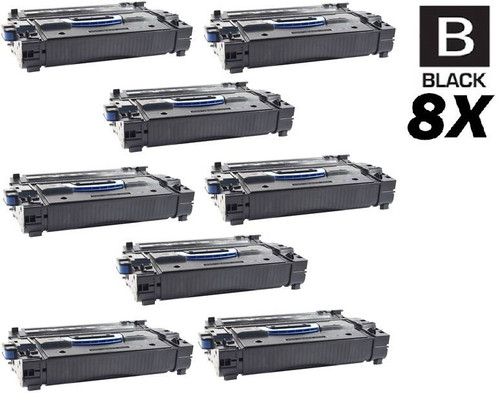
One rung below the flagship, at a rate a thousandth of a cent above it. Eight singles bought apart reach $1,177.68, so the carton trims $112.58, and each cartridge inside lands at $133.14. Nearly all of the flagship’s depth, at $262.26 less outlay.
Shop the 25X 8-Pack →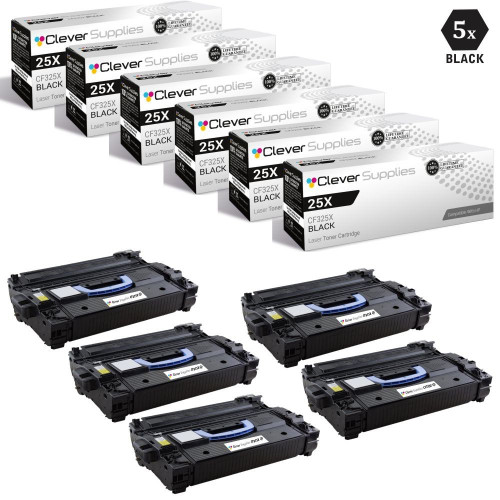
The natural size for a single M830z working as a department’s hub: 172,500 pooled rated pages is a long interval between orders. Five singles at sale total $736.05, so the pack keeps $64.33, and each cartridge inside costs $134.34 against the single’s $147.21.
Shop the 25X 5-Pack →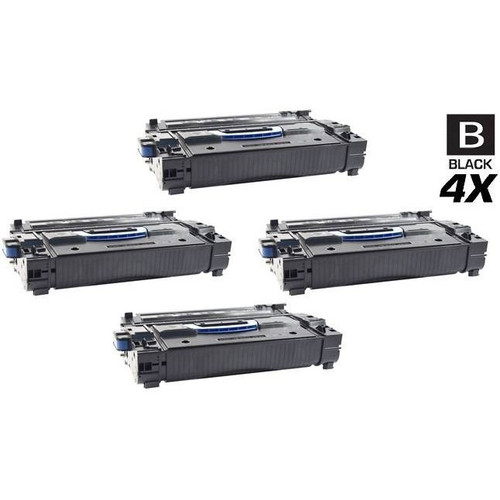
A working quarter’s cushion for one steadily used machine, at $135.15 a cartridge. Four singles come to $588.84, so the box holds on to $48.25. One caution rides with this card: the identical four-pack is also offered under a “Premium Quality” label at the same price — the first panel below gives the reasoning for carding this plainer page instead.
Shop the 25X 4-Pack →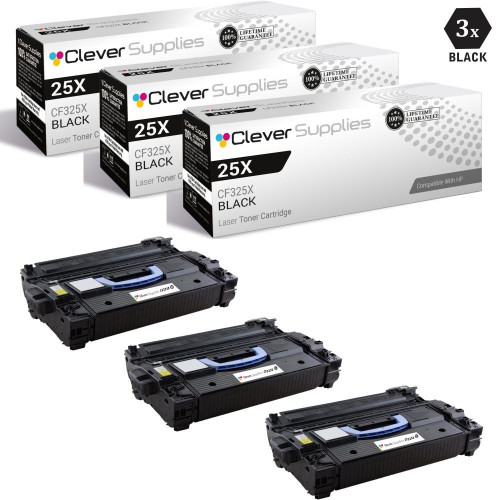
Three sealed cartridges — one in the machine, two in reserve. Three singles total $441.63 at sale, so the pack trims $32.17, and each unit inside lands at $136.49 — and those same three singles bought apart would cost $1.64 more than one genuine CF325X from HP’s store, a route this box also undercuts.
Shop the 25X 3-Pack →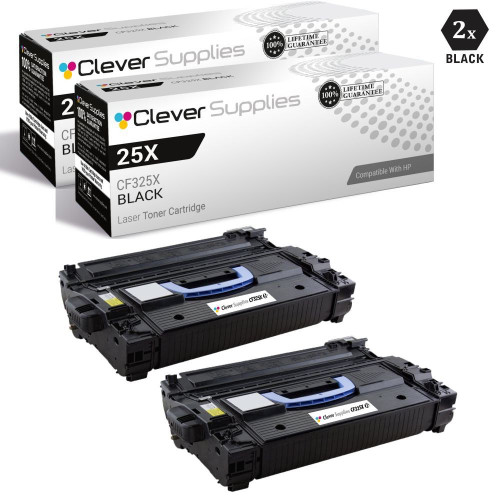
The entry-level pair: one cartridge working, one in reserve, so a fading unit never turns into a rush order. Two singles bought apart come to $294.42, so the pair keeps $16.09, at $139.17 a cartridge.
Shop the 25X 2-Pack →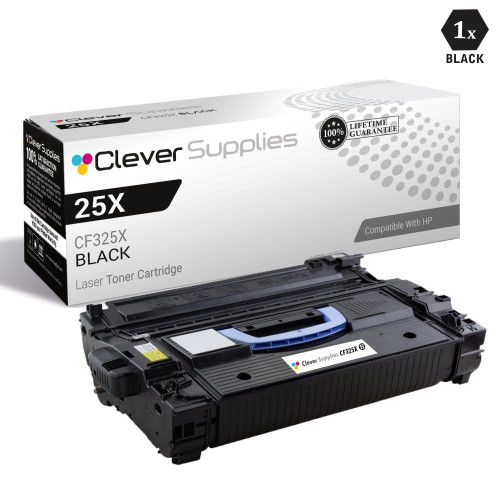
The unit on its own: the smallest outlay in the family and the dearest page rate. It suits a lightly used machine, a first order placed to judge output, or one urgent replacement. This page is the first of the family’s four single storefronts, and its own wording carries the implied standard tier corrected beside the flagship — the second panel below deals with its three copies.
Shop the 25X Single →A buyer landing on any of the four pages meets the same cartridge at the same price. This guide links only the original and accounts for the other three here.
The ladder on one page — genuine first, then seven depths
The genuine row comes first because HP’s store still lists this cartridge, with a live price and a stock state. Seven compatible configurations follow, deepest first. Read the rate column honestly: it moves by hundredths of a cent across the whole ladder, because every row is the same 34,500-page unit — the differences that matter are the totals.
| Configuration | Price | Rated pages | Cost / page | Printer fit |
|---|---|---|---|---|
| Genuine HP 25X (CF325X) — HP US store, in stock | $439.99 | 1 cartridge · 34,500 pages | 1.275¢ | All 3 models |
| 25X 10-Pack — the flagship | $1,327.36 | 10 cartridges · ~345,000 pages | 0.385¢ pooled | All 3 models |
| 25X 8-Pack | $1,065.10 | 8 cartridges · ~276,000 pages | 0.386¢ pooled | All 3 models |
| 25X 5-Pack | $671.72 | 5 cartridges · ~172,500 pages | 0.389¢ pooled | All 3 models |
| 25X 4-Pack | $540.59 | 4 cartridges · ~138,000 pages | 0.392¢ pooled | All 3 models |
| 25X 3-Pack | $409.46 | 3 cartridges · ~103,500 pages | 0.396¢ pooled | All 3 models |
| 25X 2-Pack | $278.33 | 2 cartridges · ~69,000 pages | 0.403¢ pooled | All 3 models |
| 25X Single | $147.21 | 1 cartridge · 34,500 pages | 0.427¢ | All 3 models |
Set the first row against the last and the family’s shape appears: the genuine cartridge costs $292.78 more than the compatible single, and three compatible singles bought apart — $441.63 — would cost $1.64 more than the genuine unit itself. Set the flagship against the single and a second shape appears: the entire compatible ladder spans 0.042¢ a page from top to bottom.
Three machines take this cartridge — and no listing claims a fourth
HP’s user-guide documentation for the platform names three machines: the LaserJet Enterprise M806dn, the LaserJet Enterprise M806x+ and the LaserJet Enterprise flow MFP M830z. Every card on this page fits all three, and the family as a whole is filed under the store’s HP CF325X category.
On fit, this family’s record is clean, and this guide says so plainly. All twelve descriptions were read against the neighboring departmental lines that third-party sellers routinely attach to high-volume cartridges — the color M855 and M880 lines, the M601, M602 and M603 group, the M712 and M725 series — and not one reaches for a printer beyond the three above. The shortfall runs the other way, toward saying too little: the older listings’ shared compatibility line names series rather than models, the newer listings’ fit line names two of the three machines, and the M806x+ is named in no newer listing at all. The full roster appears in no listing; it is the paragraph above.
One piece of catalog structure belongs here: the store’s category tree multiplies buckets around this small roster, carrying variant categories for names such as M806X, M806Z and an “M806X+ NFC” — variants HP never sold as distinct models. A category page is a filing device, not a machine; the roster here follows HP’s documentation, and only the three primary model categories are linked from it.
Identifying the cartridge a machine is already running takes seconds: the unit that slides out of any of the three is stamped CF325X, with 25X as the short name for the same supply. A genuine cartridge for this platform will never show a CF325A stamp — no such part number exists in HP’s catalog for these machines.
34,500 pages today — the 40,000-page figure belongs to 2013
Every listing in this family states the same rating: 34,500 pages per cartridge, with the pooled totals multiplying out correctly — 138,000 pages in a four-pack, 276,000 in an eight-pack, 345,000 in a ten-pack. The figure never drifts: not upward in one listing, not downward in another, and not split between a spec field and prose, because yield lives only in the prose here and the prose agrees. Every per-page figure in this guide is a sale price divided by that arithmetic.
When this platform launched, HP’s ISO/IEC 19752 yield test report — run on the flow MFP M830 in September 2013 — declared 40,000 standard pages for this cartridge, off a calculated test average of 44,571. HP’s current publications tell a different story — roughly 34,500 pages — and that is the figure this guide and the store’s listings use. A source quoting 40,000 pages is quoting the superseded launch declaration — not a different cartridge, and not a store error.
In print-room terms, 34,500 rated pages is about sixty-nine reams of paper per cartridge. Coverage decides how quickly a rating is spent in practice — dense financial reports burn through it sooner than memos do — but with a single rating across the shelf, the ranking never changes: deeper is cheaper per page at any coverage.
All-in-one by HP’s own test report — nothing else to order
HP’s ISO yield test report describes this supply in three words: “CF325X all in one.” The toner supply and the imaging drum are sealed in a single body and renewed together at every swap, and no drum unit exists for the M806 or M830 under a separate part number — so the cartridge price on every card above is the platform’s complete consumable cost. The newer listings’ single mention of a drum fits that design rather than contradicting it: they name the OPC drum among the new components inside the compatible cartridge build, which is a part of the cartridge itself, not a unit a buyer orders alongside it.
The chip question answers itself at fitting time. These compatibles leave the shelf carrying the store’s current-generation chip — the up-to-date, trouble-free chipped stock this store sells across its compatible range — already fitted, so there is nothing to transplant from the spent cartridge: seat the unit with both hands, close the machine, and it reports its toner level the way a genuine unit would. That holds for the firmware these machines run today; no seller can honestly warrant firmware that has not been written yet.
The same one-year terms, stated on all twelve listings
Nothing in this family’s terms needs decoding. The carded listings, the grander-labeled copy and the single’s three duplicates all state the same pair of promises in their own answers — cover for a year if a cartridge fails, and a year to send one back. No listing inflates either promise into grander language, so the four tiles below mean exactly what they say.
Sizing the carton to the department
The cartridge is a constant, so the only judgment left is how much volume the order should cover:
Questions from M806 and M830 print rooms
No. HP cataloged exactly one supply for the M806 and M830 platform — the CF325X — and no CF325A appears in its store, its datasheets or its user guides for these machines. The X in the name reads like the top of a two-tier ladder only because so many other HP families are built that way; here it is the whole range. It matters because the carded single’s own text implies otherwise, contrasting the 25X with a “shorter starter-style rating” and with “standard cartridges” changed twice as often — a comparison against a cartridge that was never sold.
Both figures are HP’s, from different years. The ISO/IEC 19752 test report from the platform’s 2013 launch declared 40,000 standard pages; HP’s current store page and datasheets publish roughly 34,500. The later figure supersedes the earlier one, so this guide and the store’s listings work from 34,500 throughout. A seller still quoting 40,000 is quoting the launch declaration, not a larger cartridge.
It was listed four times over. Beyond the original listing there is a plainly worded copy, and two further copies titled for individual printers — one for the M806DN, one for the M830 — even though each copy’s own fit line names the whole platform. All four pages share one price block and one stock figure, and the cartridge behind each of them is identical, so the original takes the card and the copies are accounted for in prose above.
On the evidence, nothing. Both four-packs sit at $540.59 at sale, both read a stock figure of 1, and both are filed in the same twenty-one categories. The labeled page describes itself as a separate “Premium Quality line of the CF325X” — a distinction of wording, not of contents — so the card on this page belongs to the plain listing.
No. HP’s own test report describes the CF325X as an all-in-one cartridge — toner and imaging drum sealed together and renewed in the same swap — and no drum unit exists for these printers under a separate part number. The cartridge price is the whole consumable cost.
Two different prices are in circulation for the same boxes. The descriptions were written against list — the single is described there at $169.29 — while the register charges sale, $147.21, and this guide works from sale throughout. The descriptions’ per-page claims inherit the same list basis, which is why they sit higher than the rates computed here. No description in the family quotes its sale figure at all.
Price and disclosure note: Sale prices govern everywhere on this page; they were read from the carded listings on November 18, 2026, and if a product page shows a different figure today, the product page wins. The descriptions argue from the other number. List is what their About paragraphs and per-page claims are built on — the single described at $169.29 on each of its four pages, the two-pack at $320.08, the three-pack at $470.88, the four-pack at $621.68 under either label, the five-pack at $772.48, the eight-pack at $1,224.87, the ten-pack at $1,526.46 — and no description quotes the figure a buyer actually pays. Badge arithmetic is kept honest by comparing like with like, sale against sale: $294.42 of singles against the two-pack’s $278.33; $441.63 against $409.46; $588.84 against $540.59; $736.05 against $671.72; $1,177.68 against $1,065.10; $1,472.10 against $1,327.36. HP’s own US store supplied the genuine figure — $439.99 for the CF325X, with the cartridge shown in stock when read. Yield is HP’s current ISO/IEC 19752 declaration, 34,500 pages, and compatibility follows HP’s documentation — three machines: LaserJet Enterprise M806dn, LaserJet Enterprise M806x+, LaserJet Enterprise flow MFP M830z. Then the catalog’s own errors, in order.
(1) List-price arithmetic in all twelve descriptions: every About paragraph and every per-page statement prices at list, and every quoted per-page rate is list-derived — the single at “roughly half a cent per page, about $4.90 per thousand pages” against 0.427¢ and $4.27 per thousand at sale; the four-pack at “roughly 0.45 cents” against 0.392¢; the eight-pack at “roughly 0.44 cents” against 0.386¢; the grander-labeled four-pack at “$155.42 per cartridge” against $135.15; the ten-pack at “about $152.65” per cartridge against $132.74. (2) A standard tier implied that HP never sold, in the canonical single’s text: its yield answer contrasts the 25X with “a shorter starter-style rating” and its About with “changing standard cartridges twice as often” — no standard-capacity cartridge exists for this platform. (3) Four storefronts for one single: the original plus a plainly worded copy plus two copies titled for single models, M806DN and M830, whose own fit lines name the whole platform — all four on one price block and reading one stock figure of 5. (4) A four-pack sold as its own product line: the labeled copy matches the plain four-pack on price block, stock figure and all twenty-one categories, yet its text presents a distinct “Premium Quality line” and never concedes the two pages sell one cartridge in one box size. (5) A broken “<p> />” fragment sits in the boilerplate of all twelve descriptions — the newer generation is no cleaner than the older here. (6) Fit under-naming in both generations: the older group’s shared compatibility line names series only against a three-model roster; the newer group’s fit line names two of the three models, the M806x+ appears in no newer listing, and no listing enumerates the full roster. (7) The newer group’s thin filing: the five-pack, the ten-pack and both model-named singles never enter the family category at all, sit in only two categories apiece, and no newer listing is filed under the brand root or the series page. (8) Stock-field zeros at the top of the ladder: the two deepest packs — the eight-pack and the flagship ten-pack — read a stock figure of 0 in the catalog data while standing visible and orderable on the storefront; three listings in total read 0. This guide makes no stock claim for any listing. (9) Stock figures that repeat across storefronts: 5 read by four listings, 1 read by four, 0 read by three, and 2 by one — pooled echoes, not twelve independent counts. (10) Weight fields that flatten the shelf: all twelve listings, a single cartridge and a ten-pack alike, are recorded at weight 2, while HP’s genuine single cartridge ships in a package of about 12.41 lb. (11) The series page above the family in the catalog tree answers with a server error in the live store; it is not linked from this page. The negative results are recorded as well: no invented tier in the store — no 25A, no extended-code variant and no “Maximum Yield” listing exists, and the code CF325A occurs in none of the twelve descriptions; no printer named outside the roster in any description, though the neighboring departmental lines sellers commonly attach to this cartridge were all compared; no drift in yield, every listing stating HP’s current declared figure exactly and the pooled totals coming out arithmetically correct; warranty language that never reaches for “Lifetime” anywhere in the family; drum claims that never invent a separate unit — the single drum mention names the OPC drum inside the all-in-one cartridge; no production or prompt text leaked into any description; no description linking to any product page, so none links into the family’s one excluded listing either; and an image carried by every listing.
Seven cards carry everything a buyer can actually order in this family — one per configuration of the one genuine cartridge. Four more listings repeat offers already carded (the four-pack under its grander label, the single under three further names) and are dealt with in prose; one more listing is omitted from this guide entirely. Underneath sit the terms as the listings themselves state them: warranty for a year, free returns for a year, support on weekdays from 9 AM to 5 PM Central, and orders leaving warehouses in Illinois, Pennsylvania, Georgia and California.