




HP’s compact LaserJet Pro desktops — the 3001 and 3002 printers and the MFP 3101 and 3102 multifunctions — run on a two-tier black cartridge family: the 138A (W1380A), rated at about 1,500 pages, and the 138X (W1380X), rated at about 4,000. Unlike the departmental families, there is no fit fence here at all: each cartridge installs in every machine on the platform, so the A-against-X decision is a question of volume and nothing else. This store sells the two cartridges in six configurations, priced below at the sale figures checkout actually charges. One caution governs the whole page, and it is stated now rather than buried: the yield printed in each listing’s own specification field — 1,500 pages for the 138A, 4,000 for the 138X, the same figures HP declares under ISO/IEC 19752 — is not the figure the listings’ description prose uses, which claims 2,600 and 9,200 pages instead. Every rate in this guide is reckoned on the field figures, the only ones HP supports; the prose figures are recorded further down as what they are, a defect on the product pages, and are never used as a rating here.
Whichever of the four store models you run — a LaserJet Pro 3001dw or 3002dw, or a LaserJet Pro MFP 3101fdw or 3102fdw — both cartridges on this page fit it, so skip the compatibility worry and decide on volume. The 138X single costs just $4.73 more than the 138A single and carries 2,500 more rated pages, which is why this page leads with the 138X 2-pack at $71.21: two high-yield cartridges, about 8,000 rated pages, 0.89¢ a page. Everything carded below is a Clever Supplies compatible — this store stocks no genuine HP cartridge for the family — so HP’s prices appear further down labeled as HP’s, as a benchmark. And plan your page counts on 1,500 and 4,000 pages per cartridge, the ratings in the listings’ own yield fields and in HP’s declaration, not on the larger figures the product descriptions print.
Two cartridges, six boxes: the shelf in full
The family’s thirty-one listings reduce, once the re-listings are set aside, to six configurations: a single, a 2-pack and a 4-pack in each tier, and no other pack size in either. The remaining twenty-five listings are duplicates — each configuration re-listed under the four printer names, plus a second generic listing of the 138A single — at prices identical to the cards below, and none of them is carded or linked a second time. Each card below shows a single configuration a single time, priced at the sale figure verified for it. A SAVE badge is a single subtraction, struck against buying the same cartridges one by one within their own tier, at sale prices. The high-yield line follows the flagship; the standard line closes the shelf.

HP offers no genuine pair to set against it: the W1380X is sold singly only, at $149.99, so two genuine cartridges total $299.98. This pair costs $71.21 for the same 8,000 rated pages — $228.77 less on a single order. In practice the shape is the point: one cartridge working, one sealed beside the printer, on desktop machines whose page counts are counted in hundreds a week rather than thousands a day.
Shop the 138X 2-Pack →THE REST OF THE HIGH-YIELD LINE — THE SAME CARTRIDGE, SMALLER AND DEEPER

The step up, bought alone: $4.73 more than the standard single, for about 2,500 extra rated pages. HP’s genuine W1380X is $149.99, so this single runs $106.35 under its counterpart.
Shop the 138X Single →
Cartridges at $31.59 apiece, and the cheapest page on the shelf. A box for a small office where two or three of these machines draw on one supply shelf.
Shop the 138X 4-Pack →THE STANDARD LINE — THE SAME FIT, A SHORTER RATING
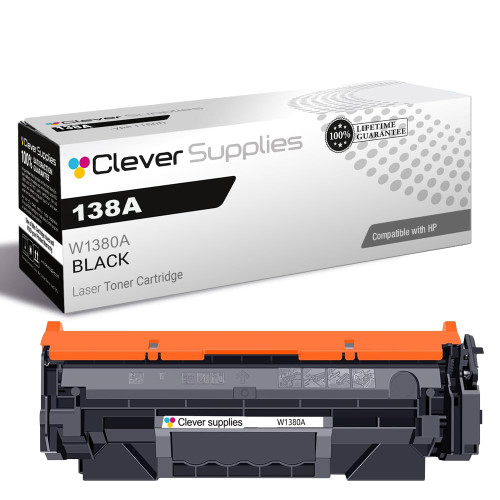
The family’s smallest order, and still a step up from the roughly 1,000-page cartridge the printer arrived with. HP prices the genuine W1380A at $78.99 — this single runs $40.08 under it.
Shop the 138A Single →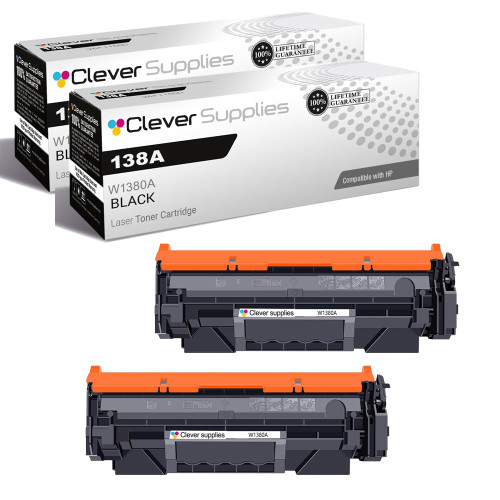
Cartridges at $30.87 apiece. The standard tier’s working shape for a lightly used machine: one printing, one in reserve, and no high-yield premium paid for pages that may take a year to spend.
Shop the 138A 2-Pack →
Cartridges at $26.85 apiece — the standard tier’s cheapest page. Read it against the high-yield single before buying: the dearest 138X page still costs less than this box’s best.
Shop the 138A 4-Pack →The six boxes, priced per page
Each row divides the box’s sale price by the rated pages inside it — 1,500 pages for every 138A cartridge, 4,000 for every 138X, the figures from the listings’ own yield fields. The rows run cheapest first. The fit column is the shortest story in this series: it does not change from the top of the table to the bottom, because both cartridges fit every machine the store covers.
| Configuration | Sale price | Pages in the box | Cost per page | Fits |
|---|---|---|---|---|
| 138X 4-Pack | $126.34 | 4 cartridges · ~16,000 pages | 0.79¢ | All four store models |
| 138X 2-Pack — the flagship | $71.21 | 2 cartridges · ~8,000 pages | 0.89¢ | All four store models |
| 138X Single | $43.64 | 1 cartridge · ~4,000 pages | 1.09¢ | All four store models |
| 138A 4-Pack | $107.39 | 4 cartridges · ~6,000 pages | 1.79¢ | All four store models |
| 138A 2-Pack | $61.73 | 2 cartridges · ~3,000 pages | 2.06¢ | All four store models |
| 138A Single | $38.91 | 1 cartridge · ~1,500 pages | 2.59¢ | All four store models |
Two different slopes are stacked in these six rows. Inside a tier, the bigger box trims the rate gradually — the high-yield line drifts from 1.09¢ down to 0.79¢, the standard line from 2.59¢ to 1.79¢. Between the tiers the rate drops off a step instead: the most expensive way to buy a 138X page, the single at 1.09¢, still costs less than the cheapest 138A page, the 4-pack at 1.79¢. The two lines never cross, so on this platform the tier decision is worth more than the pack decision — settle the cartridge first, and let the box size follow your shelf space.
Fit: every model takes both cartridges
HP’s specification pages for this platform name the same two replacement cartridges for every machine on it — “HP 138A Original Black LaserJet Toner Cartridge (~1,500 yield) W1380A; HP 138X Original Black LaserJet Toner Cartridge (~4,000 yield) W1380X” — with no model split between them. The store stocks categories for four of those machines, and every cartridge on this page fits all four: the LaserJet Pro 3001dw, the LaserJet Pro 3002dw, the LaserJet Pro MFP 3101fdw and the LaserJet Pro MFP 3102fdw. Each name above links to that model’s category page in this store. There is no family category page to link to — the store does not keep one for this cartridge — so the four models are the whole linked roster.
Two corrections belong beside that short list, in opposite directions. First, HP’s own published compatibility runs wider than four models: its yield reporting form for this cartridge covers the LaserJet Pro 3001 and 3002 printers and the MFP 3101, 3102, 3105 and 3106, and its supplies datasheet summarizes the span as the 3001 through 3004 printers and the MFP 3101 through 3104. The listings’ claim that the four store models are “the complete list for this code” understates HP’s record — they are the four models this store stocks categories and listings for, not the cartridge’s whole fit span, and owners of the wider-span models are reading a cartridge their machines were documented for. Second, and cutting the other way: the span’s “e” variants — the 3001dwe, 3101fdwe, 3102fdwe and their kin — are HP+ machines, and HP states that HP+ printers work only with original HP toner as a condition of the program. Nothing on this page is offered for those models, and no compatible should be bought for one on the strength of the wider list.
One more code deserves a sentence, because owners of the 3002 and 3102 engines may meet it elsewhere: HP sells the identical physical cartridge under a second code, W1390A, for those engines in some channels — its own yield form footnotes that the W1380A cartridge “is identical to the physical cartridge for the W1390A in every way.” This store stocks nothing under the W1390A code, so it carries no card here; its W1380A listings claim the 3002dw and 3102fdw directly, which matches how HP itself tested those engines.
The yield split, stated plainly — and HP’s prices beside it
This is the one family in the series where the store argues with itself, and the argument is over the most basic number on the page. Every listing carries a Page Yield field, and those fields read 1,500 pages for the 138A and 4,000 for the 138X — exactly the yields HP declares for the W1380A and W1380X, each as an approximate average in accordance with ISO/IEC 19752. The descriptions printed on the same listings say something else: they rate the 138A at 2,600 pages and the 138X at 9,200, build pack totals on those figures — about 5,200 pages for the standard 2-pack, about 18,400 for the high-yield one — and nowhere print the field figures at all. The inflation is 73 percent on the standard cartridge and 130 percent on the high-yield. This guide rates both cartridges at the field figures, because those are the numbers that are simultaneously the store’s own specification and HP’s ISO declaration; the prose figures appear on this page only inside this disclosure, as a defect a buyer should know about before planning a year’s printing around them.
The split matters because the descriptions’ arithmetic inherits it twice over. The high-yield single’s page, for instance, works out “roughly 0.55 cents per standard page” by spreading its $50.19 list price across the 9,200-page prose rating; checkout charges $43.64 for that cartridge, and at the 4,000-page rating its true cost is 1.09¢ a page — twice the printed figure, arrived at from a price the buyer will not pay and a yield the cartridge does not carry. The same double error, list price divided by inflated yield, runs through the family’s price answers, and it flatters the high-yield tier most: the descriptions put the 138X at about a third of the standard tier’s per-page cost, where the honest ratio at sale prices and field yields is about 2.4 to 1. Every rate in this guide is therefore built the other way — sale price, field yield — and the closing note records the full basis.
Against the compatible shelf stand HP’s genuine prices, drawn from HP’s US store and flagged as HP’s at every appearance: the genuine W1380A at $78.99, which is 5.27¢ a page at its rating, and the genuine W1380X at $149.99, or 3.75¢. HP sells both cartridges as singles only — no genuine 2-pack or 4-pack exists for this family — so the shelf’s packs have no genuine counterpart to be priced against, and none is implied here. The gaps on the singles are wide enough: the compatible 138A single runs $40.08 under its genuine counterpart, the compatible 138X single $106.35 under, and the flagship pair $228.77 under the two genuine high-yield singles it replaces.
All-in-one by design — and a short cartridge in the printer box
There is no second imaging part to budget for on this platform. HP’s own product pages for both cartridges describe “the all-in-one design” as including the imaging drum, and the store’s listings agree in their plainer way — the drum is built into the cartridge, so each replacement hands the printer a fresh imaging surface along with fresh toner. Drum life is therefore inside the rating and the price of every box above, and HP’s genuine supply list for these machines holds exactly two numbers, W1380A and W1380X, both of them this cartridge. A fuser kit belongs to the printer’s service schedule rather than to its consumables, and this store does not stock it.
The cartridge the printer arrives with is a reduced measure, and HP prints the figure in its specification pages as a line of its own: “Page yield (set-up/inbox cartridges): ~1,000 black pages.” One multifunction’s box contents name the same unit an “Introductory Cartridge, yield ~1000 pages.” So the first replacement decision on this platform is also a step up in stamina whichever tier is chosen — the standard 138A carries half again the in-box rating, the 138X four times it. The high-yield cartridge is never the one in the box: HP’s footnote on its own cartridge page reserves it as a separate purchase, in so many words.
Chips: silence on the listings, a notice on the printer
On chips, this family’s listings say nothing at all — and on this platform, of all platforms, the silence is worth reporting exactly as found. Across all thirty-one descriptions in the family, the words chip, firmware and dynamic do not appear once: no template claims a chip, and none warns about one either. HP’s own specification pages for these printers, meanwhile, carry the dynamic-security notice in full — the printer “is intended to work only with cartridges that have a new or reused HP chip, and it uses dynamic security measures to block cartridges using a non-HP chip.” A buyer who reads only the product pages would never learn that the question exists.
What can be stated is the store’s standing position for its compatible cartridges, given here as the store’s position rather than as a quotation from these listings, because the listings offer nothing to quote: the supplier fits its cartridges with a current-generation chip; they go in plug-and-play, and the spent cartridge’s chip leaves with the spent cartridge — nothing is carried across. The boundary this series always prints applies with the same force — nothing is promised about firmware still to come. The cover standing behind every cartridge on the shelf is set out in the listings’ own terms in the next section.
The cover behind every box
Choosing by volume, not by model
Answers for the 3001, 3002, 3101 and 3102 owner
4,000. The 9,200-page figure lives only in the listings’ description prose; the same listings’ own Page Yield fields read 4,000 pages for the 138X and 1,500 for the 138A, and those are precisely the yields HP declares for the W1380X and W1380A under ISO/IEC 19752. The prose also inflates the pack totals built on its figures — about 18,400 pages for the high-yield 2-pack, where two cartridges at their rated figure give about 8,000. This guide rates every cartridge at the field figure and treats the prose numbers as a defect on the product pages, recorded in the note at the foot of this page.
Either fits. There is no tier fence on this platform: HP’s specification pages name both the W1380A and the W1380X as the replacement cartridges for every machine in the line, so the LaserJet Pro 3002dw on a desk and the LaserJet Pro MFP 3102fdw at the counter take the high-yield cartridge exactly as they take the standard one. Choose on how much you print: the 138X carries about 4,000 rated pages against the 138A’s 1,500, and costs less than half as much per page.
By HP’s record, the cartridge family reaches further than this store’s shelves: HP’s yield form for the W1380A covers the LaserJet Pro 3001 and 3002 printers and the MFP 3101, 3102, 3105 and 3106, and its datasheet summarizes the span as the 3001–3004 printers and MFP 3101–3104. This store stocks categories and listings for four models only, so those four are the ones linked and carded here; the listings’ description of them as “the complete list for this code” is narrower than HP’s own statement. One part of the wider span is excluded deliberately: the “e” variants are HP+ machines, which HP states work only with original HP toner, and nothing in this guide is offered for them.
No. The cartridge is an all-in-one unit — HP’s own product pages describe the design as including the imaging drum — so drum life rides inside the cartridge’s rating and price, and every swap renews the print quality along with the toner. HP’s genuine supply list for these printers holds exactly two numbers, the W1380A and the W1380X, and both are toner cartridges; no drum is sold for the 3001, 3002, 3101 or 3102, here or by HP.
A set-up cartridge rated at about 1,000 pages, on HP’s own specification line for the platform — “Page yield (set-up/inbox cartridges): ~1,000 black pages.” That is a shortened measure, so the first full cartridge lasts noticeably longer than the one it replaces: half again as long for the standard 138A, about four times as long for the 138X, which is never the in-box unit and is always a separate purchase. Judge the tier choice by the page counter that first cartridge gives you; a machine that emptied it inside a month is a high-yield machine.
The same physical cartridge under a second HP code. HP’s yield reporting form for this platform footnotes that the W1380A cartridge “is identical to the physical cartridge for the W1390A in every way” — the W1390A code serves the 3002 and 3102 engines in some channels. This store stocks nothing under that code, so there is no W1390A card on this page; its W1380A listings claim the 3002dw and 3102fdw directly, which is how HP itself documents those engines.
Price and disclosure note: All prices quoted here are sale prices. Each was checked live on November 17, 2026 against the store catalog and again on the listing’s own storefront page, matched by title in both places. Above every sale price sits a higher list price; if a promotion ends, the product page’s figure is the one that rules. Every SAVE badge is computed on the sale basis — what the pack saves against the same cartridges bought singly within its tier, also at sale prices. For the standard tier the arithmetic runs: two singles come to $77.82, which is where the 2-pack’s $16.09 badge comes from, and four come to $155.64 behind the $48.25 badge. For the high-yield tier: two singles come to $87.28 behind a $16.07 badge, and four to $174.56 behind $48.22. HP’s prices come from HP’s US store, were checked the same day, and are flagged as HP’s at every mention — the W1380A at $78.99 and the W1380X at $149.99, both sold as singles only; no genuine multi-pack of this family exists, and none is implied by the pack comparisons above, which are drawn against genuine singles. Yields are the split this family is known by, and the basis is stated in full: the listings’ Page Yield fields read 1,500 pages for the 138A and 4,000 for the 138X, matching HP’s ISO/IEC 19752 declarations, and every rate in this guide divides by those figures; a pack’s page total adds its cartridges’ ratings together, and its per-page rate divides its price by that total. Fit follows HP’s specification pages for the platform, which name both cartridges for every model in the line. Set against that record, the store’s own surfaces diverge in the respects itemized here.
First, description prose inflates both tiers’ yields family-wide — 2,600 pages per 138A cartridge and 9,200 per 138X, against the fields’ and HP’s 1,500 and 4,000 — and builds pack totals on the inflated figures, about 5,200 pages for the standard 2-pack and about 18,400 for the high-yield 2-pack; the field figures appear nowhere in any description. Second, the prose’s per-page arithmetic is struck from list prices divided by those inflated yields at once: the high-yield single’s page derives roughly 0.55¢ a page from its $50.19 list price and the 9,200-page claim, where checkout charges $43.64 and the field rating gives 1.09¢, and the second generic standard single derives about 1.7¢ from its $44.75 list price and the 2,600-page claim, where the sale price and field rating give 2.59¢. Third, About and FAQ sections price at list throughout: the standard single at $44.75 where checkout charges $38.91, its 2-pack at $70.99 against $61.73 and its 4-pack at $123.50 against $107.39; the high-yield single at $50.19 against $43.64, its 2-pack at $81.89 against $71.21 and its 4-pack at $145.29 against $126.34. Fourth, both 2-pack listings carry a spelling error in the store SKU itself — CS-HP-138A-2Balck and CS-HP-138X-2Balck, “Balck” for “Black” — on the two configurations a buyer is likeliest to reorder by code, while the 4-pack SKUs are spelled correctly. Fifth, the standard single exists in a second generic listing whose SKU carries a doubled hyphen, CS-HP-138A--Bk; it is a duplicate of the carded single at the same price and stock, not a seventh configuration. Sixth, filing: this monochrome family is carried under the store’s COLOR LASERJET SERIES category in every listing’s category set, and the 3001dw model category is itself parented under that color series while its three sibling model categories sit under the monochrome LaserJet series — a split the descriptions’ own printer link blocks inherit, the 3001dw resolving through the color path and the other three through the mono one. Seventh, fit prose understates HP’s roster: one listing’s About calls the four store models “the complete list for this code” and another’s says they are “the four it fits,” where HP’s own documents span the LaserJet Pro 3001–3004 and MFP 3101–3106 families; the one part of that wider span this guide does not extend to is the HP+ “e” variants, which HP states work only with original HP toner. Eighth, the pack listings’ Page Yield fields read identically to the singles’ — “Black: 1500” and “Black: 4000” with no per-cartridge qualifier — so a buyer comparing fields alone cannot tell whether the figure describes one cartridge or the whole box.
Each unique configuration is carded once above — six cards across the two genuine tiers. The family’s remaining twenty-five listings are duplicates; none is carded and none is linked. They are the four printer-named re-listings of every configuration, at prices and stock identical to their canonical listings, plus a second generic listing of the standard single on a different description template. On chips the family is silent in a way the chip section records: no description in the family mentions a chip, firmware or dynamic security at all, on a platform whose printer pages carry HP’s dynamic-security notice; the store’s standing supplier position appears in the chip section above as the store’s own, bounded by the usual limit — nothing is promised about firmware still to come. The in-box figure is taken from HP’s specification pages for the platform. Every offer carries the cover its listing states for it: a 1-year warranty, 1-year free returns, support staffed on weekdays between 9 AM and 5 PM Central, and stock warehoused in Illinois, Pennsylvania, Georgia and California.