




Some platforms ask a buyer to climb a ladder of yields before the real questions start. This one never had a ladder. Brother built ten printers around a single toner cartridge — the TN350, rated at about 2,500 pages — and a single drum, the DR350, rated at about 12,000, and it sells nothing else for them: no standard tier, no high-yield tier, no second code to mistake for the first. What that leaves is the cleanest buying problem in this catalog. The roster is ten names long and fixed by Brother; the yield is quoted the old way, at 5% coverage, with no ISO standard standing behind it; and the only real choices are how many cartridges go in the box and how the drum gets bought when its turn comes. This guide takes those in order: the ten names first, then the four toner boxes and their arithmetic, then the drum — where the shelf holds one real surprise.
The short answer: if your printer is one of Brother’s ten — the HL-2040, HL-2070N or DCP-7020, an MFC-7220, MFC-7225N, MFC-7420 or MFC-7820N, or an IntelliFax-2820, 2910 or 2920 — the 2-pack at $35.93 is the default buy at about 0.72¢ a page, and the 4-pack at $55.77 (about 0.56¢) is the same idea sized for a busier machine. If it is the drum your printer is asking for, skip ahead to the set at $42.99: it pairs a fresh drum with a fresh cartridge and costs less than the drum-only packs standing beside it.
Match your badge to Brother’s ten first — the roster is printed in the next section. For toner, start with the 2-pack at $35.93: it halves the reorder errand and brings the per-page cost down to about 0.72¢. Steadier printing earns the 4-pack at $55.77 (about 0.56¢); the lightest use is honestly served by the single at $26.00. For a worn drum, start with the set at $42.99 — it is the cheapest route to a new DR350 on this shelf, and the toner inside it is a cartridge you would have bought regardless.
The roster: ten printers, exactly as Brother prints it
Brother USA’s page for the TN350 closes with a “Use with” line, and the DR350 page repeats the same ten names word for word: the DCP-7020, the HL-2040, the HL-2070N, the MFC-7220, the MFC-7225N, the MFC-7420, the MFC-7820N, and the IntelliFax-2820, IntelliFax-2910 and IntelliFax-2920. Every card further down fits those ten machines, and one shared DR350 drum serves all ten as well — there is no per-model drum variation to trip over.
Several listings in this store name fifteen, eighteen, in places even more models for this cartridge. The extras are overseas variants — the HL-2030, DCP-7010, DCP-7025, MFC-7820D and IntelliFax-2850 among them — machines that take TN350 hardware in other markets but never appear on Brother USA’s roster. This guide follows the manufacturer’s ten and links only those ten categories. If your printer’s badge carries one of the variant names, the honest position is that Brother USA does not publish this cartridge for it, whatever a wider list elsewhere may claim.
One name deserves a specific note, because two older listings here get it wrong in the opposite direction. The MFC-7820N stands on Brother’s list for both the cartridge and the drum, yet the single and the 3-pack below never mention it — they name the 7820D variant in its place. An MFC-7820N takes every offer on this page, and it is linked in the roster above on equal terms with the other nine.
And one warning about a code that looks like a sibling: the TN360 is not a larger TN350. It serves a different printer family — the HL-2140 line — over a different drum, and the two cartridges fit none of each other’s machines. TN350 owners need nothing from that shelf, and TN360 owners need nothing from this page.
The toner ladder: one cartridge in four boxes
Strip the shelf down and it is one cartridge repeated: the same TN350, rated by Brother at about 2,500 pages at 5% coverage on Letter paper, sold one, two, three or four to a box. No listing duplicates another — each pack size exists exactly once — so the ladder is pure arithmetic against the single’s $26.00. Two bought singly cost $52.00, three cost $78.00, four cost $104.00, and every box below beats its own line of that sum by the amount printed on its card.

The printers on this roster are not new, and the people who run them tend to keep them running for years — a fax line in a small office, a laser on a home desk, a workhorse in a back room that has outlasted two computers. Their printing arrives in a steady trickle rather than a flood, and a 2,500-page cartridge already lasts such a machine a long stretch. The 2-pack’s argument is not urgency. It is that the second cartridge adds $9.93 to the single’s price while trimming nearly a third off the per-page figure — about 0.72¢ against about 1.04¢ — so the spare is close to free insurance against the one week the trickle turns into a flood. That is why this box, and not the deeper 4-pack, leads the page.
Shop the 2-Pack →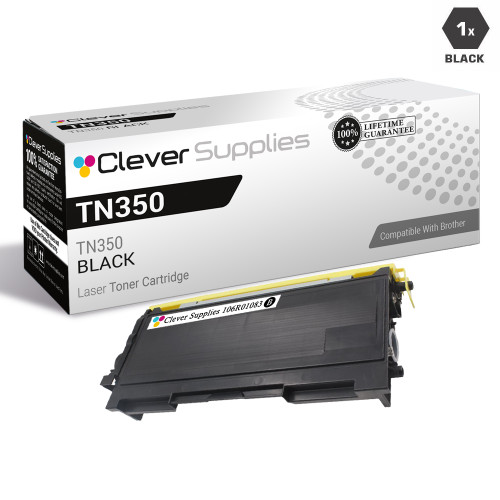


Between the four boxes, nothing changes but the count. A machine that prints a few pages a week may take years to finish even the 2-pack, and for it the single is the honest purchase — toner sitting in a cupboard is money at rest. A busier desk, printing most days, will feel the 4-pack’s 0.56¢ every single month, and the $48.23 it keeps back against four singles is the largest single sum on this page. The 3-pack splits the difference for the steady middle. The cartridge inside, and the ten printers it serves, are identical in every box.
Every toner offer on one table
The four compatible boxes, plus the genuine cartridge for scale. Brother’s own store charges the same $91.99 for a genuine TN350 as this shelf does; the row sits here so the compatible figures have an honest frame around them, and it is neither carded nor linked anywhere on this page.
| Offer | Contents | Brother’s rating | Shelf price | Cost per page | Against singles |
|---|---|---|---|---|---|
| TN350 2-pack | Two TN350 cartridges | About 5,000 pages in total | $35.93 | About 0.72¢ | SAVE $16.07 vs two singles |
| TN350 3-pack | Three TN350 cartridges | About 7,500 pages in total | $45.85 | About 0.61¢ | SAVE $32.15 vs three singles |
| TN350 4-pack | Four TN350 cartridges | About 10,000 pages in total | $55.77 | About 0.56¢ | SAVE $48.23 vs four singles |
| TN350 single | One TN350 cartridge | About 2,500 pages | $26.00 | About 1.04¢ | — |
| Genuine Brother TN350 single | One genuine cartridge (reference only) | About 2,500 pages | $91.99 | About 3.68¢ | — |
The drum runs on a different clock and gets its own section below: a DR350 is rated at about 12,000 pages, roughly five cartridges’ worth, and its three buying routes are carded separately. For scale, one genuine drum is $171.79 at Brother’s store and on this shelf alike.
The drum: one DR350, three ways to buy it
Under every cartridge on this roster sits the same drum unit, the DR350, which Brother rates at approximately 12,000 pages while noting the figure may vary with the type of use. A single drum therefore carries a printer through roughly five TN350 cartridges before print quality — fading, streaking, spotting that a fresh cartridge fails to cure — starts pointing at the drum rather than the toner. When that day comes, this shelf offers three routes to a new drum, and they are not priced the way a newcomer would guess.
First, what does not exist: there is no compatible DR350 sold on its own. Nobody can buy exactly one drum here as a standalone item. It arrives either inside the toner-and-drum set carded first below, or in packs of two and four — which produces the shelf’s standout fact. The set, holding a drum and a toner cartridge together, costs $42.99: less than the $50.05 asked for the drum 2-pack alone, and about a quarter of the $171.79 charged for one genuine DR350.
A wording trap is worth flagging before the cards. Both drum packs are titled “Toner Cartridge” in this store — an error in the listings’ names, not in their contents. Each sells DR350 drum units, each listing’s own questions and answers say exactly that, and the cards below describe the packs as what they are: drums.
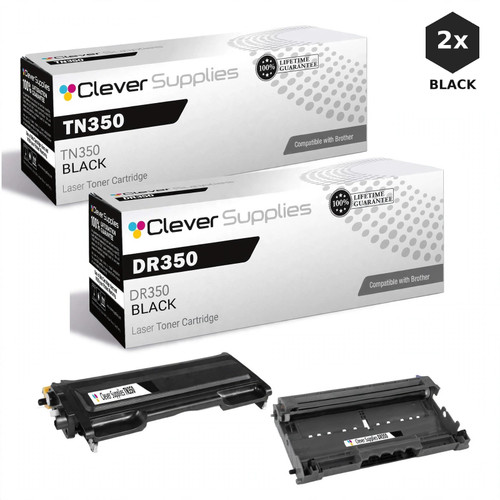


Which route fits depends on how many of the ten printers you keep running. One machine with a tired drum belongs in the set: the drum arrives with a fresh cartridge beside it, for less than the drum-only 2-pack. A single machine whose owner dislikes repeat errands takes the 2-pack and holds its second drum in reserve. The 4-pack speaks to the small fleet — two or three of these printers in one office — or to the owner who has decided this platform will be kept alive for years and wants the per-drum figure down at $21.01 while the shelf still offers it.
Chips: this family makes no claim
Buyers who read listings closely will notice something unusual on this shelf: the word “chip” is missing. Six of the seven compatible listings carded above never use it — no fitted-chip statement, no level-tracking promise, no recognition claim of any kind. The single exception is one templated manufacturing paragraph on the toner-and-drum set, which names a smart chip in a list of generic component parts. It says nothing specific about this cartridge, it appears in no other listing in the family, and it is not evidence this guide is willing to build a claim on. So none is built.
What does carry a source is Brother’s own position on third-party supplies, published on its US help site: “Brother firmware updates do not block the use of third-party ink and toner cartridges in our machines.” Beyond that sentence, this page rests on what it can show outright: Brother’s ten-model roster, Brother’s own yield wording, and prices read off the live shelf on the date printed at the top.
Before you order: the TN350 checklist
Frequently asked questions
No, and the one-digit difference in the codes causes real confusion. The TN360 belongs to a separate platform — the HL-2140 printer family, running over a DR360 drum — while the TN350 serves the ten models on this page over the DR350. The two cartridges share no printers, no drum and no parts; a TN360 will not work in a TN350 machine, and the reverse is equally true.
Because the store’s fit lists fold in overseas variants alongside the US models — names like the HL-2030, DCP-7010, DCP-7025, MFC-7820D and IntelliFax-2850, which take this hardware in other markets. Brother USA publishes a roster of ten for both the cartridge and the drum, and this guide follows those ten. A longer list is not a broader promise; it is a different market’s paperwork mixed into the same description.
Yes. Brother lists the MFC-7820N for the TN350 and the DR350 alike; the omission sits in two older listings on this shelf, which name the 7820D variant instead and simply leave the US model out. The newer listings — both packs and the drum offers — name the MFC-7820N correctly, and every card on this page is sold for it along with the other nine.
Not on this shelf — no standalone compatible drum single exists here. A drum reaches you in one of three boxes: inside the $42.99 toner-and-drum set, in the $50.05 drum 2-pack, or in the $84.03 drum 4-pack. It is worth knowing that the set is also the cheapest of the three, so the buyer who needs exactly one drum is not penalized for it.
Drum units. Both DR350 packs carry that wording in their store titles, and both sell drum units — the listings’ own questions and answers confirm which part each one is. The title is a naming error on the store’s side; the contents are DR350 drums, each rated by Brother at approximately 12,000 pages, and on this page they are described and carded as drums.
It is Brother’s own basis for the rating: pages carrying toner over roughly five percent of their area, about what an ordinary page of text uses, on Letter paper. Newer platforms state yields under the ISO/IEC 19752 test standard; this one predates that habit, Brother claims no ISO figure for it, and this page prints none. Dense work — heavy forms, graphics, solid fills — burns toner faster and lands below the rating; light correspondence lands closer to it.
Each of the seven compatible offers above is backed by the store itself: twelve months of warranty cover, and a full year in which a compatible product that does not suit your machine can come back. The genuine cartridge and drum quoted for reference sit under Brother’s warranty instead, and their return window closes at 30 days. Parcels ship from whichever of our four warehouses — Illinois, Pennsylvania, Georgia or California — is closest to the delivery address, and help is available Monday to Friday, 9 AM to 5 PM Central.