




Most toner families ask you to weigh a standard cartridge against a high-yield one. Brother’s TN210 family skips that question entirely: Brother publishes exactly one tier for these printers, rating the black cartridge at about 2,200 pages and each color at about 1,400, every figure measured under ISO/IEC 19798. With the yield settled by Brother, the only lever left in a buyer’s hands is how many cartridges to buy at once — and on this shelf that lever is worth real money, because a black page costs about 1.26¢ from a single cartridge and about 0.68¢ from the five-pack at the ladder’s foot. Two honest complications frame that arithmetic, and this guide puts both on the first screen rather than in a footnote: there is no compatible cyan cartridge sold on its own here, and there is no compatible drum at all — the drum for this platform is a four-unit set that this store carries only as a genuine Brother part.
The short answer: a whole-printer refill is the 4-color set at $60.04 — one black and the three colors in a single box. Black on its own runs from the $27.81 single down a pack ladder whose savings are all measured against real singles, ending at $74.71 for five. If the empty slot is cyan and only cyan, know before you start that no compatible cyan single exists: cyan reaches this shelf inside the color sets, or as a genuine cartridge at $107.45. And when the drum’s turn comes, it is a genuine-only purchase — a set of four drum units, rated at about 15,000 pages, priced at $214.88 here.
Start from whichever slot ran dry. All four low together means the 4-color set at $60.04, which works out to $15.01 a cartridge. Black alone is a ladder, not a product: $27.81 for one, and packs that trim the per-page figure at every step down to about 0.68¢. Two or three colors fading together point to the CMY 3-color set at $48.31 — the box that also happens to be the only compatible route to cyan. A drum message is a separate errand entirely: the genuine four-drum set, covered in its own section below.
Nine printers, one tier, four cartridge codes
Brother USA prints the same printer list on its pages for the TN210 cartridges and for the DR210CL drum set, and it is a short one — nine machines: HL-3040CN, HL-3045CN, HL-3070CW, HL-3075CW, MFC-9010CN, MFC-9120CN, MFC-9125CN, MFC-9320CW and MFC-9325CW. Every card on this page fits every one of those nine, toners and drum alike, with no model fenced off from any offer.
The tier question, which dominates most cartridge shopping, takes one paragraph here because Brother leaves nothing to weigh. The family has four codes — TN210BK for black and TN210C, TN210M and TN210Y for the colors — and no second fill level above any of them: Brother’s US catalog carries no higher-yield sibling for this platform, so any listing or label suggesting an upgraded TN210 variant is describing something Brother does not publish. The ratings Brother does publish are approximate yields under ISO/IEC 19798 (Letter/A4): about 2,200 pages for the black cartridge and about 1,400 for each color, which is also why a black cartridge normally outlives the colors around it in the same printer.
One caution about names belongs up front. Product text in this store attaches more printer names to these cartridges than Brother does — variants of these machines sold in other markets, and a couple of model numbers that belong to a different class of Brother machine altogether. None of those extra names appears on Brother USA’s TN210 pages, so this guide follows the nine, links only to the nine, and makes no fit promise beyond them. Where a listing’s roster and Brother’s list disagree, Brother’s is the one that decides whether a cartridge fits.
Start with the full refill: the sets
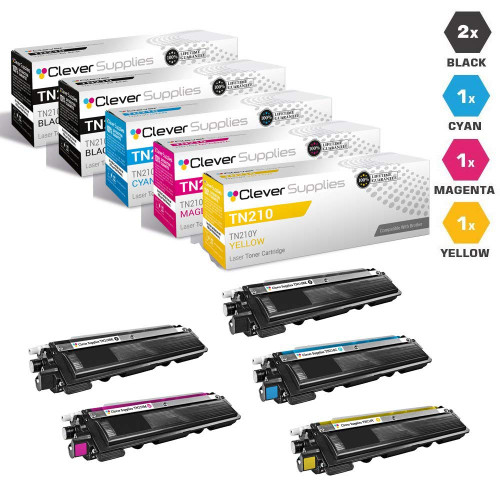
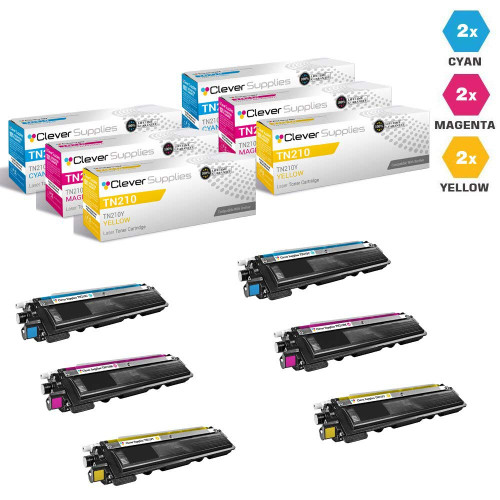
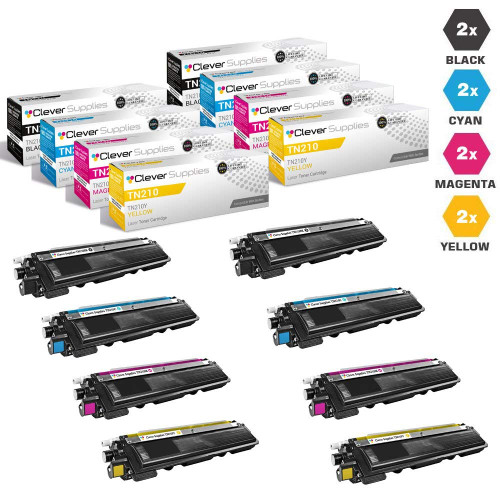
A color printer rarely empties one slot in isolation for long, so the sets lead this page. The range runs from the standard four-cartridge refill through a five-cartridge version carrying a spare black, an eight-cartridge double refill, and two color-only boxes for printers whose black is still healthy. One thing no set card below will show is a savings badge, and the reason is structural rather than modest: a set’s saving is normally proven against the singles it replaces, and cyan — present in every set on this page — has no compatible single in this store to price against. The totals cannot be formed honestly, so they are not claimed; the comparison table further down shows the per-cartridge and per-page figures that can be proven.
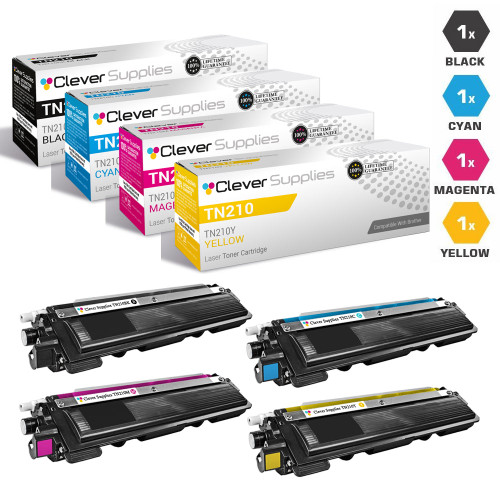
This is the purchase the rest of the page is organized around, because it matches how these printers actually consume toner: the three colors fade within a short span of each other, and the black follows. One honest complication rides along with it — this same box is listed three times in the store, under three slightly different titles, at the same $60.04 each time. The listings are duplicates of one offer, not three competing products, and the card above links the one listing we verified end to end, so the duplication costs you nothing but a moment’s confusion if you meet the other two in search results.
Shop the 4-Color Set →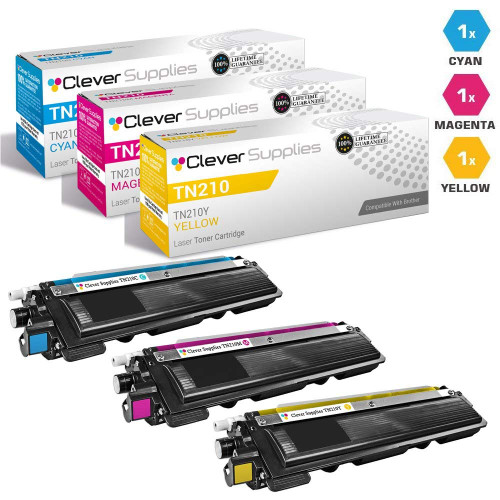
Black: one cartridge, four ways to buy it
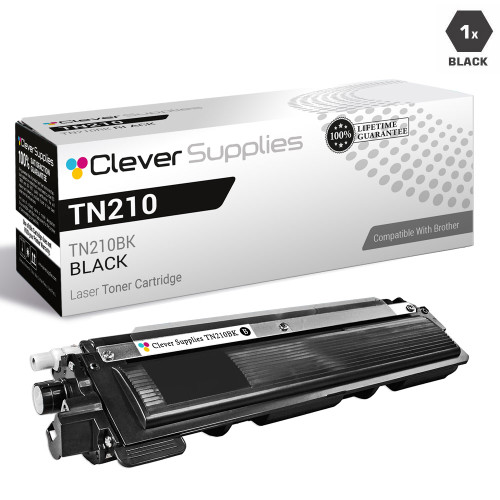
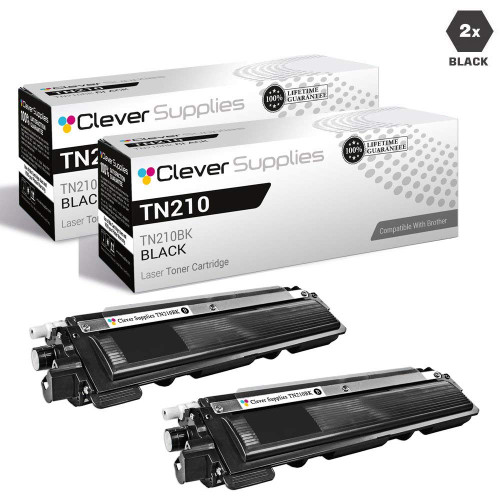
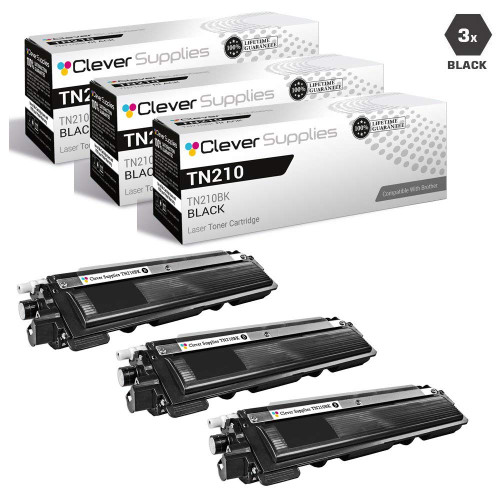
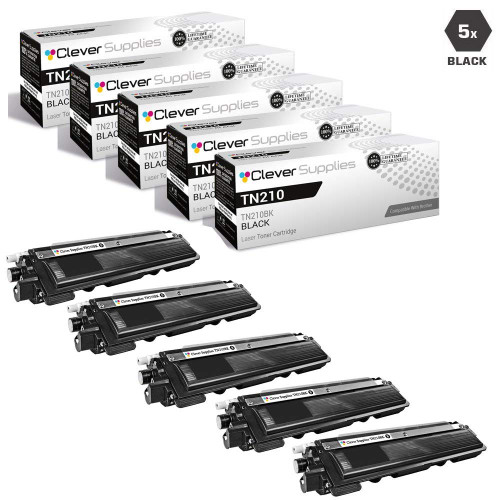
This ladder is the family’s one true decision, and it is a clean one. The TN210BK is the same cartridge in every box — same rating of about 2,200 pages, same fit across the nine printers — so the only thing that changes as the packs grow is the price of a printed page: about 1.26¢ from the single, about 0.90¢ in the 2-pack, about 0.78¢ in the 3-pack and about 0.68¢ in the 5-pack. Unlike the sets above, every saving on this ladder is measured against a single cartridge that genuinely exists and is genuinely priced, so every badge below is arithmetic you can redo from the single’s $27.81: two singles would cost $55.62, three $83.43, five $139.05.
Choosing a rung is a question about your printer’s appetite, not about quality. A home machine that prints a few pages a week will take years to empty a 5-pack, and toner bought that far ahead mostly tests your storage shelf; a shared office printer that runs documents all day moves in the opposite direction, and for it the deeper packs are simply the same cartridge bought at a better rate. The middle rungs suit the broad middle case — a small office that replaces black a few times a year and would rather reorder less often.
Colors: two honest singles and one deliberate gap
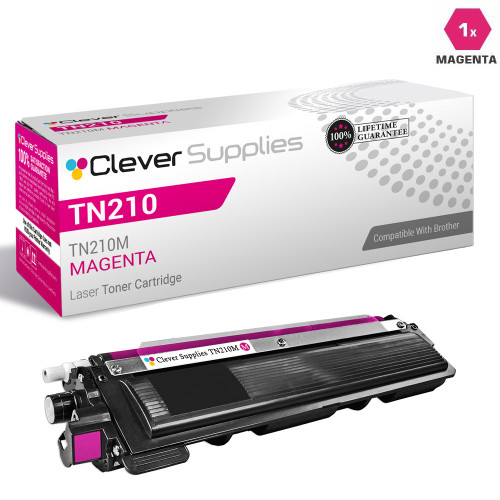
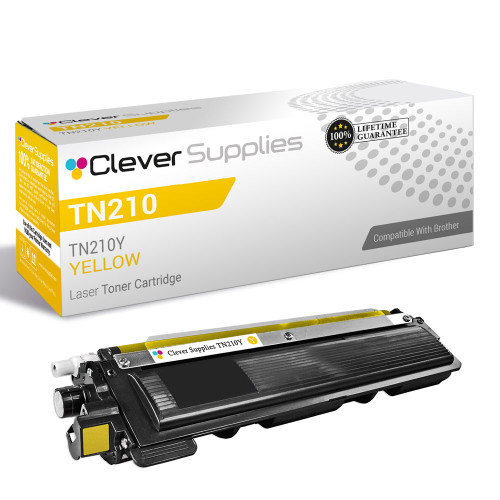
Two of the three color slots can be refilled one cartridge at a time. The magenta and yellow singles below are each rated at about 1,400 pages and priced at $26.82 — about 1.92¢ a page — and they are identical in every respect except the color they carry, so the choice between the two cards is simply whichever slot your printer is flagging.
Cyan is where this shelf has a hole, and this guide names it rather than routing around it silently: no compatible TN210C single is sold here. The listing that would have carried it does not exist, and no card below pretends otherwise. A printer that needs only cyan therefore leaves a buyer with three real routes. The first is the CMY 3-color set at $48.31, which delivers cyan alongside fresh magenta and yellow — usually the sensible buy, since the three colors tend to fade within a short span of one another. The second is a full 4-color set when the black is also running low. The third is the genuine Brother cyan cartridge, sold on this shelf at $107.45 — more than four times the price of its compatible magenta and yellow counterparts, and quoted here as context, not as a recommendation.
Why the colors run out sooner is built into the ratings rather than into any defect: each color cartridge is rated at about 1,400 pages against the black’s 2,200, so on a printer doing steady color work the color slots will call for attention first — which is precisely the situation the color sets above exist for, and why the cyan gap matters more here than a missing single would on a platform where colors lasted as long as black.
Every offer on one table
All eleven compatible offers in one place, at today’s prices from each offer’s own product page, with Brother’s ratings as the common yardstick. Two rows you might expect are missing by design: there is no cyan single row, because no such compatible product is sold here, and no drum row, because the drum is a genuine-only set covered in prose further down rather than carded as an offer.
| Offer | What is inside | Brother rating | Price | Cost per page | Against buying singly |
|---|---|---|---|---|---|
| 4-color set | TN210BK + TN210C/M/Y | Black about 2,200 · colors about 1,400 | $60.04 | Full-color page about 4.29¢ | — |
| 5-color set | 2× TN210BK + TN210C/M/Y | Two blacks about 2,200 each · colors about 1,400 | $71.76 | $14.35 a cartridge | — |
| 8-color set | Two complete 4-color sets | As the 4-color set, twice over | $103.99 | Full-color page about 3.71¢ | — |
| CMY 3-color set | TN210C + TN210M + TN210Y | About 1,400 each | $48.31 | $16.10 a cartridge | — |
| CMY 6-color set | Two of each color | About 1,400 each | $80.54 | $13.42 a cartridge | — |
| TN210BK black single | Black only | About 2,200 | $27.81 | About 1.26¢ | — |
| TN210BK black 2-pack | Two black cartridges | About 4,400 in total | $39.53 | About 0.90¢ | SAVE $16.09 vs two singles |
| TN210BK black 3-pack | Three black cartridges | About 6,600 in total | $51.26 | About 0.78¢ | SAVE $32.17 vs three singles |
| TN210BK black 5-pack | Five black cartridges | About 11,000 in total | $74.71 | About 0.68¢ | SAVE $64.34 vs five singles |
| TN210M magenta single | Magenta only | About 1,400 | $26.82 | About 1.92¢ | — |
| TN210Y yellow single | Yellow only | About 1,400 | $26.82 | About 1.92¢ | — |
The genuine shelf, for scale — every figure is the price on our own shelf, labeled as ours: a genuine TN210BK is $101.00 (about 4.59¢ a page), genuine color singles are $107.45 apiece (about 7.68¢ a page), the genuine CMY 3-color set is $295.69 and the genuine 4-color set is $363.91. Brother’s own store prices the same cartridges lower — the black at $89.79 and the colors at $79.29 each — which makes our genuine 4-color set an oddity worth knowing about: at $363.91 it costs more than the four genuine singles bought from Brother itself, which total $327.66. The genuine drum set is $214.88 here against Brother’s list price of $164.79. None of these genuine items is carded or linked on this page; they are quoted so the compatible figures have an honest frame around them.
The drum: a four-unit set, and genuine-only here
Toner is only half of this platform’s running gear. Behind the four cartridge slots sit four drum units — one working behind each color — and Brother sells them exclusively as one combined part, the DR210CL, rated at approximately 15,000 pages. Brother publishes that life as a single approximate figure, with no standard and no per-job breakdown attached, so this page repeats it in exactly that form and builds no finer claim on it. There are no individual color drums to buy for these printers, from Brother or from anyone: when one drum wears, the set is the replacement.
In this store the drum shelf is genuine-only, and the guide states that as plainly as the cyan gap above: no compatible DR210CL is stocked, so the drum carries no card and no purchase link here. The one drum listing the store does carry is the genuine set at $214.88 — about 30% above Brother’s own list price of $164.79, a gap worth knowing about before that purchase is planned. Its listing title, incidentally, calls it a “Black” drum set; the part is nothing of the kind, and the title undersells what arrives — a set of four drums serving all four colors. The platform’s other consumable, Brother’s WT200CL waste toner box, is not stocked in this store either.
Knowing when the drum is the problem saves a wasted toner purchase: print that fades or bands evenly down the page, and stays faded after a fresh cartridge goes in, points at the drum behind that color rather than at the toner. When that day comes the arithmetic is at least simple — one part, one price, and a rated life long enough that most of these printers will need it once, if that, across their working lives.
Chips: what the listings say, and what this page claims
This guide makes no claim about chips for the TN210 family, and the census behind that restraint is short enough to give in full. Of the sixteen compatible listings in this family, seven — all from one product line — carry a single shared sentence listing a “smart chip” among a new cartridge’s internal parts, alongside its drum and blades. The other nine listings say nothing about chips at all, and no listing in the family documents a fitted-chip program or a recognition guarantee of any kind. A parts list repeated across one block of listings is not evidence about any individual cartridge, so it is not promoted into a promise here.
The one statement on the subject that does carry a source comes from Brother rather than from any listing: Brother has said publicly that its firmware updates are not a way of locking third-party cartridges out of its printers. Beyond that, this page confines itself to what it can stand behind exactly — which printers these cartridges fit, what Brother rates them at, and what they cost.
Before you order: the TN210 checklist
Frequently asked questions
No. Brother publishes one tier for this platform and one only: the TN210BK black at about 2,200 pages and the three colors at about 1,400 each. Brother’s US catalog carries no higher-yield sibling code for these printers, and this store sells none either. If a listing or a label suggests an upgraded TN210 variant, it is describing a product Brother does not publish — the four codes on this page are the whole family.
Because this store does not stock one — the compatible cyan single simply does not exist as a listing here, while its magenta and yellow counterparts do. Cyan reaches the compatible shelf only inside the color sets: the CMY 3-color set at $48.31, the 4-color set and the larger boxes built from them. The only single-cartridge route to cyan is the genuine Brother cartridge at $107.45. This guide treats the gap as a fact to plan around, not a detail to hide.
Match the pack to how quickly your printer empties a black cartridge, because the cartridge itself never changes — only its per-page price does. Light, occasional printing argues for the single at $27.81 (about 1.26¢ a page) or the 2-pack; a small office replacing black a few times a year is the 3-pack’s natural home at about 0.78¢ a page; heavy or shared printers earn the 5-pack’s 0.68¢. Every one of those figures, and the savings badges on the pack cards, is measured against the real single’s price.
No. The word in that title is the listing’s own error of emphasis. The DR210CL is a set of four drum units — one sitting behind each cartridge, black and the three colors alike — rated at approximately 15,000 pages as a set. Brother sells it only in that combined form, and this store carries it only as a genuine part at $214.88; there is no compatible drum for this platform, which is why the drum has a section of prose on this page but no card.
Duplication is built into this family’s shelf: sixteen compatible listings cover just eleven distinct offers. The 4-color set appears three times under three near-identical titles, the black single and the 3-pack and the 5-color set twice each — and in every case the duplicates agree on price, so the repetition costs a buyer confusion rather than money. Each card on this page links one verified listing per offer, and the duplicates are left to agree with it from the search results.
Not on the evidence this guide is willing to stand behind. Brother USA’s compatibility for the TN210 cartridges and the DR210CL names nine machines, and they are the nine linked at the top of this page. Listing copy in the store attaches additional names — variants of these printers sold in other markets, and a couple of model numbers that belong to a different kind of Brother machine entirely — and where listing text and Brother disagree, this page follows Brother. If your model is not among the nine, treat the fit as unproven rather than promised.
This page offers none, deliberately. Across the family’s sixteen compatible listings, the word “chip” appears only inside one shared sentence — a list of a new cartridge’s internal parts — repeated across a single block of seven listings; the remaining nine listings never mention one, and nothing in the family documents a fitted-chip program. That record is far too thin to hang a guarantee on. Brother’s own public position is that firmware updates are not used to shut third-party cartridges out.
The compatible cartridges carded above carry this store’s own backing: a twelve-month warranty, and twelve months to return a compatible product that is not right for you. Genuine Brother items on the shelf carry Brother’s warranty instead, and genuine returns close at 30 days. Orders ship from the closest of our four warehouses — Illinois, Pennsylvania, Georgia or California — and the support desk is staffed Monday to Friday, 9 AM to 5 PM Central.