




Twenty-seven printers take this cartridge, and every one of them takes it in every slot. LC61 is Brother’s standard-yield tier for a wide Innobella platform — six DCP models and twenty-one MFC models built across several years — and it rates its cartridges split: the black at up to 450 pages, each color at up to 325. Four of the twenty-seven also accept a high-yield sibling, and that four-printer exception is the one real decision on this page. Everything else is box size: all six offers below are priced per page, and the tier question is worked out in the open.
If the nameplate on your machine is any one of the twenty-seven DCP and MFC models in the roster further down, this page is your ink shelf: six listings, all compatible, a new compatible chip in every cartridge, and no genuine LC61 stocked in this store. The Set of 4 at $29.94 heads the page because it renews the whole printer in a single order. Behind it, the Set of 10 at $59.85 is the bulk box — four blacks and two of each color — and the only offer here that reaches free shipping by itself. The four singles wait at $8.69 apiece. What needs a page of explanation is the platform around the shelf: ratings that split between black and color, a roster long enough to need two lists, a high-yield tier that exists for four printers and not the other twenty-three, and a starter record Brother leaves mostly blank. Each gets its own section below.
The standard shelf in six offers: full refill, ten-box, singles
Fit is the simple part — all six offers serve all twenty-seven printers — so the ladder is arranged by how owners actually reorder. The Set of 4 comes first, because a four-slot machine usually fades as a set. The Set of 10 follows for households and offices that would rather stock once a season. The singles close the ladder, each answering whichever slot gave out ahead of the others.
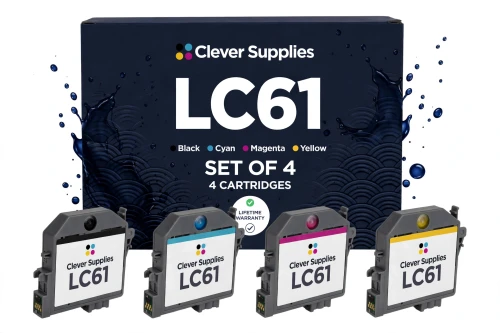
The genuine comparison is a short one. Brother’s own LC61 singles — the black at $32.99, each color at $14.19 — add up to $75.56 for the same four slots, and every one of them showed out of stock at Brother when these figures were gathered. This box covers the four slots for $29.94. It does not reach the $49 free-shipping line on its own; in this family only the ten-box below does that.
Shop the LC61 Set of 4 →THE REST OF THE LADDER — THE TEN-BOX, THEN THE SINGLES
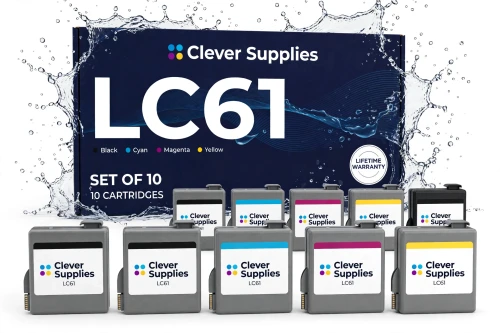
The deepest stock on the shelf: $5.99 a cartridge, the lowest unit price and the lowest blended rate on this page. The mix leans black — four blacks against two of each color — because these printers spend their lives on documents. At $59.85 it is the one offer here that ships free standing alone.
Shop the LC61 Set of 10 →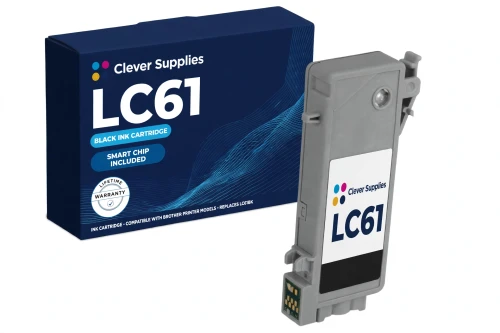
The hardest-working slot in the machine gets the family’s longest rating — 450 pages against 325 for each color — and with it the cheapest single-cartridge page rate here. Brother’s genuine black lists at $32.99, and Brother flags that one SKU discontinued; the FAQ below has the detail.
Shop LC61BK Black →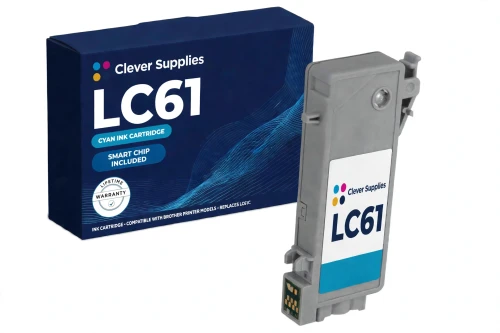
Cyan carries the blues in charts, logos and letterheads across this whole generation of machines, and it is usually the first color slot to fade. $8.69, the family’s flat single price; Brother’s genuine cyan is $14.19.
Shop LC61 Cyan →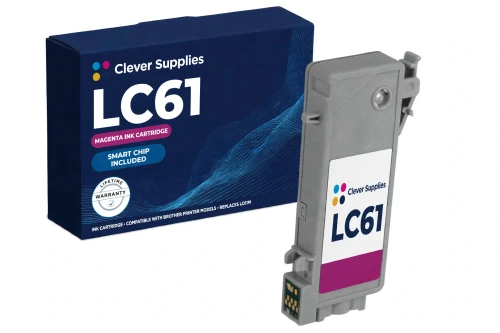
Magenta at the flat $8.69, rated up to 325 pages — flyers, report covers and photo prints all draw on this slot. Brother’s genuine version of the same cartridge lists at $14.19.
Shop LC61 Magenta →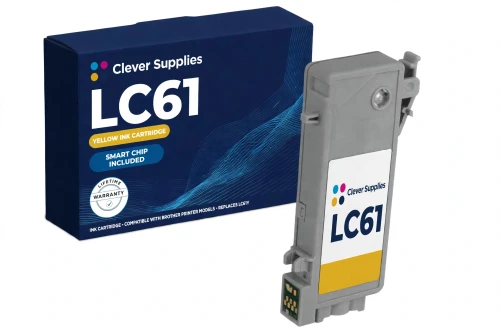
Yellow fades quietly — output washes pale instead of stopping dead — so treat its 325-page rating as a schedule for keeping a spare. $8.69 here, against $14.19 for Brother’s genuine cartridge.
Shop LC61 Yellow →A note on why four singles anchor a page led by boxes. Slots do not empty in step: a document-heavy month drains the black while the colors sit nearly full, and a photo-heavy month reverses the order. The single exists for the slot that moved — it renews one cartridge and leaves the other three, ink still in them, exactly where they are. Boxes win on the rate per page; singles win on never paying to replace ink you still own.
One more consequence of a twenty-seven-printer platform is worth a line of its own: homes and small offices often run two or three of these models side by side, bought in different years for different desks, and a single LC61 shelf restocks all of them. The box on the supply shelf does not care which of the twenty-seven front panels it eventually sits behind — and neither, for once, does the person ordering it.
All six offers on one table, priced per page
Brother’s measuring stick for this platform, quoted as Brother prints it: “‡Approximate page yield in accordance with ISO/IEC 24711.” The stick is applied to cartridges one at a time — the black at up to 450 pages, each color at up to 325 — and never to a box. The set rows are therefore costed by division instead: the Set of 4’s price over the 1,425 rated pages packed inside it, the Set of 10’s over 3,750. Where the per-page column says “blended”, that division is all it means.
| Offer | Fits | Price | Rating per cartridge | Cost per page | Against the singles |
|---|---|---|---|---|---|
| LC61 Set of 4 BK C M Y — the flagship | All twenty-seven printers | $29.94 | Black up to 450; each color up to 325 | 2.10¢ blended | SAVE $4.82 |
| LC61 Set of 10 BCMY | All twenty-seven printers | $59.85 | 4 blacks at up to 450; 2 of each color at up to 325 | 1.60¢ blended | SAVE $27.05 · ships free alone |
| LC61BK black single | All twenty-seven printers | $8.69 | Up to 450 pages | 1.93¢ | The document slot |
| LC61C cyan single | All twenty-seven printers | $8.69 | Up to 325 pages | 2.67¢ | One slot, one cartridge |
| LC61M magenta single | All twenty-seven printers | $8.69 | Up to 325 pages | 2.67¢ | One slot at a time |
| LC61Y yellow single | All twenty-seven printers | $8.69 | Up to 325 pages | 2.67¢ | One slot, one cartridge |
Two ladders run down this table at once. The box ladder steps from $8.69 a cartridge bought singly to $7.49 inside the Set of 4 and $5.99 inside the Set of 10. Inside it runs a color ladder: on single cartridges the black’s longer rating makes its page the cheap one at 1.93¢, while each color page costs 2.67¢ — and the blended set figures average the two together, settling at 2.10¢ and 1.60¢. A bigger box buys no extra rating. It buys more rated pages for each dollar, and a longer quiet stretch between orders.
Standard-yield for twenty-seven, high-yield for four
LC61 is the tier every printer on the roster shares. Brother labels it Standard-yield, and for twenty-three of the twenty-seven models it is the only tier there is — no high-yield cartridge of this shape exists for them, under this code or any other.
The exception is a group of four wide-format MFC models: MFC-5890CN, MFC-5895CW, MFC-6490CW and MFC-6890CDW. Those four also accept Brother’s High-yield tier, LC65HY — a black rated up to 900 pages and colors up to 750. Brother’s own wording for the MFC-5890CN calls it a “High Yield 4-Cartridge System” and adds that “both standard and high yield ink cartridges are available”. On these four machines the tiers mix slot by slot, so a printer can run a high-yield black beside standard colors, or any other combination its owner prefers.
This store stocks the LC65HY shelf as well, and its price shape is the interesting part. LC65HY singles are $8.99 — thirty cents over LC61’s $8.69 — for ratings that roughly double, which works out to 1.00¢ a page for the black and 1.20¢ for each color, against this page’s 1.93¢ and 2.67¢. At set level the premium disappears entirely: the LC65HY Set of 4 and Set of 10 sit at the same $29.94 and $59.85 as the LC61 sets above. An owner of one of the four dual-tier printers who buys sets pays nothing extra for the longer-running box. An owner of any other model never faces the question — LC61 is the whole shelf, and this page is the whole answer.
There is also a middle course on the four dual-tier machines, and the slot-by-slot rule is what makes it possible: step up only the black. The black is the slot that empties first under document work, and it is also where the high-yield tier’s advantage is widest — up to 900 rated pages against 450. An owner can run the high-yield black beside three standard colors, pay the thirty-cent premium on one cartridge, and leave the rest of the buying habit exactly as it was.
Starter cartridges: what the record shows — and what it does not
Every printer on the roster left its carton with starter cartridges in the slots, and part of a starter’s ink is spent priming the machine before the first real page. But the only starter figure this pass could read in Brother’s own words belongs to a different cartridge series. On the MFC-6490CW — one of the four dual-tier models — Brother’s in-box footnote states: “Actual yield of starter cartridge will be approx. 65% of replacement LC-65 cartridge series, due to ink system initialization process.” That sentence describes the LC-65 series on that machine. It is not an LC61 rating, and this guide does not borrow it as one.
For LC61 itself, no starter percentage and no starter page count could be read from Brother’s published pages — the specification blocks where such figures would sit were not published in readable form. So this page prints no LC61 starter number rather than a borrowed one. What is certain is the endpoint: the first cartridge an owner buys from this page is a full-rating retail cartridge — up to 450 pages for the black, up to 325 for each color.
The chip is part of the product here
Begin where the listings begin: the specification field of all six reads “New compatible chip”, and the descriptions repeat the phrase three or four times apiece. The Set of 10’s text explains why the emphasis is earned: “the LC61 family reads its cartridges electronically, so the chip is part of the product, not an accessory”. A cartridge whose chip does not read is not recognized by these printers at all — nothing on this shelf is sold without one.
The limit rides at the same size as the claim. Every text carries the firmware caveat in plain terms — a cartridge can occasionally fail to read after a firmware change — and prints the working routine alongside it: lift the cartridge out, check the chip contact is clean and untouched, seat it again, and restart the printer. And every text declines the larger promise in the same breath: “No compatible cartridge can honestly be promised to read in every firmware state”. Where the routine fails, the listings point to the lifetime warranty in the specification block rather than to another workaround.
Brother’s side of the record is stated too: since March 2025 Brother has held that its firmware updates do not block the use of third-party ink. Read together, the position this page prints is the one the listings print — a new chip in every cartridge, a known routine if a read fails, and no promise that covers every firmware state a printer might be in. Everything in this section comes from these six listings; other families in this store word their chip arrangements differently, and their pages speak for themselves.
The twenty-seven: one shelf from DCP-165C to MFC-J630W
Brother prints one and the same compatibility list on all four of its LC61 cartridge pages — twenty-seven printers, six from the DCP line and twenty-one from the MFC line. It is the longest roster in this guide series, and also the simplest to use: every name on it takes every offer on this page, in every slot.
The DCP six: DCP-165C, DCP-385C, DCP-395CN, DCP-585CW, DCP-J125 and DCP-J140W.
The MFC twenty-one: MFC-250C, MFC-255CW, MFC-290C, MFC-295CN, MFC-490CW, MFC-495CW, MFC-5490CN, MFC-5890CN, MFC-5895CW, MFC-6490CW, MFC-6890CDW, MFC-790CW, MFC-795CW, MFC-990CW, MFC-J220, MFC-J265W, MFC-J270W, MFC-J410W, MFC-J415W, MFC-J615W and MFC-J630W.
Four names on that list carry the distinction the tier section explains: MFC-5890CN, MFC-5895CW, MFC-6490CW and MFC-6890CDW are the dual-tier models that also accept the high-yield LC65HY. The other twenty-three take LC61 in every slot and nothing else — which is why this page, and not a tier comparison, is their whole buying guide.
The store files the family the way Brother lists it: all six listings sit in each of the twenty-seven model categories and in the family’s own code category, the Brother LC61 category — arrive by printer or arrive by cartridge code, and the shelf you reach is the same six listings.
What stands behind the six listings
Before you order: five checks on a twenty-seven-printer shelf
Questions this platform draws
Both fit your machine, slot by slot and in any mixture — yours is one of the MFC-5890CN, MFC-5895CW, MFC-6490CW and MFC-6890CDW. The arithmetic argues for the high-yield tier: its singles cost $8.99 against $8.69 here, for a black rated up to 900 pages against 450 and colors at 750 against 325 — 1.00¢ and 1.20¢ a page against 1.93¢ and 2.67¢. And its sets give the premium back entirely: the LC65HY Set of 4 and Set of 10 are priced at the same $29.94 and $59.85 as this page’s sets. What LC61 keeps, even on your printer, is the lowest single-cartridge price on the platform — and the shared shelf, if your home or office runs more than one of these twenty-seven machines.
No — and that absence is Brother’s design, not a gap in this store. The high-yield LC65HY tier fits the four models named above and no others. For the remaining twenty-three printers on the roster, LC61 is the only cartridge tier Brother made. The way to lower the per-page cost on those machines is the box ladder on this page: 2.10¢ blended in the Set of 4, 1.60¢ in the Set of 10.
Because that is the shape Brother published for this family — the split stands in Brother’s own figures, on the same basis line quoted in the table section above. Unlike families that rate every slot alike, LC61 gives the document slot the longer run. The store’s pricing follows a different flatness of its own: all four singles cost the same $8.69, so the black’s longer rating is exactly what makes its page the cheapest single-cartridge page here, at 1.93¢ against the colors’ 2.67¢.
Only in part — and the part matters. Brother’s own product data flags the genuine black cartridge, LC61BK, as discontinued; the three genuine colors still read as current products there. Discontinued or not, all four genuine singles showed out of stock at Brother when these pages were checked, and Brother publishes no genuine pack for this family at all. Some texts in this store describe the whole LC61 series as discontinued; Brother’s per-cartridge record is narrower than that, and it is the record this page follows. The compatible shelf above is the stocked route either way.
On the four dual-tier models, yes — that is what Brother’s “both standard and high yield ink cartridges are available” means in practice: the tiers mix slot by slot, so a high-yield black can sit beside standard-yield colors, or the reverse. On the other twenty-three printers, no LC65HY cartridge fits any slot; those machines take LC61 in all four.
Work the listings’ routine in order: lift the cartridge out, check that the chip contact is clean and untouched by fingers, seat it firmly back in its slot, and restart the printer. Most read failures on this family end there, including the ones that follow a firmware change. The listings promise a new compatible chip in every cartridge; they do not promise a read in every firmware state, and neither does this page. A cartridge that still refuses after the routine is covered by the lifetime warranty in its listing.