




Ten Brother workgroup printers from the late 2000s still earn their floor space in offices and back rooms, and all ten lay their toner down through the same drum. Brother prints the drum’s rating on the product page itself — approximately 25,000 pages — and still sells the genuine unit today. The compatible shelf in this store holds two offers, a single drum and a 2-pack, though a quirk of the catalog shows each of them twice. This guide cards the two listings worth buying from, prices them at what checkout actually charges, and sets the genuine shelf’s prices beside Brother’s own counter price, so every figure on the page can be checked rather than believed.
Start with the short shelf. One compatible DR620 drum costs $29.15; the 2-pack brings the unit price down to $21.11 and saves $16.09 against two singles. Search the store and you will meet each offer twice — the catalog carries a second listing of the single and a second listing of the pair, at identical prices and identical stock, so this page links one of each and treats the twins as what they are. Brother’s genuine drum is stocked here at $206.49 for a single and $377.49 for a pair, while Brother itself charges $176.99 for the same drum — every one of those numbers is printed below, side by side. Three cautions ride along. The newer listings headline these drums as toner cartridges, which they are not. Both listings of the pair argue their savings from list prices, so their prose overstates the pack’s price and its saving alike. And neither compatible offer reaches the $49 free-shipping line on its own.
Two offers, four listings: reading a shelf that lists everything twice
The duplication deserves one plain paragraph, because a careful shopper will spot it. The single drum stands in this catalog under two listings — an older one titled, correctly, as a laser drum unit, and a newer one carrying the same price, the same stock count and even the same main photograph. The 2-pack is doubled the same way. Nothing about the part changes between a listing and its twin: same DR620, same rating, same money. The cards below point at the two listings this store’s TN620 guide already treats as the shelf’s reference copies; ordering a twin instead would bring the identical box to your door, no better and no worse.
A second label problem sits on the newer listings. Their headlines call the contents toner cartridges, and their specification tables file the part as a laser cartridge — yet every question their own text answers is about drum life, drum counters and drum changes, because a drum unit is all that either box holds. The older single and both genuine listings are named for what they are. So are the cards that follow: everything on this page is called a drum, because a drum is what you would be buying.

Drum changes on machines of this age are usually solitary affairs: one printer, one warning light, one replacement that then serves for years. This card prices that errand. The pair below exists for the owner who would rather shelve a spare today than wait on a delivery when the next counter runs out; everyone else starts here, at $29.15, and the rest of the page is measured against it.
Shop the Drum Single →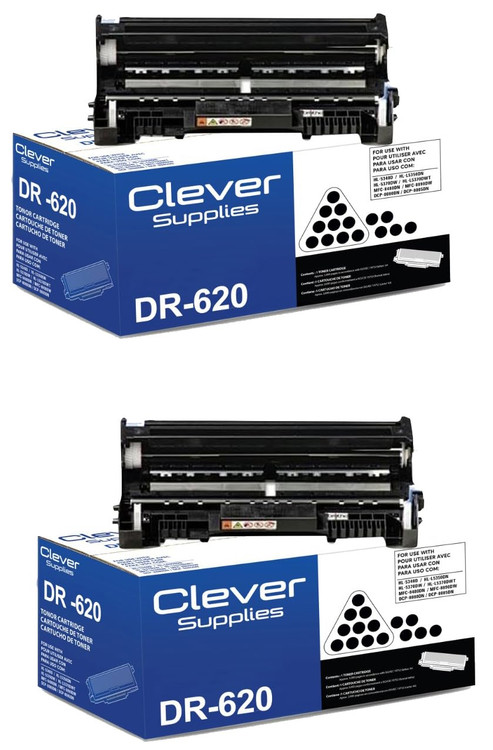
Each drum in the pair lands at $21.11 — $0.84 per thousand rated pages, roughly 0.08¢ a page — and the box undercuts two singles bought apart by $16.09 (SAVE $16.09). Its two units hold some 50,000 pages of drum life between them, drawn down 25,000 at a time: one turning in the printer, one resting in its carton. Ordered alone at $42.21, it stops $6.79 short of the $49 free-shipping line.
Shop the 2-Pack →Every route to a DR620 drum, on one table
Every rate here is a price spread over the 25,000 pages Brother allows a single drum. Where a box holds two drums, its coverage figure is simply two such allowances added — the 50,000 pages in the second row describe a pair’s combined span, not a rating any lone unit carries.
| Offer | Box price | Works out per drum | Price per 1,000 pages | In the box |
|---|---|---|---|---|
| Single drum (flagship) | $29.15 | $29.15 | $1.17 | A lone drum at the ≈25,000-page rating |
| Drum 2-pack | $42.21 | $21.11 | $0.84 | A pair of drums — about 50,000 pages of life between them |
| Genuine Brother DR620 (reference) | $206.49 | $206.49 | $8.26 | One genuine drum — Brother itself asks $176.99 for it |
| Genuine Brother DR620 2-pack (reference) | $377.49 | $188.75 | $7.55 | Two drums bundled by this store — Brother sells the drum singly only |
The compatible column tells a simple story: one step down in unit price, from $29.15 to $21.11, and then the ladder ends — there is no compatible 4-pack on this platform. The genuine rows run on different economics entirely; their section below weighs them against Brother’s own shelf.
The pair’s own description argues from prices nobody pays
Open either listing of the 2-pack and its savings answer works in a currency of list prices: “The 2-pack is $48.54 — $24.27 per drum. Two drums bought singly at $33.52 would come to $67.04, so the pair saves you $18.50.” The twin listing repeats the same figures in its own words. Every number in those sentences is a list price — the single’s shelf tag before discount, not what any register asks. The selling account runs lower across the board: the pair is $42.21, each drum in it $21.11, two singles together $58.30, and the saving the pair genuinely delivers $16.09.
The listings even correct themselves a paragraph later, without noticing: the TN620-guide sentence woven into the same answers quotes the true $16.09 saving and the true $21.11 per-drum figure, so a reader who finishes the page holds two contradictory accounts of one box. This guide keeps the account that matches the checkout total, and it is the only account used anywhere on this page.
Brother’s ten printers — against the longer lists in the listings
Brother gives one fit list for this platform and repeats it unchanged across three pages: the DR620 page, the TN620 page and the TN650 page all name the same ten machines, and every one of them takes both toner tiers over the same drum. Each name below opens that model’s category in this store.
DCP series: DCP-8080DN · DCP-8085DN
HL series: HL-5340D · HL-5350DN · HL-5370DW · HL-5370DWT
MFC series: MFC-8480DN · MFC-8680DN · MFC-8690DW · MFC-8890DW
Two cartridge tiers sit on top of this drum. The standard TN620 is rated at up to 3,000 pages and the high-yield TN650 at up to 8,000, both under Brother’s own footnote: “‡Approximate toner cartridge yields in accordance with ISO/IEC 19752 (letter/A4).” That laboratory label stays with the cartridges alone — for the drum Brother wrote a plainer basis instead: “Drum yield is approx., and may vary by type of use.” The two measures are kept apart on this page. Brother still sells both cartridges ($89.79 and $143.29, the TN650 flagged its top seller), and here the compatible TN620 single at $28.86 is the drum’s everyday partner — note that the compatible shelf stocks the standard tier only, the TN650 having no compatible counterpart in this store. Our Best Brother TN620 Toner Cartridges guide prices the whole ladder, and the family gathers under the TN620 code category and the TN650 code category; no DR620 code category exists. Set against the drum, the span runs to roughly 8.3 standard cartridges or 3.1 high-yield cartridges inside one drum’s life.
Now the lists you will actually read if you open the product pages, because they are longer than Brother’s ten and, in the newer listings, partly wrong. The fit answers name fourteen models — the ten above plus four names Brother’s current pages do not carry, among them an MFC-8880DN whose own Brother printer page has been taken down entirely; Brother’s pages omit it, so this guide does too, and says so rather than quietly copying the longer list. The introductions on the three newer listings go further and sweep in printers from the previous Brother platform altogether — machines such as the DCP-8060, the HL-5240 and the MFC-8860DN, which take the DR520 drum and cannot physically accept this one. Those names belong to a different guide and a different drum. Brother’s ten govern everything recommended here.
One neighboring platform is close enough in name to cause real mistakes: a printer fed by TN630 or TN660 cartridges belongs to the HL-L23xx family and takes the DR630 drum, not this one — the codes differ by a single digit, the drums do not interchange.
Telling a tired drum from an empty cartridge before you spend
The two failures wear different signatures on the printed sheet. A drum reaching the end of its surface leaves marks that come back at the same spacing page after page — a repeating spot, a streak that will not wash out, a gray haze sitting behind text that used to print clean. A cartridge running dry leaves no marks at all: the page simply fades, evenly, top to bottom, and a fresh cartridge brings it back in full. The printer keeps separate tallies for the two parts, so its display names the culprit as well — a drum warning is the drum counter expiring, which no toner reading can overrule.
The buying rhythm follows from the ratings. A standard cartridge gives out around 3,000 pages and a high-yield one around 8,000, while the drum underneath is allowed roughly 25,000 — so somewhere between three and eight cartridges pass through during one drum’s service, and on a machine already fifteen years into its working life, the drum bought today may well be the last one that printer ever asks for.
After fitting the new unit, one step remains, and skipping it is the commonest cause of a warning that refuses to clear: the drum counter has to be reset from the machine’s menu, following the sequence Brother documents for the model. The printer cannot see the fresh surface; it believes the count it kept against the old one. Resetting the counter without changing the drum, on the other hand, buys silence and nothing else — the worn surface goes on signing every page.
The genuine shelf, priced against Brother’s own counter
Brother still manufactures and sells this drum, and its own price for it is $176.99. This store’s genuine single is $206.49 — $29.50, or about 16.7%, above the maker’s counter — and the genuine pair stocked here, at $377.49, works out to $188.75 per drum, which is also more than Brother charges for one. Two genuine singles ordered from Brother itself would total $353.98 and undercut this store’s pair by $23.51. Those comparisons are printed here in full because they are the genuine shelf’s honest context: the pair does run $35.49 below two of this store’s genuine singles bought apart ($412.98), and that is the extent of its arithmetic advantage.
Measured per thousand rated pages, the genuine single costs $8.26 here (about 0.83¢ a page) and the pair’s drums $7.55 (about 0.75¢), against $7.08 at Brother’s own price (about 0.71¢) and $1.17 for the compatible single. Set against that, the genuine route’s return is origin and cover: a drum from the maker’s own line under its warranty, plus a 30-day return window at this store for genuine items. Owners who want precisely that are welcome to it, figures in plain view — this page only refuses to call the shelf the economical way to buy Brother’s drum.
Chips: a word that appears nowhere on this shelf
Read all six listings that sell this drum, compatible and genuine alike, and the subject never comes up — no chip is named, specified or promised in any of their descriptions, and none of them carries such a field. That silence fits the part rather than betraying an omission: a drum is the surface the image forms on; it consumes nothing, senses nothing and reports no level, so electronics have nothing to tally. This guide therefore makes no recognition claim for the DR620. The single on-record statement available is Brother’s own, from its published support answers: “Brother firmware updates do not block the use of third-party ink and toner cartridges in our machines.” It stands here word for word, with no claim of this page’s own stacked on it.
The terms standing behind the two offers
Five checks before a DR620 drum goes in the cart
Questions owners ask when the drum warning appears
Approximately 25,000 pages. Brother publishes that figure on the drum’s own product page — “Yields approx. 25,000 pages” — with the maker’s condition attached in its footnote — drum yield is approx., and may vary by type of use. Your own count will land somewhere around the rating: coverage, job length, heat and humidity each pull it off the printed number.
The $42.21 — that is the selling price, the figure checkout charges. The $48.54 in the text is the pack’s list price, and the savings built on it inherit the same inflation: the pair truly saves $16.09 against two singles, not the larger figure its prose claims. Every price and saving on this page is figured from selling prices.
Because the store lists each compatible offer under two product pages — the single twice, the pair twice — at identical prices and identical stock. They are not different versions of the drum; the part, the rating and the box are the same whichever page you order from. This guide links the listing of each pair that the store’s TN620 guide already uses as its reference, so this page and that one point at the same shelf.
Drums arrive. The newer listings took their headlines and their specification rows from the toner shelf, but the boxes hold drum units and nothing else — their own help text talks only of drum life, drum counters and a drum’s 25,000-page yield. Judge the part by its contents; this page does, and names the offers accordingly.
No. The box holds two separate drums of approximately 25,000 pages each, and the second is fitted only when the first one’s counter runs down. Laid end to end they cover roughly 50,000 pages across two lives — a sum of coverage, never a rating carried by a single unit.
Brother’s current pages do not say so. Every store listing for this drum names the MFC-8880DN, but Brother USA’s DR620, TN620 and TN650 pages list ten models and the MFC-8880DN is not among them — its own Brother printer page has been removed as well. This guide follows the maker’s published list of ten and links only those; if your machine is the MFC-8880DN, verify against Brother’s documentation for your region before ordering rather than relying on the listings’ longer list.
Either — all ten printers accept both tiers, and the drum serves them identically. The practical difference is arithmetic and supply: the TN650’s 8,000-page rating means fewer cartridge changes across the drum’s life, while the compatible cartridges stocked here are TN620 only, the high-yield tier having no compatible counterpart in this store. Brother still sells both tiers itself.
Because the printer’s count still belongs to the drum you removed. It tracks drum life as a tally in its own memory, and fresh hardware alone does not clear that tally — the menu’s reset sequence does, and Brother documents the steps for every one of the ten models. Run it as part of the swap. Run it on its own, with the old drum still fitted, and all you have cleared is the message; the worn surface goes on signing every page.