




Eleven Brother monochrome printers from the mid-2000s image every page through one drum, and that drum is still a going concern: Brother rates it at approximately 25,000 pages in its own manuals and still sells the genuine article today. The compatible shelf here is a tidy ladder of three — a single drum, a 2-pack and a 4-pack — and this guide prices each rung at the figure actually charged, walks through where Brother’s 25,000-page number really lives, and puts the genuine drum’s two prices, this store’s and Brother’s own, side by side.
The ladder is short and honest. A single compatible DR520 drum costs $28.68; the 2-pack drops the unit price to $20.65 and saves $16.07 against two singles; the 4-pack drops it again to $16.63 and saves $48.22. Brother’s genuine drum is stocked here at $296.29, which is $31.00 more than the $265.29 Brother charges on its own site — both figures are printed in this guide, and the choice between them is yours to make with open eyes. Two warnings belong up front. The packs’ store titles call them toner cartridges, which they are not — drums are all their boxes contain — and the packs’ own descriptions argue from list prices nobody is charged. Nothing in this guide does: each number below is a price the register actually asks.
A single, a pair and a case of four: the whole drum shelf
This shelf has the shape drum shelves are supposed to have. The single drum exists, so it leads: it is the unit every pack is measured against, the purchase most owners actually make, and the baseline for both savings printed below. The packs earn their places the old-fashioned way, by charging less per drum than the single does — first the pair, then the case of four — and nothing on the ladder inverts that order.
Before the cards, one label deserves a warning of its own. Whoever titled the two packs reached for the wrong part name: both listings headline themselves as toner cartridges, and their specification tables repeat the error. Open either box and you will find drum units, only drum units. The single was titled properly, as was the genuine listing, and the cards that follow call every offer by the part it actually is.
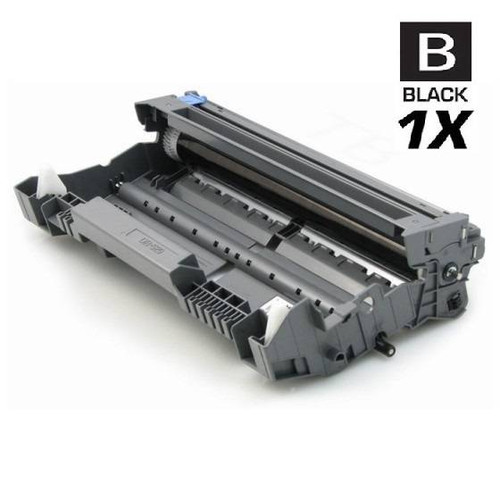
Most drum changes on these machines are one-printer events: a warning on the display, a drum at the end of its count, and a single replacement that settles it for years. That is the purchase this card prices. The packs below are for owners who would rather hold a spare or feed several machines; the owner with one printer and one warning buys exactly this, and the arithmetic of the whole shelf starts from its $28.68.
Shop the Drum Single →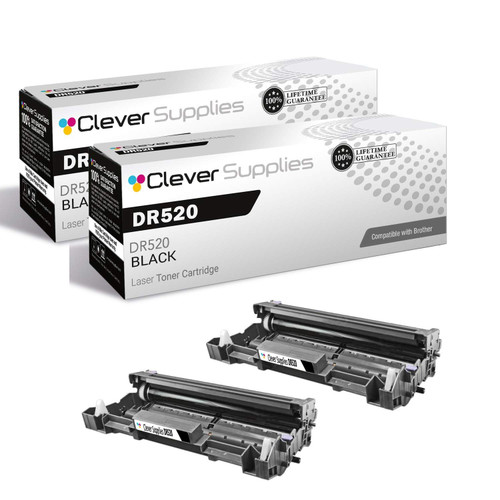
$20.65 a drum and $0.83 per thousand rated pages, about 0.08¢ a page — SAVE $16.07 against two singles bought apart. The pair holds roughly 50,000 pages of drum life between its two units, one fitted now and one shelved against the next warning. At $41.29 it still stops $7.71 short of the $49 free-shipping line on its own.
Shop the 2-Pack →
$16.63 a drum and $0.67 per thousand rated pages, about 0.07¢ a page — SAVE $48.22 against four singles. Between them the four drums hold roughly 100,000 pages of drum life; a single box also undercuts buying the same four drums as two 2-packs by $16.08, and at $66.50 it is the only compatible offer here that clears the $49 free-shipping line alone.
Shop the 4-Pack →Three boxes, one rating: the ladder on a single table
One rule produces every rate in this table: a box’s price divided by 25,000 pages, the rating of a single drum. A multi-drum box is therefore credited with several separate lives added together — the 100,000 pages beside the 4-pack are four drums’ worth of coverage, not a rating any one of them carries.
| Offer | Price | Per drum unit | Cost per 1,000 pages | What arrives |
|---|---|---|---|---|
| Drum single — this page’s flagship | $28.68 | $28.68 | $1.15 | One drum, rated ≈25,000 pages |
| Drum 2-pack | $41.29 | $20.65 | $0.83 | Two drums; ≈50,000 pages of combined drum life |
| Drum 4-pack | $66.50 | $16.63 | $0.67 | Four drums; ≈100,000 pages of combined drum life |
| Genuine Brother DR520 (reference) | $296.29 | $296.29 | $11.85 | One drum — Brother’s own price for the same part is $265.29 |
The unit column is the page in miniature: $28.68, then $20.65, then $16.63 — two honest steps down, no inversions. The genuine drum plays by different rules altogether, charging $11.85 for every thousand of the same rated pages; its own section below makes its case.
A correction before the cards’ numbers settle: the packs quote their list prices
Read either pack’s own description closely and a second, larger set of prices appears. The 2-pack’s savings answer states it outright: “Two single DR520 drums bought separately cost $65.96; this 2-pack is $47.48, so you save $18.48. That works out to $23.74 per drum instead of $32.98” — and its summary repeats the $23.74. The 4-pack answers the same way: “The 4-pack is $76.48, which is $19.12 per drum. Bought one at a time at $32.98, four drums would total $131.92 — so the case saves you $55.44.” Every one of those figures is a list price. The register charges less: two singles total $57.36, not $65.96; the 2-pack sells at $41.29 and saves $16.07; the 4-pack sells at $66.50, works out to $16.63 a drum, and saves $48.22 against the $114.72 that four singles total.
Neither page is even consistent with itself. Later edits stitched a second sentence into each savings answer, and that sentence works from selling prices — the 2-pack’s answer gives the true $16.07 saving a short way below its own $18.48 — leaving two contradictory accounts inside a single answer. This guide follows the selling account throughout; while the listings disagree with themselves, checkout is the arbiter.
Eleven printers on Brother’s list — and a longer one in the listings
Ask Brother which printers take this drum and you get one answer, given three times over: the identical eleven names appear on the DR520 page, the TN550 page and the TN580 page. No model uses a different drum, and none is confined to one toner tier. Each name below is a link to that model’s category in this store.
DCP series: DCP-8060 · DCP-8065DN
HL series: HL-5240 · HL-5250DN · HL-5250DNT · HL-5280DW
MFC series: MFC-8460N · MFC-8660DN · MFC-8670DN · MFC-8860DN · MFC-8870DW
Two cartridge tiers ride on this drum, and one naming trap is worth closing first: there is no TN520 toner. The 520 number belongs to the drum alone; the cartridges are the TN550, rated by Brother at approximately 3,500 pages, and the high-yield TN580 at approximately 7,000 — both under Brother’s own footnote, “‡Yields approx. 7,000 pages @ 5% coverage on Letter size paper” in the TN580’s case, a 5%-coverage basis rather than any laboratory standard. Brother has discontinued both cartridges and publishes no price for either, so the compatible shelf is where this platform’s toner now lives — and it is TN580-only: the compatible TN580 single at $28.24 is the drum’s working partner; the full toner ladder is priced in our Best Brother TN550 Toner Cartridges guide, and the family’s products collect under the TN580 code category. The standard TN550 tier survives only as a genuine listing; the drum serves both tiers regardless.
The listings’ own fit lists run to twenty-two or twenty-three names — Brother USA’s eleven padded with variants sold in other markets. This guide follows the maker’s eleven for every offer on the page. The span arithmetic follows Brother’s ratings too: at 25,000 pages a drum, one drum lasts through about 3.6 TN580 cartridges or about 7.1 TN550 cartridges. The single’s own text says “roughly five standard toner cartridges”, a figure that matches neither tier; the ratings above are the ones to plan by.
Where the 25,000-page figure actually lives
A reader who goes looking for the drum’s rating on Brother’s DR520 product page will not find a number there. That page publishes the price and the basis sentence — “Drum yield is approx., and may vary by type of use.” — and stops. The numeral lives one shelf over, in Brother’s own documentation for the printers themselves: the HL-5240 and HL-5250DN series User’s Guide states it in the drum chapter, word for word: “A new drum unit can print approximately 25,000 A4 or Letter size single-sided pages at 5% coverage.” Brother’s HL-5200 series specification sheet lands on the same figure.
Two consequences follow, and this guide honors both. First, the rating is a manual’s figure, not a product page’s — it is attributed that way everywhere on this page. Second, it is a 5%-coverage figure, the same basis the platform’s toners carry; the manual itself adds that real drum life moves with temperature, humidity, paper, toner and pages per job. Every per-page rate in this guide divides by that 25,000 with those conditions attached.
Worn drum or empty cartridge? The printed page can tell them apart
Both failures print in black, but they leave different evidence. A drum at the end of its life marks the page: the same spot or streak returning at a fixed interval down the sheet, a gray background that survives a cartridge change, output that looks tired in patches rather than evenly pale. A cartridge running dry does the opposite — the whole page fades uniformly, with no repeating marks, and a fresh cartridge restores it completely. The machine keeps separate books as well: these printers count drum pages apart from toner pages, and a change-drum message is the drum counter reporting, not the toner gauge.
The platform’s own numbers explain why the drum question comes up so rarely. A cartridge lasts roughly 3,500 or 7,000 pages depending on tier; the drum is rated at roughly 25,000. Most owners therefore change three, four, even seven cartridges inside one drum’s life — the drum is the long-lived part of the imaging path, and on machines this age it may be changed only once or twice more in the printer’s remaining service.
Fitting the drum is only half the job. Until somebody runs the reset sequence from the printer’s menu — Brother documents the steps model by model — the machine goes on counting pages against the drum that just came out, and the warning stays lit. Run the reset on an old drum instead and you have merely muted the messenger: the surface is still worn, and its marks keep arriving on schedule.
Brother’s own drum: still on sale — and priced lower at Brother
The genuine DR520 is stocked in this store at $296.29. Brother USA sells the same drum today at $265.29, so the genuine listing here carries a premium of $31.00 — about 11.7% — over the maker’s own counter, and this guide prints both figures rather than letting the higher one stand alone. At $296.29 the genuine drum works out to $11.85 per thousand rated pages, about 1.19¢ a page, against the compatible single’s $1.15 per thousand and 0.11¢. Even at Brother’s own $265.29, its rate is $10.61 per thousand — the gap between a maker’s part and a compatible one is wide on this platform at either price.
What can be said for the genuine route is said plainly: Brother still sells this drum, with no discontinued flag on it — unlike both toner cartridges for the platform, which Brother has retired — and a genuine purchase carries the maker’s own warranty behind it, with this store’s 30-day return window on genuine items. An owner who wants the part from the maker’s hand can have it; this page simply refuses to pretend the shelf here is the cheapest place to buy it.
Chips: a subject this family never raises at all
Across all four listings that sell this drum, the word does not appear once — no chip is specified, promised or mentioned in any description on the shelf, and no listing carries a chip field. The silence is structural rather than evasive: a drum unit is an imaging surface, it holds no supply that empties and reports no level, so there is nothing for electronics to track. This guide accordingly claims nothing about recognition for the DR520. What exists on the record is a single sentence of Brother’s, from its support answers: “Brother firmware updates do not block the use of third-party ink and toner cartridges in our machines.” It stands here exactly as Brother wrote it, with nothing built on top of it.
The terms standing behind the three offers
Five checks before a DR520 drum goes in the cart
Questions owners ask when the drum warning appears
There is not. The 520 number belongs to the drum alone; the cartridges for these eleven printers are the TN550 standard tier and the TN580 high-yield tier. A search for “TN520 toner” lands on this drum because the drum is what the number names — the cartridge your printer wants is one of the other two.
Approximately 25,000 pages, by Brother’s own manuals: the HL-5240 and HL-5250DN series User’s Guide rates a new drum unit at approximately 25,000 A4 or Letter size single-sided pages at 5% coverage. Brother’s product page for the drum prints no number, only its condition — drum yield is approx., and may vary by type of use. Heat, humidity, paper and job size move the real figure to either side of the rating.
The $41.29. That is the selling price — the amount checkout charges — while the $47.48 in the description is the pack’s list price wearing the selling price’s clothes. The 4-pack’s text does the same thing with $76.48 against a real $66.50, and both packs’ printed savings inherit the inflation. On this page, prices and savings alike are figured from what the register charges.
Drums — the title is simply wrong. Both packs headline themselves as toner cartridges and file themselves that way in their specification tables, but no toner is in either box: their questions and answers run entirely to drum life and drum counters, and the yield printed on each is 25,000 pages. The guide names the offers after their contents.
No — the case changes what a 100,000-page headline means. Inside are four drums, each good for roughly 25,000 pages and each fitted only when the previous one’s count expires. The six-figure total is their four lives added end to end, never a rating attached to one drum.
Either — all eleven printers take both tiers, and the drum serves them identically. The practical difference is supply: Brother has discontinued both cartridges, and the compatible shelf that remains is TN580-only, so the high-yield tier is the one with a living compatible ladder behind it. The standard TN550 survives here only as a genuine listing.
Treat Brother USA’s eleven as the governing list. The listings name twenty-two or twenty-three models because they fold in variants Brother sells in other markets; some of those machines do share this platform in their own regions, but Brother USA does not list them for the DR520, and this guide links and recommends only the eleven it names. If your model is outside the eleven, verify against Brother’s page for your region before ordering.
Because the counter still belongs to the old drum. The printer tracks its drum by a page count, and fitting new hardware does not zero it — the reset sequence in the menu does, and Brother prints those steps for all eleven models. Do the reset when you do the swap; a reset performed by itself changes nothing but the message, while the worn drum keeps failing on schedule.