




Ten printers from Brother’s mid-2000s monochrome range are still earning their keep on desks and shop counters, and every one of them prints through the same drum. When that drum wears out, the replacement shelf turns out to be unusually small: the DR350 is sold compatible only in pairs and fours, never on its own, and the cheapest new drum in the store reaches you inside a box that also holds a toner cartridge. This guide prices the three compatible offers, explains why no single drum and no pack saving exist anywhere on this shelf, and sets Brother’s own drum — stocked here at exactly Brother’s price — alongside them.
The short version runs against habit. There is no single compatible DR350 drum to buy: the drum comes as a 2-pack at $50.05 or a 4-pack at $84.03, and the only way to take home exactly one new compatible drum is the $42.99 set that pairs it with a TN350 toner cartridge. Brother’s genuine drum is stocked at $171.79 — the identical figure Brother charges on its own site. Because no single exists, no pack on this shelf carries a saving measured against one, and this guide prints none. Two cautions travel with the shelf: both packs are titled “Toner Cartridge” in the store although they hold drums only, and both packs’ own descriptions quote their higher list prices as if they were the selling prices — the figures at checkout are the lower sale prices this guide uses throughout.
Pairs and fours: a drum shelf with no single on it
Both drum packs below carry the words “Toner Cartridge” in their store titles, and their specification tables file them under the same label. Open either listing and its own text settles the matter: the questions it answers run to drum life, drum counters and drum wear, because the boxes hold drum units and nothing else. The cards here name the parts as drums; the genuine listing, titled “Drum Unit”, is the one entry on the shelf named for what it actually is.
The missing single shapes everything else on this page. Drum guides ordinarily open with one drum; here the smallest drum-only purchase is a pair, because this store has never stocked a compatible DR350 by itself. An owner whose printer needs a drum today chooses between the pair — with a spare standing by for the next change — and the toner-and-drum set further down, which holds exactly one drum but brings a cartridge along with it. Brother does sell the DR350 singly, on the genuine shelf only, at $171.79; that route is priced in its own section below.

A pair leads this guide because the shelf leaves no smaller drum-only step. The owner who fits one drum today banks the second against the day the counter calls again — and on a platform whose printers are two decades into their working lives, a spare drum is not shelf clutter but the difference between a five-minute swap and a printer standing idle while a delivery travels. Owners running several of these machines will pass this card by for the 4-pack below; owners who need precisely one drum and no spare should read the set’s card before deciding.
Shop the Drum 2-Pack →
$21.01 a drum and $1.75 per thousand rated pages, about 0.18¢ a page — the one step down in unit price this shelf takes. The four drums carry roughly 48,000 pages of drum life between them, one box costs $16.07 less than two 2-packs holding the same four drums, and it clears the $49 free-shipping line on its own.
Shop the 4-Pack →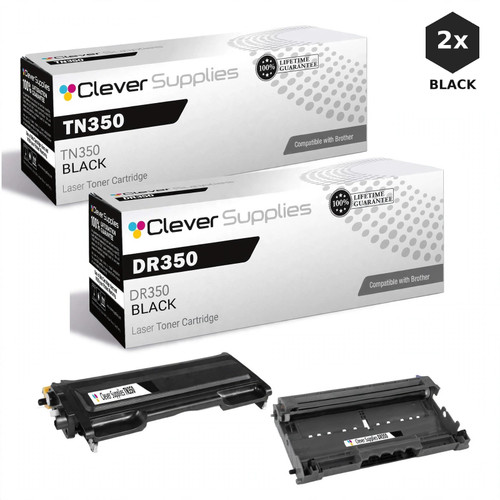
The lowest-priced new drum on this shelf, arrived at sideways: the box holds one drum and one TN350 toner, and no slice of its price belongs to either part alone, so no per-drum rate is printed for it. At $42.99 the box stops $6.01 short of the $49 free-shipping line by itself.
Shop the Set →The shelf on one table: box price, drum price, page price
Every rate below divides a box price by Brother’s ≈12,000-page rating for one drum. Where a box holds several drums, the coverage they add up to is named as a sum of separate lives — two drums in a box are two 12,000-page drums awaiting their turns, never one drum rated at twice the figure. The set’s row carries dashes where a per-drum figure would have to be invented, because this guide does not split a bundle’s price into parts it cannot measure.
| Offer | Price | Per drum unit | Cost per 1,000 pages | What arrives |
|---|---|---|---|---|
| Drum 2-pack — this page’s flagship | $50.05 | $25.03 | $2.09 | Two drums; ≈24,000 pages of combined drum life |
| Drum 4-pack | $84.03 | $21.01 | $1.75 | Four drums; ≈48,000 pages of combined drum life |
| Toner-and-drum set | $42.99 | — | — | One drum and one TN350 toner, priced as one box |
| Genuine Brother DR350 (reference) | $171.79 | $171.79 | $14.32 | One drum — the only single DR350 sold anywhere |
Read down the unit column and the shelf’s whole logic shows itself: the price of a drum steps down exactly once, between the pair and the four, while the genuine article costs nearly seven times the 2-pack’s drum. Read the flagship row first: two drums at $25.03 a unit, $2.09 for every thousand rated pages. The bundle sits outside that ladder entirely — the cheapest box on the page, yet not a drum offer so much as a drum with company.
First, a correction: the packs’ own text quotes the wrong prices
Anyone who reads the two packs’ listings before this guide meets a larger pair of numbers. The 2-pack’s description states it in so many words: “The pack is $57.56, so each drum comes to $28.78.” The 4-pack’s description answers the same question with “The pack is $96.63, which works out to $24.16 per drum.” Both statements quote the packs’ list prices as if they were the prices charged. They are not. At the register both packs ring up lower — $50.05 for the pair, $84.03 for the four — and every figure on this page is taken from those selling prices, because a comparison built on prices nobody pays compares nothing.
The 4-pack’s listing even argues with itself: a sentence added to the same answer at a later date quotes the correct $21.01-per-drum figure, so the page carries the list basis and the sale basis side by side and leaves the reader to reconcile them. Until the listings’ own text is corrected, the price shown on the product page at checkout is the one to trust.
Brother’s ten printers — the whole roster, and nothing beyond it
Brother publishes one fit list for this platform and repeats it word for word on the drum page and the toner page: the same ten models take the TN350 cartridge and the DR350 drum, with no model stranded on a different drum and no second tier hiding anywhere. Every model below links to its own category in this store.
DCP series: DCP-7020
HL series: HL-2040 · HL-2070N
IntelliFax: IntelliFax-2820 · IntelliFax-2910 · IntelliFax-2920
MFC series: MFC-7220 · MFC-7225N · MFC-7420 · MFC-7820N
Above each drum sits exactly one cartridge choice. This platform never grew a second toner tier, so the TN350 is the only cartridge these printers have ever taken, rated by Brother at approximately 2,500 pages under its own footnote — “‡Yields approx. 2,500 pages @ 5% coverage on Letter size paper.” The compatible TN350 single is the drum’s working partner, and our Best Brother TN350 Toner Cartridges guide prices the whole toner ladder gathered under the family’s TN350 code category; this page covers the drum beneath it.
The listings’ own fit lists run longer than Brother’s ten — as many as nineteen names, padded with variants Brother sells in other markets. The bundle’s fit answer errs in the opposite direction as well, dropping the MFC-7820N that Brother lists and that the bundle is in fact filed under. This guide follows the maker’s ten for every offer on the page, the MFC-7820N included.
One boundary deserves a line of its own. If the cartridge in your printer reads TN360, stop here: that cartridge and its drum belong to a different Brother family built around the HL-2140, sharing not one model with this page. The genuine listing’s own text strays across that boundary in places; Brother’s pages do not, and neither does this guide.
The bundle, taken on its own terms
It would be easy to misread the $42.99 set as a pricing trick, and it is not one. Drum changes and toner changes on these machines rarely fall due on the same day, but when both are close — a drum counter nearing its end and a cartridge fading — one box that renews the imaging path end to end is a sensible purchase, and it happens to be the cheapest box on this page. What the set is not is a drum bargain with a measurable rate: its price buys two different parts at once, and any per-drum figure carved out of it would be invented arithmetic. This guide prints the box price, says what is inside, and leaves the division undone.
Fit one caution to the bundle: bought alone it does not reach free shipping, falling $6.01 short of the $49 line, where both drum packs clear it. And its drum is the platform’s ordinary DR350 — the same unit the packs hold — so nothing about the drum itself changes with the route chosen; only the company it arrives with does. Nothing binds the two parts together, either: the set’s toner runs in any healthy DR350 drum and its drum accepts any TN350 cartridge, so the box can be split — the toner fitted today, the drum shelved against a change the counter has not yet called for.
Drum or toner? Reading what the page is telling you
On a monochrome machine the evidence prints in one color, but it still separates cleanly. Marks that repeat down the page at a steady interval, a gray wash that will not clear, or specks marching in formation point at the drum’s surface — the part that carries the image. Print that simply grows paler, evenly and without marks, is the toner running out. The display adds its own testimony: these printers count drum pages separately from toner pages, and a drum message is the machine reporting that its drum counter, not its toner gauge, has reached the end.
The platform’s arithmetic explains why the drum question arrives so much less often. At roughly 2,500 pages a cartridge and roughly 12,000 a drum, one drum images through about five toners — about 4.8 of them, if the two ratings are divided exactly — so most owners meet the drum once for every handful of cartridge changes, and some never meet it at all before the printer itself retires.
After the swap, one chore remains. The printer believes its counter, not the new surface in front of it, so the drum count has to be reset by the menu sequence Brother prints for the model; skip it and the display goes on mourning a drum that is already in the recycling. A reset without a replacement, though, only silences the report — the worn surface keeps printing its faults on schedule.
Brother’s own drum: the range’s only single, at Brother’s own price
The genuine DR350 is stocked here at $171.79, and for once the comparison needs no adjustment in either direction: Brother USA sells the same drum for $171.79, so this shelf matches the maker’s price to the cent and adds the store’s 30-day return window on top. Per thousand rated pages the genuine drum works out to $14.32, about 1.43¢ a page, against the 2-pack drum’s $2.09 per thousand and 0.21¢ — the familiar gap between a maker’s part and a compatible one, stated here without a markup story attached, because there is none.
What the genuine purchase uniquely offers on this platform is shape, not just origin: it is the only single DR350 drum sold anywhere. The owner who wants one drum, made by Brother, with nothing bundled and nothing held back as a spare, has exactly this one route. Everyone else is choosing among pairs, fours and a bundle — which is why this guide leads with a pair and treats the genuine article as the reference it is.
Chips: nearly a silent subject in this family
Four listings sell this drum, and across their descriptions the subject of chips amounts to a single passing mention buried in a boilerplate manufacturing paragraph inside the bundle’s text — neither drum pack raises it at all, and no listing carries a chip specification. That silence fits the part: a drum is an imaging surface that reports no level and empties nothing, so there is no count for electronics to keep. This guide therefore claims nothing about recognition for the DR350. The one on-record statement remains Brother’s own, from its published support answers: “Brother firmware updates do not block the use of third-party ink and toner cartridges in our machines.” Nothing is added to it here.
The cover behind every offer above
Before the cart: five checks for a DR350 purchase
Answers for owners meeting this drum for the first time
No — the compatible shelf holds pairs and fours only. One new drum reaches you either inside the $42.99 toner-and-drum set or as half of the $50.05 2-pack, with the second drum kept as a spare. The single DR350 sold on its own is Brother’s genuine drum at $171.79, covered in prose in its own section above.
You are ordering drums. Both packs are titled that way in the store and filed the same way in their specification tables, yet each box contains drum units only — their own texts answer drum questions from first to last, and their yield fields read 12,000 pages, a drum’s figure rather than a cartridge’s. This guide names them by the part inside the box.
Brother rates it at approximately 12,000 pages, with the maker’s condition attached: drum yield is approx., and may vary by type of use. Nothing more exact exists to quote — the maker publishes no laboratory-standard rating for the drum, and the toner beside it is rated under a coverage footnote instead, at 5% coverage on Letter size paper. Workload and coverage move the real figure to either side of 12,000.
The $50.05 — the figure the listing sells at, and the one charged at checkout. The $57.56 in the text is the pack’s list price, quoted there as if it were the selling price; the same habit puts $96.63 in the 4-pack’s text against its real $84.03. Every price on this page is a selling price.
No. The box holds four separate drums of approximately 12,000 pages each, fitted one at a time as each predecessor’s counter runs down. Added together they cover roughly 48,000 pages across their four lives — a sum of coverage, never a rating for any single unit in the box.
It is not. TN360 belongs to Brother’s HL-2140 family, whose drum is a different part; the printers on this page take the TN350 cartridge only, and no model appears on both rosters. If your cartridge reads TN360, shop that family’s drum instead of this one.
You can. The set is designed to be fitted together, but both parts are ordinary platform components: its toner works in any healthy DR350 drum, and its drum takes any TN350 cartridge, this set’s included or another’s. Splitting the box — cartridge in service today, drum on the shelf against the day the counter calls — costs nothing in compatibility.
The counter has not been reset. These printers judge a drum by the page count they hold against it, and that count still describes the drum you removed until the reset sequence for your model is run from the menu — Brother prints the steps for all ten machines. Reset after a genuine swap; resetting on its own, without one, only hides the warning while the old surface goes on failing.