




Ask this store what a 106R01530 is and the shelf contradicts itself twice over. Xerox’s datasheet is unambiguous: the code names the High-Capacity Print Cartridge for the WorkCentre 3550, 11,000 pages, its yield declared under ISO/IEC 19752. Yet the specification blocks on these listings file it under “Standard”, and five of the postings carded here open by calling the box a drum cartridge — for a machine Xerox built with exactly one replaceable unit, the print cartridge itself. Meanwhile the cartridge that genuinely is standard, the 5,000-page 106R01528 every 3550 carries out of the factory, is not named in a single description on the shelf. The yields, to the listings’ credit, are exact: 11,000 pages everywhere, pack totals honest. The money is not — every saving below has been recalculated at the prices checkout actually charges.
Short answer: the Black 2-Pack at $103.96 — two 11,000-page cartridges at $51.98 each instead of $60.02, a confirmed $16.08 saved against buying singles. Every box on this shelf, single included, passes the $49 free-shipping threshold by itself, and every box holds the identical high-capacity fill; the 5,000-page starter-size cartridge is not stocked here.
Start with the Black 2-Pack at $103.96. It puts 22,000 rated pages in the cupboard at $51.98 a cartridge, against $60.02 bought alone — $16.08 stays in your pocket, and one unit can sit sealed while the other works. Do not let the shelf’s vocabulary steer you: this code is the big cartridge, whatever the spec blocks say. Xerox rates 106R01530 at 11,000 pages and declares that figure under ISO/IEC 19752; the true standard cartridge is a different code, holds 5,000 pages, and is the size already inside a new machine. Nor is there a drum decision hiding anywhere in this purchase — the 3550 has no separate drum, and the drum language in five of these descriptions is stray copy, examined in detail further down. Every figure in this guide is worked out at sale prices.
A single machine wearing a wardrobe of suffixes
Everything in this family feeds one device: the WorkCentre 3550, a mono A4 multifunction machine that prints, copies, scans and faxes for a workgroup. Xerox’s datasheet puts print and copy speed at up to 33 pages per minute, the monthly duty cycle at up to 75,000 pages, and the paper supply at 550 sheets as standard, expandable to 1,050. It is a departmental workhorse, not a desktop printer.
The store hangs nine nameplates on it — 3550M, 3550T, 3550TM, 3550TS, 3550TSM, 3550X, 3550XM, 3550YX and the plain 3550. Suffixed designations are genuine Xerox practice — its datasheet lays out configuration columns headed 3550X, 3550XT and 3550XTS, and its manuals carry the model string “3550_YX” — the suffixes marking configuration and regional variants of one platform. This guide has not vouched for every letter of the store’s roster against Xerox’s regional literature, and it does not need to: the variants differ in furniture, never in the cartridge bay. Whichever suffix is stamped on your machine, the supply it swallows is the one below.
Twenty-seven listings share those five boxes unevenly: the 5-pack is posted twelve times, the single eleven, the 2-pack twice, and the 3-pack and 10-pack once each. This guide cards one posting per box — the one whose figures were audited — and leaves the rest unlinked.
The tier ladder, read the way Xerox printed it
The supplies page of Xerox’s WorkCentre 3550 datasheet (document W3BBR-01EB) lists two print cartridges for this machine, and this store stocks only the larger of them:
| Part number | What Xerox calls it | Rated yield | Sold as |
|---|---|---|---|
| 106R01530 | High-Capacity Print Cartridge | 11,000 pages · ISO/IEC 19752 declared | Single · 2-pack · 3-pack · 5-pack · 10-pack |
| 106R01528 | Standard-Capacity Print Cartridge | 5,000 pages | Not sold here — the in-box starter size |
| 106R01529 / 106R01531 | No Xerox assignment found | Unverified — third-party groupings only | Not sold here |
| 106R01533 | Phaser 4600 family — Standard Toner Cartridge | 13,000 pages · ISO/IEC 19752 declared | A different platform — does not fit |
| 106R01535 | Phaser 4600 family — High Capacity Toner Cartridge | 30,000 pages · ISO/IEC 19752 declared | A different platform — does not fit |
| — | Separate drum or imaging cartridge | None exists for this platform | The print cartridge is all-in-one |
The datasheet’s own words for the pair are “Standard-Capacity Print Cartridge*: 5,000 std. pages” against “High-Capacity Print Cartridge*: 11,000 std. pages”, under a footnote that reads: “* Average standard pages. Declared Yield in accordance with ISO/IEC 19752. Yield will vary based on image, area coverage and print mode.” The packing list settles which tier a new owner meets first: the box contents include a “Print Cartridge (5,000 print capacity*)” — the machine is born holding the standard size, and the 106R01530 more than doubles its range. Xerox’s January 2016 US price list, the last dated list this discontinued platform appears on, priced the genuine cartridges at $134.99 for the 106R01528 and $199.99 for the 106R01530.
Two neighbouring codes deserve a fence rather than a row of their own. Nothing in Xerox’s documentation assigns 106R01529 or 106R01531 to this machine; they circulate only in third-party compatible groupings, so this guide treats them as unverified and moves on. The pair below them is real but foreign: 106R01533 and 106R01535 are the Phaser 4600 family’s cartridges — 13,000 and 30,000 pages respectively, ISO-declared in Xerox’s Phaser 4622 brochure — built for a different platform with a different bay. They will not fit a WorkCentre 3550.
Finally, the replaceable-parts question, because the next section turns on it. Xerox’s WorkCentre 3550 Quick Use Guide states it flatly: “There is one Customer Replaceable Unit in the machine, the Print Cartridge.” One unit. The toner cartridge is an all-in-one design, so there is no drum on the parts list and no imaging kit. Keep that sentence in mind when the listings start talking about drums.
Drum copy on a machine with no drum — and a tier label flipped
The strangest text in this family sits at the top of all five carded listings, and readers of the Phaser 3635MFP shelf in this guide series have met it before: the same drum-cartridge boilerplate, pasted onto toner listings a second time. Each of the five opens by inviting you to “Purchase the Clever Supplies Compatible for Xerox 3550 (106R01530) Black Drum Cartridge and experience the difference!”, promises parts “including OPC drums, wiper blades, a smart chip and other internal parts”, and hangs its warranty on wording “for all Drum products” — the word “drum” recurring roughly ten times per listing, pack variants included (“2 Black Drum Cartridge”, “10 Black Drum Cartridge”). Against the Quick Use Guide’s one-CRU sentence, none of it describes this supply: the 3550’s print cartridge is an all-in-one toner unit, and Xerox sells no drum for the platform in any form. Read further down the same listings and the copy corrects itself — their FAQ and About sections talk about toner accurately; only the pasted opening block belongs to another product. This guide cards the boxes as what they are sold as: the 11,000-page print cartridge their names, prices and ratings describe.
Two claims live only inside that block and nowhere else in the family: the family’s sole mention of a chip, buried in the drum-parts sentence quoted above, and a country-of-origin banner that opens all five listings. The other twenty-two descriptions contain neither. Both are therefore reported here strictly as evidence of the paste, and neither is adopted as this guide’s own statement — text written about a different part cannot vouch for this one.
The quieter defect does more practical damage, because it survives a careful reading. The specification blocks on the older and model-named series file this cartridge under “Cartridge Yield Type: Standard”. Xerox’s datasheet assigns that word to the other cartridge — the 5,000-page 106R01528 — and calls the 106R01530 the platform’s High-Capacity cartridge. A buyer who trusts the spec field and goes shopping for the “bigger” tier will walk straight past the biggest cartridge this machine takes, and a buyer whose 3550 still holds its factory cartridge finds 106R01528 mentioned in none of the family’s twenty-eight descriptions — nothing tells them the unit in their machine may be the 5,000-page size the refill more than doubles. The tier ladder in the section above is the datasheet’s, and it is the one this guide uses.
Then the arithmetic, which follows the pattern this series keeps finding: the copy does its sums at base prices, a step above the sale prices at the till. The single’s text prices it at $69.02 and concludes it works out to “roughly 0.63 cents per page”; at the $60.02 actually charged, the rate is about 0.55¢. The 2-Pack’s copy sets two singles at $138.04 against its $119.55 and announces “you save $18.49”, at a claimed 0.54¢ a page; checkout charges $103.96, the saving is $16.08 and the rate 0.47¢. The 3-Pack is introduced at $170.10 — “$56.70 per cartridge”, three singles at $207.06, a saving of $36.96, about 0.52 cents a page; at sale it is $147.91, $49.30 a cartridge, $32.15 saved, 0.45¢. The 5-Pack’s copy works from $271.16, “roughly $54.23 per cartridge”, five singles at $345.10 and a saving of $73.94 at about 0.49 cents; the charged figures are $235.79, $47.16, $64.31 and 0.43¢. And the 10-Pack is priced in its copy at $523.84, “about $52.38 per cartridge”, against ten singles totalling $690.20 for a saving of $166.36 at roughly 0.48 cents; at sale the pack is $455.51, the cartridge $45.55, the saving $144.69 and the rate 0.41¢. Every figure in this guide is therefore recomputed from the sale price.
Set against that, the yields are beyond reproach. All twenty-seven listings rate the cartridge at 11,000 pages — Xerox’s declared figure — and every pack total in the copy is the honest multiple: 22,000, 33,000, 55,000, 110,000. No padded rating, no shrunken fill, no starter-size cartridge hiding under the high-capacity code. On the one number a buyer cannot verify without printing eleven thousand pages, this family is clean.
Two closing notes. The 5-pack also appears in a “Premium Quality” costume, and its own FAQ declines to dress it up: the five-pack “is priced at $271.16, exactly the same as our standard 106R01530 five-pack, and the cartridges carry the same yield rating and the same warranty. Whichever listing you order from, you are buying the same cartridge at the same price — there is no hidden upgrade and no hidden difference.” Same box; it is carded once here, under the CS-series posting. And the stock figures on the cards below are real counts with a visible formula: one pool of 31 divided by pack size — 31 singles, 15 two-packs, 10 three-packs, 6 five-packs, 3 ten-packs — identical across every series, with nothing at zero. Feed-side, the picture is nearly complete: a UPC is present on all twenty-eight listings, while MPN and GTIN stand empty on every one. That is catalog housekeeping, recorded here and left to it.
The whole shelf: five boxes behind twenty-seven listings
Strip away the duplicate postings and twenty-seven listings collapse into the five cartons tabulated here — five quantities of one cartridge, nothing more. Buy through the posting carded for each size; the duplicates behind it ask identical money for identical contents. All prices are the sale prices in force in November 2026, and all yields are Xerox’s declared ratings.
| Box | What’s inside | Sale price | Per cartridge | Cost per rated page | Ships free alone? |
|---|---|---|---|---|---|
| Black 2-Pack | 2 × 10⁶R01530 high-capacity | $103.96 | $51.98 | ≈0.47¢ | Yes |
| Single | 1 × 10⁶R01530 | $60.02 | $60.02 | ≈0.55¢ | Yes |
| 3-Pack | 3 × 10⁶R01530 high-capacity | $147.91 | $49.30 | ≈0.45¢ | Yes |
| 5-Pack | 5 × 10⁶R01530 high-capacity | $235.79 | $47.16 | ≈0.43¢ | Yes |
| 10-Pack | 10 × 106R01530 high-capacity | $455.51 | $45.55 | ≈0.41¢ | Yes |
Cost per page is the sale price spread over the declared rating, and since only one fill is sold here, the divisor is 11,000 pages throughout. Note the final column before the prices: postage never enters the decision, because even the lone single at $60.02 stands $11.02 clear of the $49 free-shipping line. Pack size is therefore purely a matter of unit price and how often you care to reorder.
Five boxes, each on its own arithmetic
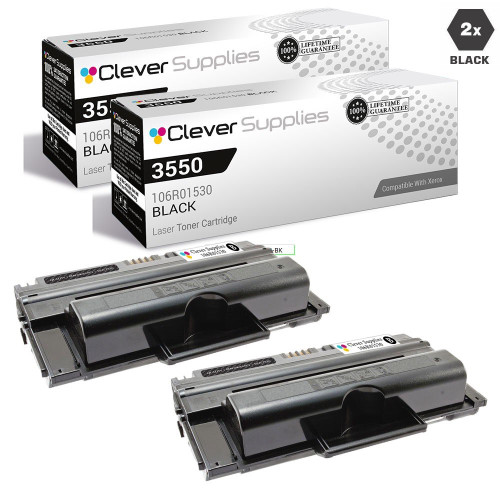
The default order for a shared 3550: the machine prints for a whole workgroup, so its empty moment lands on somebody’s deadline, and the pair’s shape — one cartridge in the bay, one waiting sealed — is the cheapest insurance against it. The listing’s own introduction prices the pair at $119.55 and keeps $18.49 against two singles; those are base-tier numbers. At the $103.96 checkout charges, the cartridge is $51.98 and the verified saving is $16.08. Its description is one of the five that open with the drum text dissected above — the box is the print cartridge its name and price describe.
See the Black 2-Pack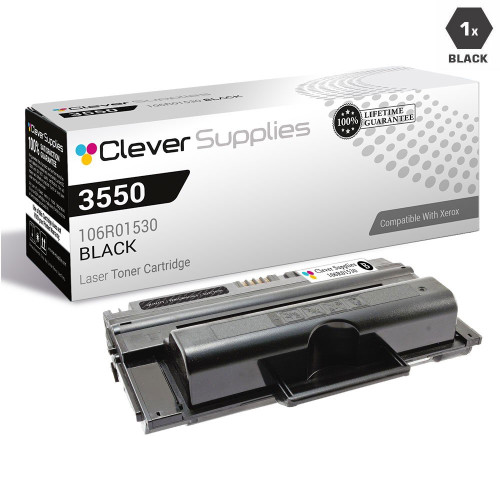
For a lightly used machine with an owner who actually watches the toner gauge, one cartridge at a time is the rational order. The listing prices it at $69.02 and works that out to roughly 0.63 cents a page; the till charges $60.02, which brings the true rate to about 0.55¢. Its description also carries the pasted drum block in its fullest form — OPC drums, wiper blades and all — pinned to a listing whose name, price and rating are the toner cartridge’s own. Shipping, at least, needs no partner item: the single clears the $49 line by $11.02 on its own.
See the single cartridge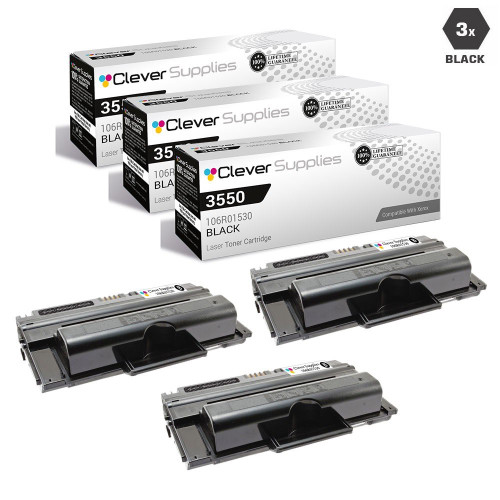
A quarter’s supply for a machine turning out a few thousand pages a month, and a box that exists only in this series — no older or model-named 3-pack was ever posted. The listing’s arithmetic sets three singles at $207.06 and keeps $36.96 against its $170.10 — base prices again. At the $147.91 charged, the singles total $180.06, the cartridge is $49.30, and the verified saving is $32.15.
See the 3-Pack
Fifty-five thousand rated pages in one carton — the family’s most-posted box, wearing twelve listings including a “Premium Quality” twin whose own FAQ concedes there is “no hidden upgrade and no hidden difference”. The posting carded here is the plain CS-series one. Its description reckons at base — $54.23 a cartridge, $73.94 saved, about 0.49 cents a page; at the $235.79 charged, the figures are $47.16, $64.31 and 0.43¢.
See the 5-Pack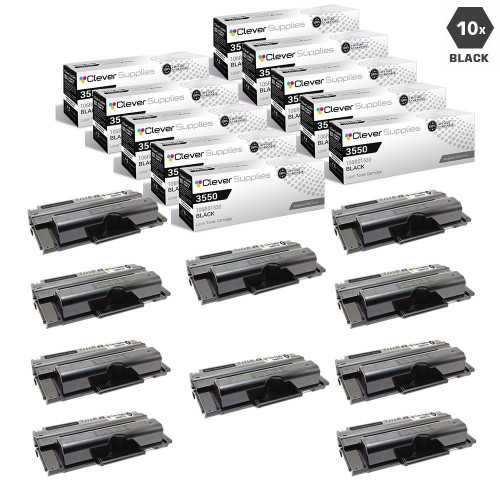
The departmental order: 110,000 rated pages — past a year’s supply even at eight thousand pages a month. Its copy prices the ten at $523.84, $52.38 a cartridge, a saving of $166.36 at roughly 0.48 cents a page — every figure at base. At the $455.51 charged: $45.55 a cartridge, $144.69 kept against ten singles, 0.41¢ a page. Like the 3-pack, it exists only in this series.
See the 10-PackChoosing among the five: volume decides, not postage
With one cartridge design in five quantities and free shipping attached to every quantity, the choice narrows to appetite and habit: how much the machine prints in a month, and how much attention anyone wants to pay toner the rest of the year. The savings for buying deep are modest — $14.47 separates the dearest cartridge from the cheapest, and the page rate drifts only from 0.55¢ to 0.41¢ — so the realistic error is not overpaying. It is mistiming: shelves bare when a shared machine runs dry, or fresh cartridges ageing beside one that prints a few hundred pages a month.
Light use first: a few hundred pages a month, essentially one person’s machine. Here the single suffices and the 2-Pack is a luxury of not thinking — at 1,000 pages a month a single cartridge runs close to eleven months, so the pair stretches across nearly two years with the second unit still sealed. Seasonal offices, quiet for months then frantic for a fortnight, belong in this bracket too; the sealed spare swallows the surge and the reorder can be left until the calm returns.
In the middle band — a true workgroup machine printing one to three thousand pages a month — make the 2-Pack the standing order, and step up to the 3-Pack if reordering keeps slipping everyone’s mind. A cartridge lasts somewhere between four and eleven months at that pace, and when a shared MFP stops, it stops the whole room’s copying as well as its printing, invariably mid-morning. One cartridge in the bay and one sealed next to the machine is the entire strategy.
Past five thousand pages a month, buy in bulk and stop thinking monthly. A cartridge is gone in about six weeks at 7,500 pages a month, which makes the 5-Pack roughly half a year’s cover and the 10-Pack a full year and more — at $45.55 a cartridge, the shelf’s floor price, with a single order raised instead of ten. Whatever the size, buy it through the carded postings: twenty-seven titles across the catalog resolve to these five boxes, and the postings above are the ones every figure was checked against.
Day to day: living with a shared 3550
On a multifunction machine the toner meter runs for copies just as it runs for prints — the engine draws from the same cartridge either way — while scans and outgoing faxes consume nothing. So keep a log: note the page counter on the carton the day a cartridge goes in, and again the day it comes out. The gap between the two numbers is your office’s real yield at your real coverage, and after two or three changes it forecasts the next order date within a week or so.
Calibrate your expectations to the tier change. On the machine’s first refill, the cartridge coming out is the 5,000-page starter size and the one going in is rated at more than double that — a first refill that seems to last forever is the datasheet working as printed, not a pleasant anomaly. From the second refill onward, cartridge life settles into a steady rhythm; a sudden shortening points to a coverage change, not a cartridge fault.
Know the end-of-life signal when it appears: print that fades down one side of the page. That one-sided fade is the classic symptom of a cartridge running dry. Pull the unit out, rock it gently from side to side to level the remaining powder, and you will generally coax out a few dozen more presentable pages — enough to close the job in hand, never a reason to cancel the reorder. Once the fade is back within days, fit the spare and bag the spent cartridge for recycling so its last dust travels with it.
What stands behind the five boxes
Behind every box carded here stands the same Clever Supplies compatible for the WorkCentre 3550, and the same terms: a one-year warranty, one-year free returns, weekday support between 9 AM and 5 PM CST, and dispatch out of four warehouses — Illinois, Pennsylvania, Georgia and California. Shipping is free from $49 upward, and this is a shelf where the threshold never needs help: the smallest box clears it alone by $11.02.
Running a WorkCentre 3550 without surprises
Questions buyers ask about this family
Drum cartridge or toner cartridge — which is it?
A toner cartridge — Xerox calls it the High-Capacity Print Cartridge, and it is an all-in-one unit. The confusion is understandable: all five postings carded here open with text that calls the box a “Black Drum Cartridge” and promises OPC drums and wiper blades, because their introductions were pasted from a drum listing and never rewritten. Xerox’s Quick Use Guide for this machine names exactly one owner-replaceable unit — the Print Cartridge — and Xerox sells no drum part for the platform. What arrives is the 11,000-page print cartridge the listing’s name, price and rating describe.
Is the 106R01530 the standard cartridge or the high-capacity one?
The high-capacity one — 11,000 pages, declared under ISO/IEC 19752 in Xerox’s datasheet for the machine. The confusion comes from the store’s own specification blocks, which file this code under “Cartridge Yield Type: Standard”. Xerox assigns the word Standard to a different cartridge: the 106R01528, rated at 5,000 pages, which is also the size that ships inside the machine from the factory. This store does not sell the 106R01528, and none of its descriptions mention it — so on this shelf, the cartridge labelled “Standard” is the largest one the machine takes.
Why did my machine’s first cartridge run out so much sooner?
Because it was a smaller cartridge. Every WorkCentre 3550 leaves the factory holding a print cartridge of 5,000-page capacity — the standard tier’s fill — while every refill sold on this shelf holds 11,000 pages. The first cartridge therefore covers well under half the ground of any refill that follows it. Nothing is wrong with the machine; the two tiers are simply different sizes, and the store’s silence about the smaller code is the only reason the difference surprises anyone.
Will a Phaser 4600 cartridge fit my WorkCentre 3550?
No. The codes 106R01533 (13,000 pages) and 106R01535 (30,000 pages) sit numerically close to this family’s code, but they belong to a different platform: Xerox’s Phaser 4622 brochure lists them as the Phaser 4600 family’s standard and high-capacity cartridges. The 4600-series bay is not the 3550’s bay, the cartridges are not interchangeable, and no listing in either family claims otherwise. For a WorkCentre 3550, the codes that matter are 106R01528 (standard, not sold here) and 106R01530 (high-capacity, this guide’s shelf).
Does “Premium Quality” make the 5-pack any different?
No, and unusually, you do not have to take this guide’s word for it. The Premium posting’s own FAQ states that its five-pack is priced “exactly the same as our standard 106R01530 five-pack, and the cartridges carry the same yield rating and the same warranty”, concluding: “there is no hidden upgrade and no hidden difference.” Same five cartridges, same 55,000-page rating, same $235.79 at sale. This guide cards the plain CS-series posting once; buying either door delivers the same cartridges.
How long will one cartridge last me?
Count prints and copies together — both draw toner at the same rate — and leave scans and faxes out of the sum, since they use none. At 1,000 pages a month, expect a cartridge to serve about eleven months. At 3,000 a month, plan on roughly three and two-thirds months per cartridge, which puts a 3-Pack within sight of a full year. At 7,500 a month the turnover drops to around six weeks, and a 10-Pack carries that pace beyond the year mark. Treat these as planning figures: they rest on declared yields at standard coverage, and an office heavy on copies will run through cartridges faster than one heavy on correspondence.
How this guide was put together
This guide rests on two bodies of evidence: the store’s own listings, and Xerox’s documentation — above all the WorkCentre 3550 datasheet (W3BBR-01EB), which fixes the two-tier map and carries the ISO/IEC 19752 declaration; the Quick Use Guide, whose statement on replaceable units settles the drum question; and the Phaser 4622 brochure (X_27974_462BR-02EB), which keeps the neighbouring 4600-family codes on their own side of the fence. Twenty-seven store products carry this code, and they reduce to five physical boxes; each is carded once, under the posting whose figures were verified, and the duplicate postings are neither linked nor counted. Prices throughout are November 2026 sale prices, and because the listings reckon from a higher base tier, every saving, per-cartridge figure and cost per page has been recalculated from the charged prices. Two provenances are stated openly. First: the introductions on all five carded listings were written for a drum cartridge and pasted onto these toner listings, so the boxes are carded by their names, prices and page ratings, with the pasted text reported as evidence rather than adopted — that block is also the family’s sole source for a chip mention and for a country-of-origin banner, and this guide repeats neither as a claim of its own. Second, an inconsistency on Xerox’s own side is noted rather than silently resolved: the datasheet’s Quick Facts say up to 33 pages per minute, a specification table in the manual says 35, and this guide follows the datasheet. The machine is presented as one platform: Xerox’s literature confirms suffixed configuration designations, but the store’s full nameplate roster was not verified letter by letter against regional literature, and nothing in this guide hangs on a single suffix. Genuine prices appear only from Xerox’s January 2016 US list, dated wherever quoted, since no current Xerox price exists for this discontinued platform. Stock and availability are as read in November 2026.