




Begin with the Black 2-Pack at $142.05. It banks 50,000 rated pages at $71.03 a cartridge, holds $16.07 against two singles, and ships free unaided — as, in fact, does every box on this shelf. The cartridge itself needs no yield detective work: Xerox rates it at 25,000 pages and declares that yield in accordance with ISO/IEC 19752, and all twenty listings repeat the figure faithfully, pack multiples included. The corrections this guide does make are the money — the listings’ savings are struck from base prices, so each is recomputed at sale below — and the roster, because the store’s fit lists mix genuine Xerox configurations with nameplates Xerox never built. One cartridge, one code, seven real machines: the sections that follow separate them.
Seven real configurations, and the nameplates Xerox never built
Everything in this family feeds one platform sold under two speeds: the WorkCentre 4250 and its faster sibling, the WorkCentre 4260. They are mono multifunction machines built for departmental volumes: the 4250 prints at up to 45 pages a minute on Letter and carries a duty cycle rated up to 200,000 pages a month; the 4260 raises those to 55 pages a minute and 250,000 a month. Both hold 256 MB of memory as standard (512 MB at most), an 80 GB hard drive, a 100-sheet duplex document feeder, and paper input that starts at 600 sheets — a 100-sheet bypass over a 500-sheet tray. Print resolution is 600 × 600 dpi, with a 1200 × 1200 enhanced image-quality mode. Xerox’s brochure states no recommended monthly volume for either model, so none is printed here.
Xerox’s configurations table names exactly seven machines. The suffix-less 4250 is a copier-only configuration: automatic two-sided copying, 600 sheets of input, a direct USB connection, and no print function in Xerox’s own table. The S tier — 4250S and 4260S — is where printing arrives, with automatic two-sided copy, print and scan, and color scanning to email, network folders and USB drives. The X tier — 4250X and 4260X — adds an embedded fax and LAN fax to the S specification. The XF tier — 4250XF and 4260XF — adds a finisher with 50-sheet stapling and high-capacity input: 2,100 sheets on the 4250XF, 3,100 on the 4260XF. Read the ladder as S for networked scan-and-print, X for fax on top, XF for finishing and feeder capacity on top of that. Note the asymmetry: there is no suffix-less 4260 — the faster line starts at S.
Against those seven, the store’s listings circulate a crowd of further badges: 4250SM, 4250XFM, 4250XM, 4260SM and 4260XM, plus 4250C and 4250CM on their own listings elsewhere in the catalogue. None of them appears in Xerox’s brochure, its configurations table or its price list. The letter M, which several of them lean on, denotes nothing anywhere in Xerox’s line for this platform. These are store-invented nameplates, not regional variants and not decoded here letter by letter — but the practical point matters more than the taxonomy: every one of those listings sells this same cartridge, and the bay it loads into is identical across the whole platform, real badges and invented ones alike.
Counted by box, the family’s twenty postings split lopsidedly: eight singles and nine 5-packs — mostly model-named pairs, one per badge — against one posting each for the 2-pack, 3-pack and 4-pack. Each box is carded once in what follows, under the posting that was audited end to end; the rest are not linked.
A ladder with one rung: the cartridge, its metered twin, and the drum behind it
Most families in this program climb a ladder of capacities. This one has a single rung. Xerox’s documents for the platform — the WorkCentre 4250/4260 brochure, document W60BR-01UH, and the Commercial Price List effective April 1, 2015 — support exactly one stocked cartridge, one contract-only variant, and one longer-lived drum:
| Part number | What Xerox calls it | Rated yield | Yield basis | Sold as |
|---|---|---|---|---|
| 106R01409 | WC 4250 / 4260 Black Toner | 25,000 pages | ISO/IEC 19752 | Single · 2-pack · 3-pack · 4-pack · 5-pack |
| 106R01408 | WC 4250 / 4260 Black Toner (Metered Only) | 25,000 pages | ISO/IEC 19752 | Not sold here — metered contract channel |
| 113R00755 | Drum Cartridge | ≈80,000 pages | — | Not sold here — context only |
The ISO position is documented twice. The brochure’s supplies table lists the cartridge at approximately 25,000 pages under a footnote that reads, verbatim: “Average standard pages. Declared Yield in accordance with ISO/IEC 19752. Yield will vary based on image, area coverage and media used.” The April 1, 2015 price list repeats the pairing — 106R01409, 25,000, ISO/IEC 19752 — in its own yield-standard column. The metered sibling sits under the same standard in that list’s metered section, also at 25,000 pages: it is the same yield wearing a contract badge, a fence rather than a rung, and no listing in this store sells it. Genuine pricing is quotable for this family, with its date attached: on that 2015 list the 106R01409 carried a genuine price of $174.99. Xerox assigns the cartridge no tier name of its own; the “Standard” in the listings’ spec blocks is store wording.
What arrives inside a new machine is settled by the brochure’s box list, which names a toner cartridge of 12,000 print capacity under the same ISO footnote — a reduced starter this time, not a full one. Every refill on this shelf therefore more than doubles the range the machine started with: 25,000 pages in place of 12,000. If the factory cartridge seemed to give up early, that is the arithmetic of the two ratings, nothing more.
Unlike some platforms in this series, this one does keep a second consumable behind the toner. A separate drum cartridge, the 113R00755, is rated at approximately 80,000 pages — roughly every third toner cartridge — and it ships inside the box alongside the starter toner. A TAA variant of the drum exists for government accounts, and Xerox also lists a maintenance kit rated at 200,000 pages. This store sells none of the three, so they appear here as platform context only: no box below contains a drum, and nothing in this guide links to one. On the 2015 list, the drum’s genuine price was $459.99.
One boundary deserves stating plainly. Because a single code serves both machine lines, a cartridge bought for a 4250 is a cartridge bought for a 4260 — Xerox itself sells it under the joint name “WC 4250 / 4260 Black Toner”. Sites running both speeds can hold one shared stock, which is exactly what several of the listings’ own answers describe.
True yields, invented nameplates, and arithmetic done at the wrong price
Begin with what this shelf gets right, because it is a long list. Every listing rates the cartridge at 25,000 pages — Xerox’s figure, unaltered — and the pack totals multiply out honestly: 50,000, 75,000, 100,000, 125,000. Across all thirty-eight platform descriptions swept for this guide there is no drum language pasted onto toner pages, even though a genuine drum exists for these machines; no chip claim of any kind; and no MICR variant anywhere. One framing fault runs the other way from the usual one: the copy describes the rating as “25,000 pages at 5% coverage”, the language of a rough estimate, and never mentions ISO at all — where Xerox’s own documents declare the yield under ISO/IEC 19752. This guide goes with Xerox. And no listing mentions the 12,000-page starter, which the codes section above restores from the brochure.
The money, though, is worked throughout at base prices a step above the till. The single’s copy prices the cartridge at $90.92, “roughly 0.36 cents per page”, and points down the shelf to a 3-pack at “$78.60 per cartridge” and a floor of “$76.13” — at the $79.06 charged, the rate is about 0.32¢, the 3-pack’s cartridge $68.35 and the floor $66.20. The 2-Pack runs: “Two singles bought separately cost $181.84. The 2-pack is $163.36, so pairing them saves $18.48”, at “$81.68” a cartridge and “roughly 0.33 cents per page” — checkout charges $142.05, making the saving $16.07, the cartridge $71.03 and the rate 0.28¢. The 3-Pack claims “$78.60 per cartridge, against $90.92 for the single — a saving of $36.96”; at sale the figures are $68.35 and $32.14. The 4-Pack: “Four singles total $363.68; this box is $308.22, a saving of $55.46”, at “$77.06” a cartridge and “around 0.31 cents” — charged, it is $268.02, the saving $48.22, the cartridge $67.01, the rate 0.27¢. And the 5-Pack: “Five single cartridges would cost $454.60. This box is $380.66, so you keep $73.94”, at “$76.13 per cartridge” — at sale, $331.01 charged, $64.29 kept, $66.20 a cartridge, 0.26¢ a page. That is why every figure in this guide starts again from the sale price.
The fit lists cannot agree with each other, let alone with Xerox. One spec block reads “WorkCentre: 4250 4250C 4250S 4250X 4260 4260S 4260X 4260XM” — eight badges that omit the 4250XF and 4260XF, which carry their own listings, while including two nameplates Xerox never made. The single’s FAQ list adds the XF machines back yet still drops every M-variant and the 4250CM. The CS listings’ header line names a third set again, XF machines included, M-variants gone. No two templates describe the same platform, and none of them reproduces Xerox’s seven-configuration roster set out above. The cartridge fits all of them regardless — but a buyer matching a badge letter by letter deserves the true list, and it is the one printed in the roster section.
The 5-Pack also carries a “Premium Quality” twin, and the twin’s own text gives the game away — it states the price is “the same as our standard 106R01409 5-pack”, with “no premium surcharge attached” — so the box is carded once, under the standard posting; the twin even repeats the same base-price sums, $73.94 included. The stock figures on the cards are formulaic — a single pool of nine split by pack size: nine singles, four 2-packs, three 3-packs, two 4-packs, a single 5-pack, nothing at zero. MPN and GTIN fields are empty on all twenty listings, and UPCs are missing from the two CS postings while present on the other eighteen. Noted for the record; nothing altered.
The whole shelf: five boxes behind twenty listings
Strip out the duplicate postings and twenty listings shrink to five cartons — five quantities of the platform’s one cartridge. Order through the carded posting for the quantity you want; the duplicates behind each box ask the same money for the same contents. The figures are November 2026 sale prices, and the yields are Xerox’s ISO/IEC 19752 declared ratings.
| Box | Contents | Price charged | Each cartridge | Per rated page | Free shipping on its own? |
|---|---|---|---|---|---|
| Black 2-Pack | 2 × 10⁶R01409 | $142.05 | $71.03 | ≈0.28¢ | Yes |
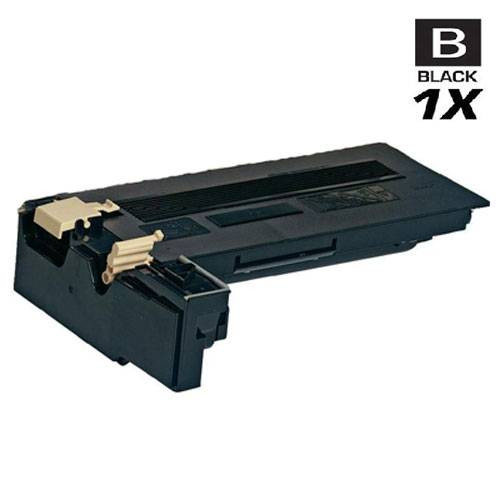
| Single | 1 × 10⁶R01409 | $79.06 | $79.06 | ≈0.32¢ | Yes |
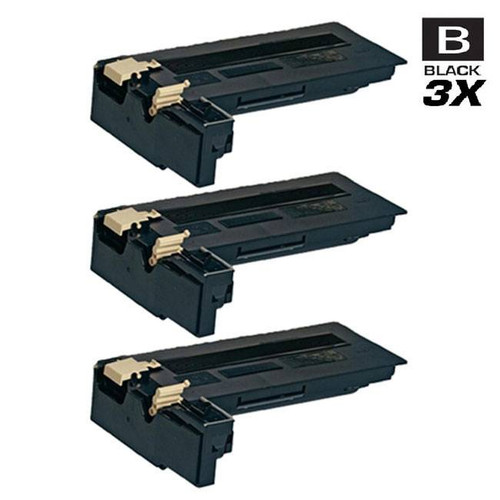
| 3-Pack | 3 × 10⁶R01409 | $205.04 | $68.35 | ≈0.27¢ | Yes |
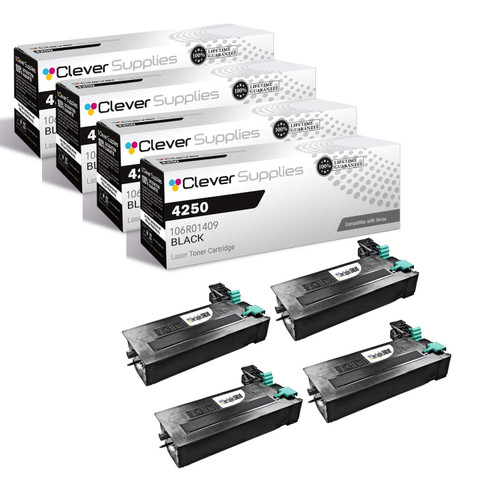
| 4-Pack | 4 × 10⁶R01409 | $268.02 | $67.01 | ≈0.27¢ | Yes |
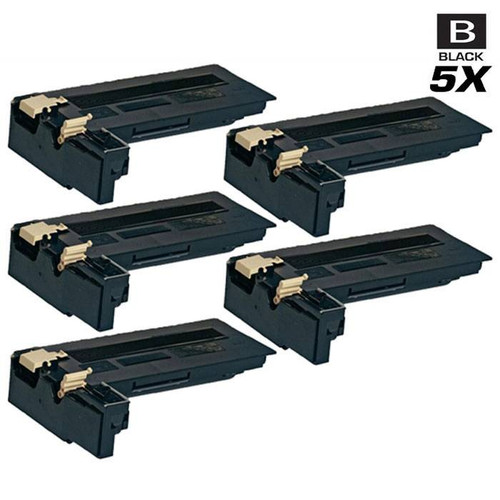
| 5-Pack | 5 × 10⁶R01409 | $331.01 | $66.20 | ≈0.26¢ | Yes |
The per-page column divides each price charged by the pages in the box, at 25,000 pages per cartridge. Shipping separates nothing here: even the single, the cheapest carton, passes the $49 free-shipping threshold by $30.06 unaided. What remains is a stocking decision — how many cartridges to keep beside the machines. The 5-Pack’s $66.20 is the lowest per-cartridge figure on the shelf; the 3-Pack and 4-Pack share a page rate, a cent apart per cartridge.
Five boxes, each with its own arithmetic

Five sizes of one cartridge: how deep to stock
With one cartridge sold five ways, the only real decision is stocking depth. Postage cannot tilt it — the cheapest box, at $79.06, already ships free by itself — and the price slope is shallow: $12.86 between the dearest and cheapest cartridge, a page rate easing from 0.32¢ to 0.26¢. What the pack sizes actually trade in is time between orders, on machines rated for up to 200,000 or 250,000 pages a month.
At departmental volumes these cartridges turn over faster than their size suggests. Five thousand pages a month empties one in five months; twenty thousand a month empties one in five weeks. A single machine on light duty is honestly served by the single or the 2-Pack — the pair’s sealed spare is the real product, converting a toner-out stoppage into a two-minute swap. Busier single machines, and any site where reordering is nobody’s named job, belong on the 3-Pack: a working cartridge, a reserve, and one behind it.
Buy deepest where several machines share the code. The 4-Pack banks 100,000 rated pages and the 5-Pack 125,000, at per-cartridge figures of $67.01 and $66.20 — the 5-Pack is the floor, and the 4-Pack all but matches its page rate, so between them the difference is one cartridge of depth. A mixed fleet of 4250s and 4260s draws on the same shelf either way, which is this platform’s quiet economy. Whichever quantity you land on, order it through one of the five carded postings above: all twenty catalogue titles resolve to these same five boxes, and the carded postings are the ones every figure in this guide was checked against.
Day to day: long cycles, and a second clock behind the toner
Turn reordering into arithmetic instead of intuition. Note the machine’s page counter on the carton when a cartridge goes in, and again when it comes out. After two or three changes you will know the yield your own documents actually deliver — forms with shaded boxes, dense tables and graphics-heavy reports all consume more than the standard coverage behind the rating, a point the listings make themselves. Until that log exists, plan on the declared 25,000.
Do not calibrate your expectations on the first cartridge. It holds 12,000 pages; every refill on this shelf holds 25,000, so the second cartridge will seem to last roughly twice as long as the first. Neither unit is misbehaving — the two ratings are simply different. From the second refill onward, consumption settles into the even cycles the pack sizes above are planned around.
This platform does run a second clock. The drum cartridge behind the toner is rated at roughly 80,000 pages — about every third cartridge change — and it arrives inside the box with a new machine, so most owners meet its first replacement years in. This store does not sell the drum, and no toner box here contains one; when its warning eventually appears, the part to look for is the 113R00755. Keep the spent toner until the replacement has printed cleanly for a few days, gather empties at one marked collection point rather than in cupboards, and store spares sealed, flat and out of sunlight.
What stands behind the five boxes
All five boxes hold the same Clever Supplies compatible cartridge for the WorkCentre 4250 and 4260, and the terms do not change with the size: a one-year warranty, free returns for a year, weekday support between 9 AM and 5 PM CST, and dispatch from the nearest of four warehouses — Illinois, Pennsylvania, Georgia or California. Shipping is free on orders of $49 or more, and the least expensive box here is $79.06, so all five sizes qualify on their own.
Running a WorkCentre 4250 or 4260 without surprises
Questions buyers ask about the 106R01409
Which cartridge does my WorkCentre 4250 or 4260 take?
One cartridge serves the entire platform: the 106R01409, rated 25,000 pages. Xerox sells it under the joint name “WC 4250 / 4260 Black Toner”, and it fits all seven genuine configurations — 4250, 4250S, 4250X and 4250XF, and 4260S, 4260X and 4260XF — as well as the machines the store badges SM, XFM, XM, C or CM. There is no second toner code to choose between and no capacity tier above or below it; the only other code Xerox lists, 106R01408, is a metered contract variant at the same yield that this store does not sell. The surest identification is the code printed on the cartridge you pull out.
Is the 25,000-page yield actually ISO-declared?
Yes. The supplies footnote in Xerox’s WorkCentre 4250/4260 brochure (document W60BR-01UH) reads “Declared Yield in accordance with ISO/IEC 19752”, and Xerox’s Commercial Price List effective April 1, 2015 prints ISO/IEC 19752 in the yield-standard column against this code. The store’s listings describe the same rating as “25,000 pages at 5% coverage” and never mention the standard — language that undersells the documentation behind the figure. The declaration belongs to Xerox; this guide simply reports it.
What are the 4250SM, 4250XFM, 4250XM and 4250CM?
Store nameplates, not Xerox configurations. Xerox’s brochure and price list name seven machines for this platform — 4250, 4250S, 4250X, 4250XF, 4260S, 4260X and 4260XF — where S marks the networked scan-and-print tier, X adds embedded fax, and XF adds a finisher and high-capacity input. The letter M denotes nothing in Xerox’s line, and the C and CM badges appear in no Xerox document either. None of this affects a purchase: the listings under those badges sell this same cartridge, and the bay is common to the whole platform.
Is there a drum cartridge to replace separately?
Yes — this platform does have one. The drum cartridge, part 113R00755, is rated at approximately 80,000 pages, and a new machine arrives with one already fitted alongside its starter toner. This store does not sell the drum, and no toner box carded above contains one, so it is named here purely so its warning, when it eventually comes, is not a surprise. On Xerox’s April 1, 2015 list its genuine price was $459.99. A TAA variant exists for government accounts; it is not sold here either.
Why did my first cartridge run out sooner than the refill?
Because the first cartridge was a smaller one. Xerox’s brochure lists the in-box toner at 12,000 print capacity, while every refill sold here is the full 25,000-page cartridge — so the second cartridge should last a little more than twice as long as the first, at the same coverage. Judge the platform’s rhythm from the second cartridge onward. Heavy forms and graphics work will still pull any cartridge’s real yield below its rating; logging the machine’s page count at each change turns that from a guess into a number.
Is the “Premium Quality” 5-pack any different?
No — and unusually, the listing itself says so: its copy explains that the price is “the same as our standard 106R01409 5-pack” and that no difference was invented to justify the label, with “no premium surcharge attached”. One footnote: the $380.66 in that answer is a base price — at sale, both postings charge $331.01. The card above uses the standard posting; the twin is not linked.
How this guide was put together
Two bodies of evidence support everything above: the store’s own catalogue, and Xerox’s published documents — principally the WorkCentre 4250/4260 brochure (W60BR-01UH) and the Commercial Price List effective April 1, 2015 — which between them settle the single-cartridge ladder, the ISO/IEC 19752 declaration, the 12,000-page in-box cartridge, the drum’s rating and the seven-configuration roster. The catalogue carries twenty listings in this family, and they reduce to five physical boxes. Each box is carded a single time below, under the posting that was audited; the duplicates are neither linked nor counted. The audit behind this guide swept thirty-eight descriptions across the platform: the family’s twenty, plus the four 4250C and 4250CM listings and the fourteen WorkCentre 4260 listings, which sell this same cartridge — their own copy calls it “the standard 106R01409 the whole 4250/4260 platform uses” — and duplicate the single and 5-pack at identical prices. Every price printed here is a November 2026 sale price — the amount checkout charges — and because the listings reckon from base figures, each saving, per-cartridge price and page rate has been worked out again from those charged amounts. Four positions are stated openly. First, the yield: two Xerox documents declare the 25,000-page rating in accordance with ISO/IEC 19752, and this guide reports it as declared — while noting that the listings state the figure in plainer 5%-coverage terms and omit the standard entirely. Second, chips: no listing in this family raises the subject, so this guide does not raise it either. Third, genuine prices: the only ones quoted anywhere here come from the dated April 1, 2015 US list — $174.99 for this cartridge, $459.99 for the drum — and no present-day genuine price was verified; the metered sibling and the drum’s TAA variant are given no genuine figure. Fourth, the roster: the machine is presented as Xerox documents it — seven configurations across two speeds — with the store’s extra nameplates identified as store inventions rather than decoded letter by letter, and no finding here turns on any single suffix. One housekeeping note: the 5-pack’s own SKU mislabels it as a 2-pack; SKUs are not buyer-facing text, and it is noted here and left untouched. The stock figures are the store’s formula — a pool of nine units split by pack size — as read in November 2026.