




Yellow is the toner nobody budgets for until the day it runs out, and then it stops the whole job: a color printer with an empty yellow bay cannot fake its way through a chart, a logo or a photograph, because every warm tone on the page is built partly from this one color. The cartridge behind this guide is the 106R01220, the high-capacity yellow cartridge for the Xerox Phaser 6360, rated at 12,000 pages. That rating makes it the biggest yellow fill Xerox ever assigned to this machine, and it is also the only yellow cartridge, of either capacity tier, that Clever Supplies carries for the 6360 at all. The platform around it is not small — four toner bays, eight cartridge codes, two capacity tiers — yet the portion of that map sold on this shelf comes down to a single carton holding a single cartridge. Everything below is organized around that fact. The page prices the box at the amount checkout actually charges rather than the higher figure the listing argues from, explains what a 12,000-page rating does and does not promise once real coverage enters the picture, places the yellow rung inside the complete eight-code map so you can see which neighboring codes are handled by other guides and which are simply not carried here, and works through how long a fill of this size tends to last in offices printing at different monthly volumes. Start with the code stamped on the cartridge you are pulling out. If it reads 106R01220, this page is your shelf. If it reads anything else, the map further down will point you to the right one.
The short version: one box, priced at $73.64, holding one high-capacity yellow cartridge rated for 12,000 pages. At the charged price the fill costs about 0.61¢ per rated page. Xerox’s own Commercial Price List effective April 1, 2015 put the genuine cartridge at $349.99, so the compatible box undercuts the manufacturer’s dated list figure by $276.35 while carrying the same page rating. The carton also clears the store’s $49 free-shipping threshold on its own, with $24.64 of headroom, so nothing else needs to ride along in the order. Two checks before you buy: the spent cartridge’s stamp must read 106R01220, and the machine must be a Phaser 6360 — the 6360N, 6360DN, 6360DT and 6360DX all take this same cartridge.
Why does yellow deserve a guide of its own on this platform? Because the Phaser 6360 gives yellow no understudy. Xerox built two yellow cartridges for the machine — a standard fill rated at 5,000 pages and this high fill rated at 12,000 — and this store carries only the larger one. An owner whose yellow bay runs dry therefore faces a short menu: this box, or a genuine cartridge at the manufacturer’s list price. There is no smaller, cheaper yellow rung here to step down to, and no multi-pack to step up to. That makes the honest questions narrow ones. Is the per-page cost fair at the price actually charged? How does the fill compare with the 5,000 pages the printer arrived with? And how many months does 12,000 rated pages really buy at the volume your office prints? Those are the questions the rest of this page answers, with every dollar figure rebuilt from the $73.64 sale price.
The yellow shelf holds exactly one carton
Plenty of families in this program present a staircase of choices, and the buying work is choosing a step. Here the staircase has one step. The store’s catalog does carry this cartridge on two separate postings, but both postings describe the same physical box at the same price, so this guide refuses to dress a duplicate up as a second option: the box is carded once, under its Clever Supplies posting, and the older duplicate posting is left unlinked and uncounted. One pricing correction has to land before any of the arithmetic makes sense. The listing’s own text figures its cost per page from a base price of $84.69, yet no buyer is charged that amount — checkout charges $73.64. Every number on this page, from the card below to the comparison tables, is therefore rebuilt from $73.64, because a supplies budget drawn up against a price nobody pays is a budget built on air. The card pairs the posting’s own photograph of the box with the price its checkout charges, and the paragraphs around it take up the rating, the coverage basis and the platform map in turn.
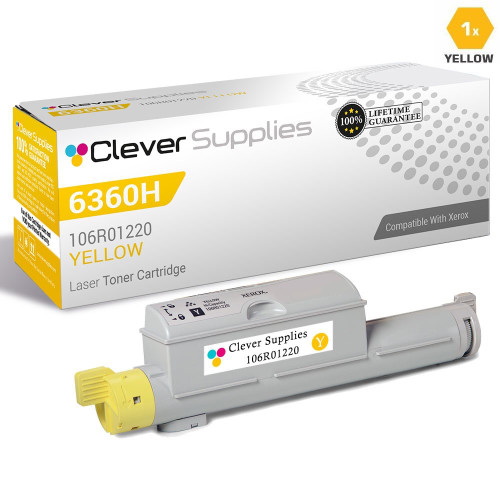
Open the carton and you will find one cartridge, not a bundle. The plural wording carried in the 6360H product name is catalog habit borrowed from multi-cartridge listings elsewhere in the range; the posting’s own answers state plainly that a single 106R01220 yellow unit is what ships, and the box holds exactly that. The cartridge itself is assembled from all-new components — the listing’s parts description names new internal parts including a smart chip — so it drops into the yellow bay and reports its remaining level to the printer in the normal way. The economics are plain: $73.64 spread over a 12,000-page rating comes to roughly 0.61¢ a page, and against the genuine cartridge’s $349.99 on the April 1, 2015 Xerox price list, the compatible carton costs a little over one fifth of the manufacturer’s figure for the same rated fill.
Buy the 106R01220 Single →What you can actually order for the yellow bay
A shelf table with one row looks like a printing error until you understand the family. There is one box because the store stocks one yellow cartridge for this platform, full stop. No pair, no triple pack and no bulk carton has ever been built around it, which also means there is no pack discount to chase and no quantity tier to game: the second cartridge costs exactly what the first one did. Offices that burn through yellow quickly simply order the single more often, and offices that print color sparingly order it rarely. The table below is the entire purchasable shelf, stated at the sale price, with the rating and the resulting per-page figure beside it. Everything else named on this page — the standard yellow, the other colors, the maintenance parts — is context, not inventory.
| Box | Contents | Rating | Sale price | Cost per rated page |
|---|---|---|---|---|
| Single | One 106R01220 high-capacity yellow cartridge | 12,000 pages | $73.64 | About 0.61¢ |
Read the row with the duplicate posting in mind: the same box appears elsewhere in the catalog under an older, code-named listing at the identical $73.64. That is a second doorway to the same product, not a second product, and it changes nothing about what arrives. Whichever posting a search engine surfaces, the purchase is one yellow cartridge at one price. This guide links only the Clever Supplies posting above, since a guide that carded the same carton twice would be padding its shelf, and a buyer comparing the two rows side by side would be comparing a box with itself.
The arithmetic of a 12,000-page yellow fill
Start with the division that matters. $73.64 divided across 12,000 rated pages gives 0.6137¢ per page, which rounds to about 0.61¢. The listing’s own text quotes roughly 0.71¢, and its arithmetic is not wrong so much as mispriced: it divides the $84.69 base figure instead of the $73.64 that checkout charges. A tenth of a cent sounds like pedantry until it is multiplied across a year of color printing, at which point the gap between the two figures is real money in a supplies budget. This guide uses the charged price everywhere, and any per-page number you meet below traces back to it.
The comparison that frames the purchase is the genuine cartridge. On Xerox’s Commercial Price List effective April 1, 2015 — the date matters, and this guide never quotes the figure without it — the genuine 106R01220 carried a list price of $349.99 for the same 12,000-page rating. The difference is $276.35. Put differently, four compatible cartridges, holding 48,000 rated pages between them, cost less than one genuine cartridge did on that list. None of that makes the genuine product a bad cartridge; it makes the compatible box the rational default for a machine of this age, where the printer itself is long past the point of protecting a warranty position with original supplies.
How long the fill lasts depends on how much color the office actually prints, and yellow follows color volume rather than total volume: a month of black-only memos barely touches this bay, while a month of brochures drains it. The table below translates the rating into rough service spans at several monthly color volumes. Treat the spans as planning figures, not promises — they assume pages printed at the light coverage the rating is built on, and the coverage section after this one explains why dense work shortens them.
| Color pages per month | Rough span of one cartridge | Cartridges per year | Annual spend at $73.64 |
|---|---|---|---|
| 250 | About 48 months | 0.25 | About $18.41 |
| 500 | About 24 months | 0.5 | About $36.82 |
| 1,000 | About 12 months | 1 | $73.64 |
| 2,000 | About 6 months | 2 | $147.28 |
| 3,000 | About 4 months | 3 | $220.92 |
| 6,000 | About 2 months | 6 | $441.84 |
Two habits keep the real cost near the table. First, reorder when the panel reports low yellow rather than when it reports empty yellow: the cartridge ships free on its own, so there is no freight penalty for ordering one at a time, and a spare on the shelf converts a stopped deadline into a two-minute swap. Second, remember that yellow rarely empties on a convenient schedule. It tends to announce itself mid-run, on the job with the most color on the page, which is exactly the job an office can least afford to reprint.
What the 12,000-page rating is measured against
Every yield figure on this page carries a condition, and honest buying means stating it in the open. Xerox’s documents for the Phaser 6360 state the basis for these ratings as 5% area coverage: the cartridge is rated as though each page it prints lays toner over about one twentieth of the sheet. That is a realistic picture of an ordinary office page — a letter with a small color chart, a report with a highlighted table — and a poor picture of a full-bleed brochure, a dense pie chart or a page of photographs, any of which can cover several times that share of the paper. Nothing in Xerox’s paperwork for this platform dresses the rating in any other standard’s clothing, so this guide does not either: the basis is 5% area coverage, stated plainly, and no grander claim is made for the number.
Yellow feels this condition more sharply than black does. Black toner is spent mostly on text, which sits close to the light-coverage assumption; yellow is spent disproportionately on the heavy elements — chart fills, highlighted bands, warm photographic tones, the gold in a logo — where coverage runs high. An office whose color work leans on presentation decks and marketing pieces should expect its yellow bay to empty ahead of the tidy monthly arithmetic, while an office printing mostly correspondence with occasional color should land close to it. Neither outcome means a cartridge underperformed. It means the rating’s assumption and the office’s pages differ, and the fix is planning, not complaint: track how many months the first cartridge actually serves, and let that observed span, rather than the printed rating, set the reorder rhythm from then on.
There is a second, quieter consequence. Because the rating is a coverage-conditioned estimate, comparing cartridges by rated pages only works when the ratings share a basis. Here they do: the standard yellow’s 5,000 pages and this cartridge’s 12,000 pages come out of the same Xerox documents on the same stated basis, so the 2.4-to-1 relationship between the fills is a genuine comparison, and the genuine cartridge’s identical 12,000-page rating is directly comparable as well. What you cannot do is carry the 12,000 figure across to some other platform’s cartridge rated on a different footing and treat the two numbers as the same currency.
The eight-code map, and where yellow sits in it
The Phaser 6360 feeds from four bays, and Xerox assigned each bay two cartridges: a standard fill and a high fill. Eight codes result, running in a tidy numeric block, and learning the block is the fastest way to avoid ordering a neighbor’s cartridge by mistake. The standard tier opens the sequence — cyan, magenta, yellow, then black — and the high tier repeats the same color order at higher fills. Yellow’s two codes are 106R01216 at standard capacity and 106R01220 at high capacity. The table gives the whole map with each code’s standing in this store, because a buyer who can see the empty cells understands this shelf better than one who is only told that a single box exists.
| Code | Bay and tier | Rating | Standing here |
|---|---|---|---|
| 106R01214 | Cyan, standard | 5,000 pages | Not carried |
| 106R01215 | Magenta, standard | 5,000 pages | Not carried |
| 106R01216 | Yellow, standard | 5,000 pages | Not carried |
| 106R01217 | Black, standard | 9,000 pages | Carried, with its own guide |
| 106R01218 | Cyan, high | 12,000 pages | Not carried |
| 106R01219 | Magenta, high | 12,000 pages | Carried, with its own guide |
| 106R01220 | Yellow, high | 12,000 pages | This guide’s cartridge |
| 106R01221 | Black, high | 18,000 pages | Not carried |
Two patterns in the map deserve a buyer’s attention. First, the color bays are symmetric: every color’s standard fill is 5,000 pages and every color’s high fill is 12,000, so no color is structurally favored — whichever bay empties first in your office says something about your documents, not about the machine’s design. Second, black breaks the pattern at both tiers, 9,000 standard and 18,000 high, reflecting how heavily a workgroup printer leans on black. The practical lesson for yellow is about neighbors. The codes on either side of this one, 106R01219 and 106R01221, belong to different bays entirely, and a cartridge ordered from a misread digit will not fit the yellow slot no matter how close its number sits. Read the full code off the spent unit, digit by digit, every time. Owners browsing the wider range can also step back to the Phaser 6360 category to see the machine’s shelf as a whole.
Four badges, one engine, one yellow cartridge
Xerox sold this printer under four badges: Phaser 6360N, 6360DN, 6360DT and 6360DX. The letters trailing the number describe how the machine was equipped — networking, duplexing, paper capacity and finishing-side extras — not a different print engine underneath. All four run at up to 40 pages per minute against a duty cycle of 100,000 pages per month, and all four draw toner from the same four bays loaded with the same eight codes. A 6360DX in a marketing department and a 6360N in a back office therefore order the identical yellow cartridge, and a mixed fleet of configurations still means a single line on the supply order. That uniformity is worth stating firmly because configuration suffixes cause real hesitation at reorder time; owners wonder whether the grander badge drinks from a grander bay. It does not.
One figure this guide deliberately leaves blank is a recommended monthly volume. Xerox’s documents for the platform state the 100,000-page monthly duty cycle, and that number is printed above, but no document behind this guide states a recommended monthly volume for the machine, so none is invented here. Duty cycle is a ceiling the hardware tolerates, not a workload prescription; offices planning around this printer should reason from their own counted color volume, the way the economics table above does, rather than from a recommendation the manufacturer never published for it.
The yellow your printer arrived with, and what replaces it
Many printers ship with reduced starter cartridges that empty early and teach owners to distrust first impressions of running cost. The Phaser 6360 was not sold that way. Xerox’s own account of the box contents lists full standard-capacity cartridges: the color bays loaded at 5,000 pages each and black at 9,000. The yellow fill a new 6360 started life with was therefore the standard yellow’s full 5,000-page rating — the 106R01216 fill, in other words, even though that code is not one this store carries today. Anyone whose sense of “how long a yellow cartridge lasts” was formed by that first cartridge should recalibrate upward: the cartridge on this shelf holds 12,000 rated pages, two and four-tenths times the fill the machine arrived with, so at the same monthly volume it should serve roughly two and four-tenths times as long.
That jump also changes ordering temperament. A 5,000-page color cartridge in a busy office is a near-monthly errand, and owners of the machine in its early life learned to keep color spares close. A 12,000-page fill stretches the interval enough that a single spare, ordered when the panel first warns, comfortably covers the gap. If your 6360 is a recent secondhand purchase, assume its yellow bay holds an unknown quantity from an unknown tier; the first cartridge you buy sets the baseline, and from the second one onward your own observed spans take over from every estimate on this page.
The parts around the toner that this store does not sell
Toner is not the platform’s only consumable, and a complete guide names the rest even when the shelf cannot supply them. The Phaser 6360’s imaging unit, code 108R00645, is rated around 35,000 pages; its transfer roller, 108R00646, carries a similar figure of roughly 35,000 pages; and its fuser, 115R00055, is rated at 100,000 pages. None of the three is sold in this store, and none is linked or carded here — they are named so that an owner reading a panel message about an imaging unit or a fuser knows which part the machine is asking for and knows to source it elsewhere. Against those spans, the yellow cartridge’s rhythm becomes clear: roughly three yellow fills pass through the bay across one imaging unit’s life, and about eight across a fuser’s, so toner remains by far the most frequent purchase in the machine’s upkeep.
Keep the categories straight when a warning appears. A low-toner message is answered by this page’s cartridge; an imaging-unit or fuser message is a maintenance event with a different part, a different price and a different supplier. Swapping toner will not clear a maintenance warning, and replacing a maintenance part will not restore an empty yellow bay. The machine’s panel names the component it means — read it literally, match the code it gives against the lists above and in the map section, and order against that code rather than against a guess.
Read the spent cartridge before you order its successor
The safest ordering habit on this platform costs thirty seconds: pull the spent unit, read the code stamped on it, and order that code. Memory is a poor substitute, because the eight Phaser 6360 codes differ by single digits and two of them sit immediately beside this one. A buyer who remembers “the one ending in twenty” is fine; a buyer who remembers “one of the high ones, twelve thousand pages” holds a description that fits three different bays. Color names alone are no safer — yellow cartridges exist for both tiers of this machine and for dozens of unrelated Xerox models, each with its own code and its own bay geometry. The stamp on the cartridge that just came out of your printer is the one specification that cannot be argued with, and the listing behind this guide says the same thing in its own words: order by the code, not by the color name.
Then confirm the two facts the short version opened with. The machine is a Phaser 6360, in any of its four configurations. And the bay you are filling is the yellow one — worth a literal look, because a printer reporting low color toner does not always mean yellow specifically, and each bay’s cartridge is keyed to its own slot. With the code read, the machine confirmed and the bay identified, the purchase itself is the simplest in this program: one box, one price, free shipping without company in the cart.
Warranty, returns and the people behind the box
This is a Clever Supplies compatible cartridge, and it is covered on compatible terms: a one-year warranty and a one-year return window, the same standing the store gives its own-brand supplies across the catalog. Those terms are the practical answer to the hesitation a low price can cause — a cartridge that misbehaves is a return, not a write-off. Orders ship from the store’s warehouses in Illinois, Pennsylvania, Georgia and California, and the single box on this shelf passes the $49 free-shipping threshold by itself, so the delivered price is the $73.64 on the card with nothing added at the freight step. Customer service answers from 9 AM to 5 PM Central, which is the channel to use if a cartridge arrives damaged or a fit question survives the checks above.
One claim deserves its exact wording. The listing describes this cartridge as built from all-new parts, including a smart chip among its internal components, and this guide repeats that claim as the seller states it: the chip is there so the cartridge registers with the printer and reports its toner level as the fill runs down. The guide adds nothing to the claim. In particular, it is not extended into any guarantee about future firmware, because no seller can honestly promise what a manufacturer’s next update will do, and a guide that printed such a promise would be selling comfort it cannot deliver.
Reading the yellow warnings when they appear
The Phaser 6360 warns in stages, and the stages are worth reading literally. A low-yellow notice is a planning signal: the bay still holds toner, printing continues, and the correct response is to order the cartridge on this page so the replacement is on the shelf before it is needed. An empty-yellow state is a different matter — color work stops being trustworthy, because the printer cannot lay a color it does not have, and pages printed around a truly empty bay come out with their warm tones shifted toward green and blue. The visible symptom usually reaches the office before the panel message does: skin tones go cold, golds turn olive, highlights lose their warmth. When output drifts that way, check the yellow level first.
Shaking a spent cartridge to coax out a final few pages is an old office ritual, and on a workgroup machine it buys little while risking a toner spill inside the bay. With a replacement that ships free on its own and a one-year return window behind it, the economics favor the clean swap. Fit the new cartridge, let the printer register it, and run a test page with a warm-toned image on it; the color balance should return in a single pass, and if it does not, the problem lies with another bay or a maintenance part rather than with the yellow you just changed.
Which offices this single-box shelf serves best
The clearest fit is the office that keeps a Phaser 6360 working as a general color printer years after the model left the showroom: reports, proposals, charts and the occasional brochure, printed in-house because the machine is already there and already paid for. For that office, a 12,000-page yellow fill at about 0.61¢ a rated page keeps the color side of the printer running for a year or more at moderate volumes, at a small fraction of the genuine cartridge’s dated list price. The second fit is the mixed-fleet office, where several 6360 configurations share a supply closet; one yellow code for every badge keeps the closet simple and the reorder a single line. The third is the light-color office, where yellow is touched so rarely that a high fill is effectively a multi-year supply — for them the cartridge’s value is not the per-page figure but the years between errands.
Who should look elsewhere? An office that needs the platform’s other colors from this same store will find only part of the set here: the standard black and the high magenta are carried with guides of their own, while the standard colors and the high cyan and high black are not carried at all, as the map section states openly. And an office whose 6360 has reached the point of needing imaging units or a fuser should settle those maintenance parts first, since no toner purchase, however well priced, returns a machine with a worn imaging unit to full health.
Questions buyers ask about this yellow cartridge
Is 106R01220 the standard yellow or the high-capacity one?
The high-capacity one. Xerox’s documents assign the standard yellow, rated at 5,000 pages, the code 106R01216, and this code, 106R01220, to the high yellow rated at 12,000 pages. This store carries only the high cartridge, so any yellow you order from this shelf is the 12,000-page fill regardless of which tier the spent cartridge came from.
Why does the product listing quote a different cost per page?
Because the listing divides its $84.69 base price, while checkout charges the $73.64 sale price. Divided properly, $73.64 over 12,000 rated pages comes to about 0.61¢ per page, and that is the figure this guide uses everywhere. The listing’s arithmetic is consistent; its price basis is simply not the price a buyer pays.
The product name sounds plural. How many cartridges arrive?
One. The box holds a single 106R01220 yellow cartridge, and the listing’s own answers say so directly, disarming the plural wording in the 6360H name. There is no multi-pack of this cartridge in the store, so every order of this box is one cartridge at $73.64.
My printer is the 6360DT. Is the cartridge different for it?
No. The 6360N, 6360DN, 6360DT and 6360DX are one engine sold in four configurations, and the suffixes describe equipment such as duplexing and paper handling, not the toner bays. Every configuration takes this same yellow cartridge.
What did the genuine cartridge cost, and when is that figure from?
$349.99, from Xerox’s Commercial Price List effective April 1, 2015, where the line for this code reads as the 6360 yellow high-capacity cartridge at 12,000 pages on a 5% coverage basis. This guide quotes that price only with its date attached, and never presents a 2015 list figure as a current retail price.
My prints have turned cold and greenish. Is that the yellow?
Very likely. Yellow supplies the warmth in color output, and as its bay runs dry, skin tones cool, golds shift toward olive and highlights lose their warmth while blues and greens hold up. Check the yellow level on the panel; if it reads low or empty, the cartridge on this page is the fix, and a warm-toned test page after the swap should confirm the balance is back.
Does this cartridge have a chip, and what does it do?
The listing describes the cartridge as built from all-new parts including a smart chip, which lets it register with the printer and report its toner level as it runs down. That is the claim exactly as the seller states it. This guide repeats it without stretching it into any promise about future firmware updates.
Sources, method and the final word
Everything factual on this page traces to three Xerox documents for the platform: the Phaser 6360 brochure, the Phaser 6360 Evaluator Guide, and the Xerox Commercial Price List effective April 1, 2015, which was read directly for this code and which carries the genuine cartridge at $349.99 — the only genuine price quoted here, and never without its date. The store’s catalog posts this cartridge twice; since both postings describe one identical box at one identical price, the box is carded once under its Clever Supplies posting and the duplicate is neither linked nor counted as a separate product. Every per-page figure was recomputed at the $73.64 sale price, because the listings compute theirs at base. No MICR variant of this cartridge is sold in this store, so there is nothing of that kind to card, link or price here.
The closing summary is as short as the shelf. For the yellow bay of a Phaser 6360, this store offers one answer: a high-capacity cartridge rated at 12,000 pages on a 5% area coverage basis, priced at $73.64, working out to about 0.61¢ per rated page and shipping free on its own. Read the code off the cartridge you are replacing, confirm it reads 106R01220, and the rest of the decision has already been made for you — order the box before the low-toner warning becomes a stopped color job.