




Some office machines earn a second decade. The Aficio 1515 copiers and the MP 161, MP 171 and MP 201 printer family were built as small-workgroup workhorses, and a great many of them are still on desks doing daily duty. They all drink from the same well: one black toner cartridge, Ricoh's Type 1170D, ordered under code 888260 and sold here in three box sizes. The cartridge itself is the easy part. The paperwork around it is not. Read the question sections on our own product pages and you would come away believing this cartridge feeds the Aficio 2015, 2018 and 2020 — a different platform entirely, which it has never fit. The savings printed there were figured from a price column above the one the checkout uses. And the inventory behind all three boxes, the single included, stood at zero when we counted in November 2026, even though every listing still takes orders. What follows sets the record straight on all three fronts: which machines Ricoh documented for this cartridge, what the checkout actually charges, and where the stock honestly stands.
The short answer: the 2-pack at $34.02 is where most owners should land — $17.01 a cartridge against $25.05 bought singly, $16.08 kept across the pair, and a sealed spare on hand for the day the working cartridge gives out. Two honest qualifications. Our November 2026 count found none of the three boxes in stock, so treat this as an order-ahead purchase, not a same-week rescue. And $34.02 stops $14.98 short of the $49 free-shipping line; the 4-pack at $51.96 is the only box that crosses it alone, at $12.99 a cartridge. The $25.05 single is the trial size, and the yardstick every saving on this page is measured against.
One supply runs this whole platform: the Type 1170D toner cartridge (888260), rated at 7,000 pages on the basis Ricoh itself states — 6% coverage. It carries toner and nothing else; the imaging parts live inside the machine as long-life service components. The shelf holds a single at $25.05, a 2-pack at $34.02 and a 4-pack at $51.96. For most owners the 888260 2-pack is the sensible buy: it undercuts two singly-bought cartridges by $16.08, and the second cartridge waits sealed as a reserve. Place the order while the fitted cartridge still has life in it — at our November 2026 count, every box on this shelf recorded zero stock while remaining orderable.
Twenty-one store pages over one small-copier platform
Begin with Ricoh's own filing. The safety data sheet Ricoh Americas issued for this cartridge is titled "Toner Type 1170D/S15/LD015" — the S15 and LD015 in that title are the Savin and Lanier names for the same hardware, so the badge question is answered by Ricoh before marketing gets a say. In this store, all three boxes are filed under twenty-one model pages. On the Ricoh side they are the Aficio 1515, its fax-equipped sibling the Aficio 1515F and the Aficio 1515MF, the Aficio MP 161L, and the Aficio 717 with its fax sibling the 717F.
The badge twins hold pages of their own: the Gestetner DSM 415; the Lanier LD 015, 016SPF, 117 and 117SPF; and the Savin 3515, 3515MF, 917F and 917SPF. A longer list of names travels in fit notes and Ricoh manuals without a store page of its own: the MP 161, MP 171 and MP 201 families under those exact names, the Savin 816, 917 and 920, the Lanier LD016 and LD220, and the Gestetner DSM516. If your machine wears any name on either list, the cartridges below are its supply.
Three Ricoh numbers, one physical cartridge
Ask the warehouse for this cartridge and one code does the job: 888260. Ricoh's paperwork, though, has known the same article under three numbers. The original was 885531, recorded in Ricoh's supplies cross-references for the 1515 and MP 161 machines. The current United States number is 841718 — the number Ricoh Americas put on this cartridge's own safety data sheet. Savin's badge for the same cartridge is the Type 1270D, code 888261. None of the three denotes a different grade or a different yield; they are three labels pinned to one cartridge, and Ricoh offered no cheaper or longer-life variant beside it.
One consequence deserves plain words. This store sells the 841718 number as a family of its own, with its own listings and its own buying guide elsewhere on the site. The cartridge inside those boxes is the same Type 1170D, and that shelf's prices match this family's to the cent. Which shelf you order from is therefore a matter of which listings you land on, not of what arrives in the box. This guide covers the three 888260 boxes only; the 841718 listings are neither priced nor linked here, because a guide that mixed two shelves for one cartridge would end up counting its own shelf twice.
| Cartridge code | Color | Rated yield | Declared basis |
|---|---|---|---|
| 888260 (Toner Type 1170D) | Black | 7,000 pages | 6% coverage (Ricoh's stated basis) |
The 7,000-page rating arrives with something this family of guides rarely gets: the manufacturer's own stated basis. Ricoh Americas' brochure for the MP 171 prints the consumable as a 7,000-page black cartridge and footnotes it directly — toner yield is based on 6% coverage. So the figure is quoted here with its convention attached, and the convention is worth a second look: 6% coverage describes a somewhat heavier page than the 5% convention many other families are rated under, so per-page costs on this page are not perfectly like-for-like against guides measured at 5%.
What sits inside the cartridge is toner powder and nothing more — Ricoh's data sheet lists the contents as a black powder, full stop. There is no drum in the box. The imaging components on this platform are long-life parts built into the machine, renewed through service on their own far longer schedule; the drum unit (order code 411114) is a separate service part that we do not stock. Fitting a fresh cartridge therefore refills the toner supply and touches nothing else, and the later sections explain how to tell a toner problem from an imaging one.
Two financial notes before the shelf. First, the genuine cartridge: we could not retrieve any Ricoh US price for it — the platform is absent from Ricoh USA's July 2016 price list altogether — so this page quotes no genuine figure anywhere. Second, our own numbers: the savings printed across this family's product pages were all calculated from the middle of its three price tiers, where a single stands at $28.81, rather than from checkout prices. Every figure below is therefore rebuilt from what the checkout actually charges.
The shelf at checkout prices
Measure everything against the single at $25.05. Two at a time brings the per-cartridge cost down to $17.01; four at a time brings it to $12.99. Divided by the 7,000-page rating, the running cost works out near 0.36 cents a page for a lone cartridge, about 0.24 cents inside the pair, and roughly 0.19 cents inside the four-box. The contents never change — the same sealed cartridge sits in every box — so choosing a pack is purely a decision about how far ahead to buy, and with recorded stock at zero across the shelf, it is a decision to make before the need turns urgent.
| Box | Checkout price | Cost per cartridge | Against buying singles | Suits |
|---|---|---|---|---|
| 888260 black 2-pack THE DEFAULT ORDER | $34.02 | $17.01 | Saves $16.08 vs two singles | One cartridge working, one sealed in reserve — the standing pattern. |
| 888260 black 4-pack | $51.96 | $12.99 | Saves $48.24 vs four singles | Busy shared machines, or several of these printers drawing on one drawer. |
| 888260 black single | $25.05 | $25.05 | — | Trying the compatible for the first time, or feeding a machine that prints a few pages a week. |
Free shipping starts at $49, and exactly one box on this shelf reaches it unaided: the 4-pack, over the line by $2.96. The 2-pack stops $14.98 below it and the single $23.95 below. Combinations that do qualify: a 2-pack with a single in the same order ($59.07), or two 2-packs together ($68.04).
Put the rating on a calendar. A machine turning out 500 pages a month empties one cartridge in roughly fourteen months, so a 4-pack is close to five years of supply; at 1,500 pages a month a cartridge lasts under five months and the four-box covers about a year and a half. Size the box to the workload you can genuinely foresee; toner keeps, but cash parked in a supply drawer does no work.
Each box under the light
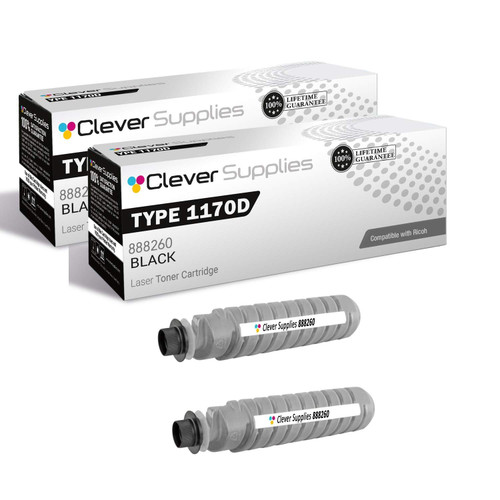
Toner on this platform gives fair warning and then none at all: pages hold their density for months, then wash out inside a single busy week. The 2-pack exists for that week. One cartridge goes into the machine; the second waits sealed, and the day it is fitted becomes the day the next order goes in, so the drawer is never the reason a job stops. The arithmetic supports the habit — $17.01 a cartridge against $25.05, with $16.08 kept across the pair. Nor will we soften the shelf behind the listing: when we counted in November 2026, none of the three boxes showed a single unit on hand, the single and the 4-pack included, even though orders remain open. Buy this box ahead of the fade, not in response to it.
View the 2-Pack →
Start with one cartridge if you have never run a compatible in this machine. Seven thousand pages of your own invoices, letters and reports will settle the quality question more convincingly than anything we could claim. The single also fits the genuinely quiet machine — a spare-room 1515 printing a few pages a week can take years to empty one cartridge, and a reserve would simply gather dust beside it. Two footnotes travel with it: it earns no free shipping on its own, and at our November 2026 count it recorded zero stock just like the packs — orderable, but not sitting on a shelf today.
View the Black Single →
Four deep is a workload decision. It suits the office where one of these machines still carries the daily copying — a front desk, a shared workroom, a small team — or a drawer feeding two or three of the platform's printers at once. In return you bank the family's lowest per-cartridge price, the only free shipping this shelf offers unaided, and a $48.24 gap against four separate single orders. It also shares the shelf's standing condition: zero recorded in stock at our November 2026 count, while remaining orderable — so the reorder belongs on the calendar while a reserve cartridge is still in hand, not after the drawer runs bare.
View the 4-Pack →Assembling the purchase
Four cartridges, three ways of buying them
Work out what four cartridges cost, bought three different ways. Singles all the way: 4 × $25.05 = $100.20. Pairing up: two 2-packs at $34.02 apiece = $68.04. One big box: a single 4-pack = $51.96. Against the singles road the four-box saves $48.24; against two 2-packs it saves $16.08; and of the three baskets, only the four-box also rides free.
Priced from the middle column
Every box here carries three prices: the checkout's, a middle figure above it, and a retail figure above that. Our product pages did all their arithmetic from the middle figure. The single's page asks how much printing $28.81 actually buys and lands near 0.41 cents a page; at the $25.05 the checkout actually charges, the answer is about 0.36 cents. The 2-pack's page sets two singles at $57.62 against a $39.12 pack and reports $18.50 saved at $19.56 a cartridge, roughly 0.28 cents a page; at checkout those read $50.10 against $34.02 — $16.08 saved, $17.01 a cartridge, about 0.24 cents. The 4-pack's page quotes $14.94 a cartridge with $55.49 saved and roughly 0.21 cents a page; the till says $12.99, $48.24 and about 0.19 cents. The pattern is this family's familiar bend: the advertised savings run too large, while the cartridges themselves cost less than the pages claim.
A different platform haunts our product pages
Read the question sections on these three listings and a stranger platform keeps walking through them: the Aficio 2015, 2018 and 2020, presented as the machines this cartridge serves, and a so-called "Aficio 1113/2015/2018 series". None of that describes the product on sale. The 2015, 2018 and 2020 run on a different toner (Type 1230D), and no 1113 takes this cartridge at all. The same pages carried the truth all along, in their fit notes and cross-references, which name the 1515 and MP 161 family exactly as Ricoh documents it. The pages cannot even agree among themselves — an opening fit line naming twenty-one models with two badges garbled together, a cross-reference carrying the full badge roster, and question sections describing another platform entirely. While we are confessing: those same cross-references link out to the sibling 841718 shelf, as if to concede the duplication. The roster near the top of this page — rebuilt from Ricoh's data sheet and the store's own category filing — is the one to order against.
Living with a toner-only platform
Changing the cartridge, start to finish
Because the supply is toner alone, the change is the simplest job on the machine: the spent cartridge lifts out, the replacement is rocked gently side to side to loosen powder that has settled in storage, and it seats in the same bay. Nothing is unclipped from the old unit and nothing is transferred to the new one. Do not skip the rocking step: powder settled in storage feeds unevenly, and the first pages after a change are where that shows. As with every compatible we sell, each cartridge here carries a one-year warranty and one-year returns.
The imaging parts keep their own calendar
A toner-only supply divides the machine's aging in two. The cartridge's clock runs 7,000 rated pages, and it is the only clock this shelf can reset. The imaging components inside the machine run far longer — they are long-life service parts, renewed through a service channel when their turn eventually comes, and the drum unit (order code 411114) is not a product we stock. Print that returns to full density with a fresh cartridge was a toner problem, finished. Faults with a mechanical rhythm — bands repeating down the page, a grey cast behind the text, the same blemish surfacing at the same interval — that survive a cartridge change completely unchanged belong to the imaging side — book a service visit rather than buying more toner.
Keeping a spare when the shelf reads zero
Our listings sell the spare-cartridge idea warmly — a sealed reserve turns a delivery wait into a two-minute swap — and the idea is sound. Its starting condition, as printed, is not: when we counted in November 2026, all three boxes on this shelf recorded zero stock, the single included, while every listing continued to accept orders. So run the policy with open eyes: reorder the day the reserve cartridge is fitted, while it still has thousands of rated pages ahead of it, and let the delivery land inside that cushion. Storage asks almost nothing: keep the sealed cartridge in its packaging, somewhere cool, dry and shaded, and fit the oldest stock first.
The 888260 pre-order checklist
Answers for Aficio 1515 and MP 161 owners
No. The 2015, 2018 and 2020 belong to a later platform fed by the Type 1230D; the Type 1170D sold here serves the earlier 1515 and MP 161 generation. Nor does it fit an "Aficio 1113", a name that surfaces in our listings but on no machine this cartridge serves. It leads this list because the confusion starts with our own store: the question sections on these product pages treat the 2015, 2018 and 2020 as if this were their cartridge. The fit note and cross-reference printed on the very same pages tell the truth — they name the 1515 family — and Ricoh's data sheet agrees. Badge reads 2015, 2018 or 2020: you need a different shelf. Badge reads 1515 or MP 161: you are in the right place.
Yes — the same physical cartridge under two of Ricoh's own numbers. Ricoh Americas issued this cartridge's safety data sheet under number 841718, its current United States number; 885531 was the original number, and 888260 is the number this shelf is sold under. This store also stocks the 841718 as a separate family, with its own listings and its own buying guide, at identical sale prices. Nothing about the cartridge changes between the two shelves; this guide simply covers the three 888260 boxes, so its shelf is counted exactly once.
Because in our catalog, availability and inventory are two different switches, and only the inventory one reads zero. Our November 2026 count found no singles, no 2-packs and no 4-packs on hand, yet all three listings kept accepting orders. We would rather print that plainly than hide behind the spare-cartridge language our product pages use: treat no box on this shelf as warehoused today. Order while the cartridge in your machine still holds rated pages in reserve, and the wait between order and delivery becomes irrelevant.
Both are honest arithmetic — from different starting prices, only one of which is real. The listing reckons from the middle tier throughout: two singles at $28.81 make $57.62, the pack is $39.12, the difference $18.50, cartridges implied at $19.56 apiece. The checkout reckons differently: two singles at $25.05 make $50.10, the pack is $34.02, the difference $16.08, cartridges at $17.01. Your card meets the second set of prices, so $16.08 is the saving you keep — softened by the fact that each cartridge also costs you $2.55 less than the listing's version claimed.
Only the 4-pack. Free shipping begins at $49, and the 4-pack's $51.96 clears it by $2.96 with nothing added. The 2-pack at $34.02 falls $14.98 short and the single at $25.05 falls $23.95 short. If four cartridges are more than you need but free postage matters, combine instead: a 2-pack and a single in one order total $59.07, and two 2-packs total $68.04.
No. The box holds toner and nothing else; the drum sits inside the machine as one of its long-life imaging parts, and the drum unit (order code 411114) is renewed through service channels on its own schedule — we do not stock it. A cartridge change therefore resets the toner supply alone. Banding, a grey background or a mark repeating at fixed intervals that a brand-new cartridge leaves untouched points at the imaging side, and a service arrangement, not another cartridge, is what fixes it.