




The machines behind this guide date from 2001, and a good many of them never got the memo about retiring. Ricoh's Aficio 1013 and 1013F were compact, unglamorous copiers, and the supply that keeps them running is equally plain: one black toner bottle, the Type 1150D, ordered as 885257, sold in three box sizes. Everything around it, though, has been written carelessly — by us. The question sections on our product pages keep telling readers this bottle feeds the Aficio 1015 and 1018, two machines it has never fit. The savings on those pages were tallied from a price tier nobody actually pays. And the packs are advertised around a shelf spare that our own inventory currently counts at zero. What follows corrects the record: the platform Ricoh documented, the prices the checkout charges, and the stock position stated out loud.
The short answer: the 2-pack at $36.70 is the sensible default — $18.35 a bottle instead of $26.39, $16.08 saved over buying the pair separately, and a sealed reserve waiting for the day the working bottle runs dry. Attach two warnings to it. First, our November 2026 count found zero of both pack sizes on the shelf (the listings still accept orders — buy ahead of need). Second, $36.70 lands $12.30 below the $49 threshold for free shipping. The 4-pack at $57.32 answers heavier volume at $14.33 a bottle and is the one box that crosses that threshold unaided. The $26.39 single is for trying the compatible, and it anchors every saving quoted on this page.
Everything on this platform runs on a single supply: the Type 1150D toner bottle (885257), rated 7,000 pages and carrying toner alone — the drum belongs to the machine, not to the bottle. Choose between a single at $26.39, a 2-pack at $36.70 and a 4-pack at $57.32. For most owners the 885257 2-pack is the buy: two bottles for $16.08 less than the same two bought one at a time, with the second held back as insurance. Order it while the fitted bottle still has life, because the recorded count for both packs is presently zero.
Eight pages in the store, fourteen names in the paperwork
Start with the strongest paper trail available. Ricoh Corporation's safety data sheet for this cartridge (RTN 00002200, issued 2003) introduces it in a single breath: "Product Name: Ricoh Toner Type 1150D Black — Product Number: 885257 — GENERAL USE: Aficio 1013, 1013F, Aficio 120." Of those three Ricoh names, the store maintains category pages for two — the Aficio 1013 and its fax-fitted sibling the Aficio 1013F — and both pages stock the three boxes further down. The Aficio 120 never received a page here, so its owners rely on this guide and on Ricoh's sheet, which is authority enough. Two more Ricoh-badged variants do have pages: the Aficio 1305 and the Aficio 1305P.
Ricoh also shipped this hardware wearing other manufacturers' badges, and two of those lines are paged in the store: the Savin 2513 with its Savin 2513F, and the Lanier 5612 with its Lanier 5613F. Beyond those eight pages, the remaining names live in fit notes only: Gestetner's 1302 and 1302F, the Lanier 5613 (our fit notes print 5613, while the store's filing and Ricoh's manual grouping both point to 5612 — we go with the filing and the manual), the Aficio 120's own badge twins Savin 2512 and Gestetner 1202, and the Nashuatec D1305 and D1305F, which surface in a single opening line of the listings and nowhere else. Read your badge against that whole list; if it appears anywhere on it, the bottle below is yours.
One code on the shelf, two more in the archives
Ask our warehouse for this bottle and there is exactly one code to quote: 885257. Ricoh's filing, though, knows the cartridge twice over. A second safety data sheet from 2006 records the identical Type 1150D black toner under product number 885527, and our listings repeat that number in their fit notes. Supply tables add a third reference, 885258 — an alternate type number, Type 1250D — carrying the same 7,000-page rating for the same machines. Treat all three as aliases for one physical article. We stock it under 885257 only, and no alias conceals a different grade: Ricoh never sold a budget or extended-life edition alongside the standard one.
| Cartridge code | Color | Rated yield | Declared basis |
|---|---|---|---|
| 885257 (Toner Type 1150D) | Black | 7,000 pages | No basis stated in any Ricoh document retrieved |
A word of honesty about the 7,000-page figure. It is not in dispute: the fit notes on all three of our listings give it, and supply tables that Ricoh feeds to its resellers give it too. What the surviving Ricoh paperwork never does is say how the number was measured — under what coverage, on what test pattern. This cartridge predates the era of standardized yield declarations, and its documentation shows it. We could paper over the gap by borrowing a measurement basis from a newer family, but that basis would belong to another cartridge, so we decline: 7,000 pages stands here as the rating, plainly labeled as a rating without a retrieved basis, and every per-page figure below is simple division of price by that number.
Inside the bottle there is powder and nothing else. Ricoh's data sheet lists the contents as toner, and the operator manual's change procedure is purely a bottle exchange — out with the empty, a handful of shakes for the replacement, in it goes. The imaging drum is not in the box. It sits in the Type 1013 Photoconductor Unit (411113), an independent supply rated at 45,000 pages that gets renewed as a service item on its own schedule. Fitting a fresh bottle therefore refreshes the toner reservoir and leaves every other wear part exactly as worn as it was; the final sections explain how to recognize which of the two has actually given out.
Two money notes before the shelf. On the genuine article: our search for a Ricoh US price came back empty — the July 2016 Ricoh USA price list skips the 1013 platform altogether, and no schedule price for this cartridge surfaced — so no genuine figure is quoted anywhere on this page. On our own figures: the product pages calculated their savings from this family's middle price tier (a single at $30.35), not from the prices charged at checkout, and the sections below redo those sums properly.
The shelf, priced as the checkout prices it
Anchor everything to the single bottle at $26.39. Buying two at once drops the per-bottle cost to $18.35; buying four drops it to $14.33. Spread across the 7,000-page rating, the running cost steps down from about 0.38 cents a page for a lone bottle, to roughly 0.26 cents inside the pair, to around 0.20 cents inside the four-box — close to a halving. The merchandise itself never varies: each box holds the identical sealed bottle, so choosing a pack is choosing a payment rhythm, not a product tier.
| Box | Checkout price | Cost per cartridge | Against buying singles | Suits |
|---|---|---|---|---|
| 885257 black 2-pack THE DEFAULT ORDER | $36.70 | $18.35 | Saves $16.08 vs two singles | One machine, sensibly run: a bottle in service and a bottle in reserve. |
| 885257 black 4-pack | $57.32 | $14.33 | Saves $48.24 vs four singles | Machines that copy all day, or several machines drawing on one drawer. |
| 885257 black single | $26.39 | $26.39 | — | A first trial of the compatible, or a copier that barely works. |
Free shipping starts at $49, and on this shelf only one box reaches it alone: the 4-pack, which clears the bar by $8.32. The 2-pack falls $12.30 below it and the single $22.61 below. Baskets that do qualify include a 2-pack paired with a single ($63.09) and two 2-packs bought together ($73.40).
Translate the rating into calendar time. A copier making 300 pages a month takes the better part of two years to drain one bottle, which makes a 4-pack a commitment stretching toward eight years. At 1,200 pages a month the same bottle empties in roughly half a year and the four-box covers about two. Match the box to the workload you can foresee; a sealed bottle waits patiently, but capital sleeping in a toner drawer earns nothing.
Each box under the light
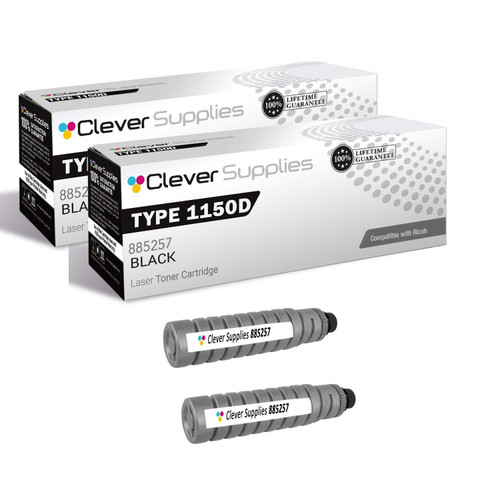
Copiers rarely fade politely. Output holds up for month after month and then washes out in the middle of the run that mattered, which is the moment this box exists for: the replacement is already in the building, the swap takes minutes, and the day the spare goes in becomes the trigger for ordering the next pair. The economics cooperate — $18.35 a bottle against $26.39, with $16.08 staying in the budget. What we will not dress up is the shelf behind the listing: our November 2026 count recorded none in stock, even though orders remain open, so plan this purchase ahead of the fade rather than in reaction to it.
View the 2-Pack →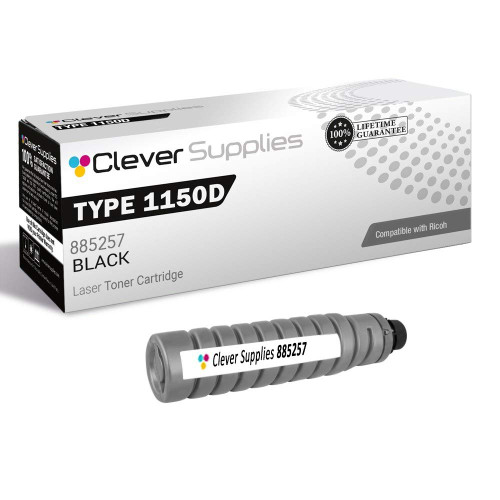
Buy one bottle first if the compatible route is new to you. Seven thousand pages of your own paperwork — your forms, your letters, your reports — will settle the quality question more convincingly than any sentence we could write. The single also suits the copier that produces a few pages a week, where one bottle may outlast the office's plans for the machine and a reserve would gather dust. Mind the two footnotes: alone in a basket it earns no free shipping, and at our last count it was the only box of the three with anything on the shelf — one unit.
View the Black Single →
Stocking four deep is a decision about workload, not enthusiasm. It fits the office where this old platform still carries the copying load — reception, accounts, a shared workroom machine — and where an empty drawer on a Tuesday is a real problem. In exchange you bank the family's lowest unit price, free shipping with no basket-padding, and a $48.24 gap versus four separate single orders, which is more than the price of a fifth bottle. This box also recorded zero stock at our November 2026 count while remaining orderable, so the same advice applies with extra force: reorder while a reserve bottle remains, not after the drawer is bare.
View the 4-Pack →Assembling the purchase
Four bottles, bought three ways
Fix the goal at four bottles in the drawer and price the three roads to it. Road one, singles all the way: 4 × $26.39 = $105.56. Road two, pairing up: two 2-packs at $36.70 apiece = $73.40. Road three, the single big box: one 4-pack = $57.32. The four-box undercuts the singles road by $48.24 and the paired road by $16.08, and it is the only one of the three baskets that also travels free. Since a single grade of bottle is all this family sells, there is no specification to trade up or down — quantity is the entire negotiation.
The listings did their sums one tier up
Three prices hang on every box here: the amount the checkout charges, a mid-level amount above it, and a retail amount above that. Our product pages ran every calculation off the middle amount, and it bent their conclusions in opposite directions at once. Take the single: priced at $30.35 in the listings' arithmetic, it is said to cost "roughly 0.43 cents per page" — rerun the division with the $26.39 you would actually pay and the rate drops to about 0.38 cents. The 2-pack is presented at $42.21 with bottles at $21.11 and a headline saving of $18.49; the checkout version is $36.70, bottles at $18.35, saving $16.08. The 4-pack is quoted at $16.48 a bottle, $55.48 saved, roughly 0.24 cents a page; at the till those read $14.33, $48.24 and about 0.20 cents. Notice the pattern: the advertised savings are too generous, yet the bottles themselves are cheaper than the pages suggest. Both errors trace to that same starting column.
A different copier haunts our product pages
Spend time in the question sections of these three listings and a pattern emerges: answer after answer discusses the Aficio 1015 and 1018 — how far a bottle stretches in them, splitting a pack between one of each, keeping their owners supplied. One closing description even bills this bottle as rated for the "Aficio 1015/1018 series". None of it is true of the product being sold. Those two machines belong to a different platform with its own toner line, Type 1140D and 1220D, and a 1150D bottle will not fit them. Oddly, the accurate text was on the same pages all along: each listing's fit note names the Aficio 1013, 1013F and 120, matching Ricoh's data sheet word for word in substance. The pages even disagree with each other about the wider family — ten models in the opening line, nine in the fit notes, eight badge names in the closing text, and the Lanier twin spelled two ways. The roster at the top of this page was rebuilt from Ricoh's document and the store's category filing, and it is the one to rely on.
Living with a 2001 copier platform
Changing the bottle, start to finish
Ricoh's operator manual treats the toner change as a job for whoever is standing nearest: the spent bottle pulls out, the replacement gets shaken five or six times to stir the powder loose, and it slides home in the same slot. Nothing detaches from the old bottle, nothing attaches to the new one, and the whole exchange is measured in minutes. The shaking step is worth honoring rather than skipping — powder that has rested in storage settles, and loosening it first is what keeps the opening copies even. Every bottle on this page is backed the same way our compatibles always are: a one-year warranty and one-year returns.
Two wear parts, two separate clocks
A toner-only supply splits the machine's aging into two independent timelines. The bottle's timeline is 7,000 rated pages, and it is the only one this shelf can reset. The photoconductor's timeline runs to roughly 45,000 pages — more than six bottles end to end — inside a unit that is replaced as a service part and is not stocked here. Telling the timelines apart is the owner's essential skill. Pale output that a fresh bottle restores was a toner problem, case closed. Output faults with a mechanical signature — bands marching down the sheet, a grey film behind the print, a blemish recurring at fixed intervals, solids breaking up — that look identical before and after a bottle change belong to the photoconductor, and the correct purchase is a service call, not more toner.
Keeping a spare, honestly scheduled
The sales copy on our listings leans hard on the spare-bottle story: keep one in the building and a dry machine never stops a job. The story is right; its timing, as printed, is not. When we counted in November 2026, neither pack size had a single unit recorded in stock, and the single had one — yet all three listings were still taking orders. So schedule the policy realistically: place the reorder on the day the reserve bottle goes into the machine, while the fitted bottle still has thousands of pages in it, and let delivery happen inside that cushion. Storage, meanwhile, asks almost nothing — the sealed bottle lives in its packaging, somewhere cool, dry and out of the sun, and the oldest stock gets fitted first when rotation time comes.
The 885257 pre-order checklist
Answers for Aficio 1013 and 1013F owners
It does not. Those machines form a separate platform whose toner line runs under different type numbers — 1140D and 1220D — and the 1150D bottle sold here belongs to the earlier 1013 generation. This question leads the list because our own store is the source of the confusion: the question sections on these product pages discuss the 1015 and 1018 as though this were their supply. Read instead the fit note on those same pages, which names the 1013, 1013F and 120, or Ricoh's data sheet, which says the same. Badge says 1015 or 1018: shop elsewhere. Badge says 1013 or 1013F: stay.
One: the 4-pack. Orders travel free from $49 upward, and its $57.32 price puts it $8.32 into qualifying territory without help. The 2-pack's $36.70 leaves a $12.30 gap, and the single's $26.39 a $22.61 gap. If free postage matters and a four-box is more than you need, the qualifying combinations are a 2-pack plus a single in one order ($63.09) or two 2-packs together ($73.40) — both spelled out here so the checkout total holds no surprises.
Because availability and inventory are separate switches in our catalog, and only one of them is at zero. Our November 2026 count recorded no 2-packs and no 4-packs on hand, and exactly one single, while all three listings continued accepting orders. Rather than quietly enjoy the spare-bottle language our product pages use, we print the position here: neither pack should be treated as sitting in a warehouse today. Order either one while the bottle in your machine still has rated pages in reserve, and the gap between order and delivery stops mattering.
We cannot tell you, and we have chosen not to guess. Our hunt for a manufacturer figure covered the Ricoh USA July 2016 price list — which omits the 1013 platform entirely — and the federal schedule sources, and produced nothing quotable. Genuine bottles do trade through resellers at prices of their own setting, but a reseller's tag is evidence of that reseller's margin, not of Ricoh's price, and quoting it in this space would dress it up as the latter. The actionable numbers remain the three checkout prices in the table above.
Both sums are internally consistent; they simply start from different prices, and only one starting point is real. The listing's version uses the family's middle tier throughout: two singles at $30.35 come to $60.70, the pack at $42.21, difference $18.49, bottles implied at $21.11. The checkout's version: two singles at $26.39 come to $52.78, the pack at $36.70, difference $16.08, bottles at $18.35. Since the second set of prices is the set your card meets, $16.08 is the saving you will actually keep — and note the consolation hiding in the same correction: each bottle costs you $2.76 less than the listing's arithmetic claimed.
No. What arrives is a bottle of toner; the drum lives elsewhere, inside the Type 1013 Photoconductor Unit, a standalone part rated at 45,000 pages and replaced through service channels when its turn comes. Swapping bottles therefore resets only the toner supply. If your copies carry banding, a grey background or a mark that repeats at regular intervals, and a brand-new bottle changes none of it, the photoconductor is the failing part — arranging its service will fix what no quantity of toner can.