




Some buying guides exist to untangle a crowded shelf. This one has the opposite job: the shelf holds a single cartridge. Lexmark’s X203n and X204n multifunction lasers were built around one Return Program toner cartridge, the X203A11G, rated at about 2,500 pages, and Lexmark’s ordering table for the platform knows no other size — no smaller standard cartridge, no longer high-yield one. Clever Supplies sells that code three ways (single, 2-pack, 4-pack) and then lists the trio again under each printer’s name, turning three boxes into nine listings. What a shopper cannot learn from those listings is the platform’s structure: that the cartridge belongs to a return program at all, that an outright-sold twin exists under a part number borrowed from a different family, and that the printer’s imaging life runs on a separate photoconductor kit. Compatibility, at least, needs no detective work — the store states Lexmark’s two-model roster correctly on every surface it publishes. What follows prices the three boxes at the amounts charged at checkout and puts the missing structure back on the record.
Owners of an X203n or X204n can skip the compatibility research entirely: only one cartridge is stocked for these machines, and Lexmark documents it for both. Start with the 2-pack at $122.77 — about five thousand rated pages at 2.46¢ apiece — because it pairs a working cartridge with a shelf spare at a materially better rate than buying singly. Volume users should look at the 4-pack, which trims the page cost to 2.29¢; the $69.42 single remains the smallest first step. Carry two facts into the cards below. First, the stocked code is Lexmark’s Return Program cartridge, a fact its listings never mention, and its Regular twin is cataloged under an X340 number rather than an X203 one. Second, these printers image onto a photoconductor kit with a rated life of 25,000 pages; the kit is neither inside the cartridge nor sold by this store, and a later section deals with it so the expense can be planned instead of discovered.
Nine listings, three boxes
The family’s nine product pages reduce to three distinct offers. One set of three is named for the cartridge itself and is the set carded here; the identical trio then reappears named for the X203N, and again named for the X204N, every price matching to the cent. Re-listings under printer badges add shelf bulk without adding choice, so each configuration is shown a single time below. The 2-pack opens the shelf; the 4-pack and the single follow in the grid. Multi-packs carry a SAVE badge, computed the same way throughout this guide: take what the enclosed cartridges would cost one by one at the sale prices printed here, subtract the pack’s sale price. On the product pages that comparison starts from list prices, which makes the badges read larger; the note at the foot of this guide sets the two computations side by side.
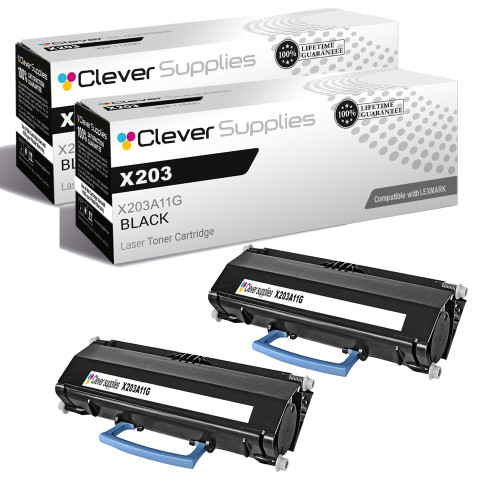
Why lead with the pair? Because a 2,500-page cartridge in a shared multifunction tends to empty mid-job and mid-week, and the second cartridge in this box converts that from a purchasing emergency into a brief pause. Purchased as two separate singles the same toner costs $138.84, so the box starts $16.07 ahead. Doubling again to the 4-pack shaves a further 0.17¢ off each page — worth collecting where print volume is heavy, less compelling where a cartridge already lasts months.
Shop the X203 2 Pack →THE REMAINING TWO BOXES
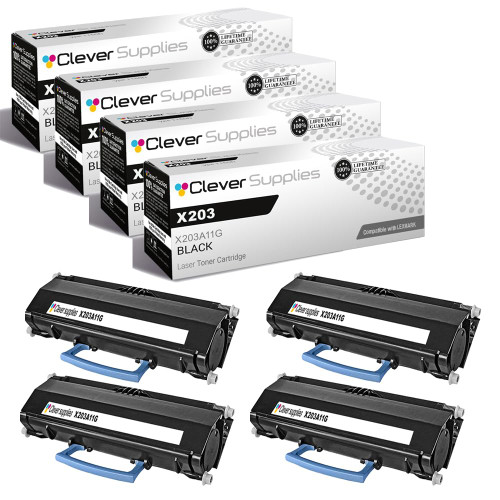
Four cartridges at the family’s lowest per-page rate — in the region of ten thousand rated pages before another order is needed. Buying those four cartridges individually instead would add up to $277.68.
Shop the X203 4 Pack →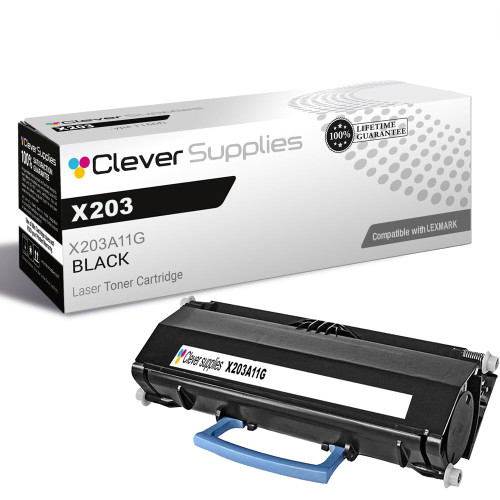
The entry point: least cash committed, highest cost per page. Suited to a lightly used machine, or to a first purchase while pack economics are still unproven — and what arrives is the complete retail cartridge, full rating included.
Shop the X203 Single →Fit is identical across the three cards, so the only variable left is how much toner to keep on hand. That is a pricing question, and the next section answers it in cents per page.
Per-page pricing for the three boxes
The method is uniform: divide the box’s sale price by the combined rated yield of its contents. One code and one tier mean the table can rank nothing but pack sizes, and the final column repeats down every row — pack a cartridge singly or in fours and its documented fit stays the same two printers.
| Offer | Sale price | Rated pages per box | Per-page cost | Fits |
|---|---|---|---|---|
| X203 4 Pack | $229.46 | 4 cartridges · ~10,000 pages | 2.29¢ | X203n and X204n |
| X203 2 Pack — the flagship | $122.77 | 2 cartridges · ~5,000 pages | 2.46¢ | X203n and X204n |
| X203 Single | $69.42 | 1 cartridge · ~2,500 pages | 2.78¢ | X203n and X204n |
From the top row to the bottom, the spread totals 0.49¢ — and the single-to-pair move captures most of it, leaving only 0.17¢ for the step from two cartridges to four. Expressed per cartridge, a pair works out to $61.39 each and a four to $57.37 each, versus $69.42 for a lone cartridge. Spreads this narrow do not punish any choice; they simply reward whichever box best matches the interval an office prefers between orders.
Fit: two printers, and the store says exactly that
Under Lexmark’s documentation the X203A11G belongs to the X203n and the X204n — two models, both sitting under the Lexmark X Series, each linked here to its own category page in this store. All nine listings are filed beneath those two categories. Nor can a tier boundary complicate the picture: Lexmark allots one cartridge to each program on this platform, and the Regular twin discussed below is documented for the identical pair, so no model on the platform is shut out of any cartridge by a fence.
Guides in this series usually find at least one store surface that overstates or understates a roster. This family is the exception, and it deserves saying plainly. File the listings by category and the two models appear. Open the Compatible Printers block on any product page and it links those same two categories, no others. Read the introductory text and both printers are named as compatible. Read the compatibility answers in the listings’ questions and the answer, for single and packs alike, is the same pair. Set any of those beside Lexmark’s user-guide ordering table and nothing needs correcting in either direction.
A word about the nine names, since they can look like nine different products. The X203N and X204N sets re-list the identical three configurations under each printer’s badge, price for price. Ordering from the page named after your own machine is perfectly sensible; it simply does not change the contents of the parcel, which is an X203A11G in every case — the reason this guide cards the cartridge-named set and shows each box once.
A yield nobody disputes — and a twin wearing another family’s number
Start with the number itself, because here it is uncontested. Every one of the nine listings carries “Black: 2500” in its Page Yield field; the description texts repeat 2,500 and multiply it correctly into box totals of 5,000 and 10,000; and Lexmark’s datasheet entry for the X203A11G states “up to 2500 pages” measured under ISO/IEC 19752, with Lexmark’s regional leaflets for the cartridge confirming the same ISO basis. An older platform, then, but a rating expressed in the current standard’s terms, and one this guide adopts without adjustment.
The program behind the code is the part the listings omit. Lexmark’s ordering table for these printers assigns a single cartridge to each of its two programs: the Return Program entry is the X203A11G stocked here, while the Regular entry — the version sold outright, free of any return arrangement — is the X340A21G. Lexmark never minted an X203-prefixed Regular code; the outright version wears a number inherited from the X340 line. Shoppers will not find that twin in this store: no listing exists for it under any name, and no description anywhere in the catalog refers to it. Tier choice is equally absent. Descriptions in this family sometimes describe the cartridge as “standard,” yet the platform’s ladder contains just one rung, so the word distinguishes it from nothing.
In practice, the cartridge you remove tells you what to order. An X203A11G label corresponds to the cards above, exactly. An X340A21G label identifies the unstocked Regular twin — equivalent rating, equivalent fit — for which the stocked Return Program cartridge is the substitute offered here. And a machine still on its first supply is running the 1,500-page starter it shipped with; everything carded above is the full-rated retail cartridge that succeeds it.
Making the value case without a genuine benchmark
Elsewhere in this series, each shelf is weighed against a genuine Lexmark price. That comparison is unavailable here, and rather than fill the gap with an unofficial figure, this guide explains the gap. The cartridge is discontinued: Lexmark’s US store publishes no supply page for the code and returned no price for it. The Texas DIR schedule — Lexmark’s official US price list, hosted on lexmark.com and relied on for several neighboring families — has no entry for the X203A11G, none for the X340A21G and none for the photoconductor kit; the same is true of Lexmark’s US price lists dated January 31, 2026. Genuine stock does circulate through third-party resellers at their own asking prices, but those are resellers’ numbers, not Lexmark’s, and quoting one as a benchmark would mislead. Accordingly, no genuine price is printed on this page, and the argument below rests on the shelf’s internal arithmetic.
That arithmetic holds up on its own. Converted to a standard block of ten thousand pages, toner from this shelf costs approximately $278 in singles, $246 in 2-packs and $229 in 4-packs. At a sustained ten thousand pages a month, a year’s printing runs to roughly $3,332 bought singly versus roughly $2,754 bought in fours — a difference near $578 a year attributable purely to box size, on hardware that demands little else. Pack depth is the only lever this family offers, and the table above quantifies it rather than asserting it.
When cross-checking against the product pages, allow for their habit of computing from list prices instead of charged prices. The single’s text, for example, divides its $79.83 list price and arrives near 3.19¢ per page; dividing the $69.42 a buyer actually pays yields the 2.78¢ figure used across this guide. The closing note audits the remaining listings in the same way.
The second consumable, and the first cartridge
Budgeting for toner alone understates this platform’s running costs, because imaging is handled by a photoconductor kit — Lexmark’s X203H22G — that lives in the printer, not in the cartridge. The cartridge docks into the kit and is lifted out of it at replacement time, while the kit itself carries on. Lexmark specifies the kit at 25,000 pages at roughly five percent coverage, a measurement basis of its own rather than the ISO cartridge standard, which equates to the rated span of ten toner cartridges; as the kit ages, the machine posts its “84 PC Kit Life Warning” and eventually “84 Replace PC Kit” messages. Clever Supplies stocks no photoconductor kit for these models, the word “photoconductor” is absent from every listing in the family, and no Lexmark price for the kit could be located. It appears in this guide so that owners can plan around a known future expense instead of meeting it as a surprise.
As for the first cartridge: Lexmark’s Service Manual for machine type 7011 puts the starter supply these printers ship with at 1,500 pages, against 2,500 for the retail cartridge. Research for this guide retrieved no distinct starter figure for the X203n versus the X204n, so a single platform figure is all that is printed. A starter at three-fifths of the retail rating means the first replacement falls due comparatively soon after setup — and the retail cartridges carded above are that replacement, at full rating.
Chips and firmware: a subject the listings skip entirely
Search all nine descriptions in this family for any statement about chips and the search comes back empty — literally: the word occurs zero times, and no listing carries a chip entry among its specification fields. Many shelves in this series recite a boilerplate smart-chip line; this family’s template does not, and the absence is recorded here without embellishment. Firmware receives the same treatment throughout the family: it is raised nowhere, in either a promising or a warning sense.
Two documented positions do apply, and they should not be confused with each other. The store’s standing position for its compatible range — stated here on the store’s authority, since the listings are silent — is that its supplier builds cartridges around the current-generation chip, that installation is plug-and-play, and that nothing needs to be transplanted from the spent cartridge; consistent with every guide in this series, that position carries no promise regarding firmware Lexmark may release in the future. Lexmark’s own documented position, from the platform’s Maintenance Guide and user guide, is a caution: harm caused by supplies or replacement items from another maker falls outside the printer’s warranty, print quality may suffer from such supplies, and Lexmark’s life estimates presume letter or A4 plain paper. Nothing in Lexmark’s documentation for this platform describes a firmware regime that blocks cartridges, and this guide invents none.
The cover that comes with each cartridge
Matching the box to the workload
Questions X203n and X204n owners ask
The X203n and the X204n — those two, exclusively. Lexmark’s ordering table for the platform assigns the cartridge to that pair, its datasheet compatibility statement names the same pair, and no further model is documented. The store’s surfaces are in full agreement: check the category filing, the printer link blocks, the introductory paragraphs or the compatibility answers inside the listings, and each returns the identical two names, neither extended nor trimmed.
No such split exists. Each of Lexmark’s programs for this platform contains exactly one cartridge, and both are rated around 2,500 pages, so there is no extended-life option to upgrade to and no economy option to downgrade to. Where a listing describes the cartridge as “standard,” the adjective is casual rather than categorical — it names no tier. For these printers, capacity is increased only by holding more of the same cartridge, which is what the pack sizes above accomplish.
The distinction is the sales program, not performance: yield and printer fit are the same for both. X203A11G designates the Return Program version, sold under Lexmark’s single-use arrangement in which the empty goes back; X340A21G designates the Regular version, sold outright. The second number looks out of place because it is — Lexmark cataloged the outright version under the X340 family’s prefix instead of issuing an X203 one. Only the Return Program version is stocked here, so it is also the replacement for a spent X340A21G in either printer.
A starter cartridge rated at 1,500 pages, according to Lexmark’s Service Manual for machine type 7011 — some thousand pages below the retail rating, which is why a first replacement tends to fall due sooner than owners expect. This guide’s research located no model-specific ships-with figure distinguishing the X203n from the X204n, so it prints the platform figure rather than inventing two. Whatever the model, the starter is the briefest supply the machine will ever run; the retail cartridge above is its first full-capacity successor.
It does not. The kit — part X203H22G — is a printer-side component rated by Lexmark at 25,000 pages at about five percent coverage, the equivalent of roughly ten cartridges. The toner cartridge docks into the kit but embodies no imaging surface itself; consequently none of the kit’s lifespan is folded into the cartridge’s 2,500-page rating or into its price, and the two components deplete on separate timelines. This store does not carry the kit, and the listings never refer to it; the section above names it so the eventual cost is on the owner’s horizon.
The two sets of figures begin from different prices. Listings compute against list prices; this guide computes against the sale prices a buyer is actually charged. Consider the 2-pack: its page takes the $141.19 list price as its basis and reports $70.60 per cartridge and $18.47 saved, whereas the sale-basis computation — $122.77 for the pair, measured against $138.84 for two singles — yields $61.39 per cartridge and $16.07 saved. The single and the 4-pack exhibit the same list-price habit in their questions and About sections, and the note following this section examines each in turn.
Price and disclosure note: Every price quoted here is a sale price, read from the relevant product’s storefront page and matched against that page’s listing title on November 17, 2026, then confirmed live once more in the run-up to publication. Each listing also displays a higher list price; should a sale price expire, the figure on the product page governs. SAVE amounts follow a single convention on this page — a pack’s sale price compared with buying its cartridges individually at sale prices ($138.84 for two singles; $277.68 for four) — giving $16.07 on the 2-pack and $48.22 on the 4-pack. The absence of any genuine Lexmark price from this guide is deliberate and evidenced: the US Lexmark store maintains no supply page for this discontinued code; the Texas DIR schedule dated July 25, 2024 contains no entry for the stocked code, its Regular twin or the photoconductor kit; and Lexmark’s US price lists dated January 31, 2026 omit all three as well. Prices asked by independent resellers for genuine stock are those resellers’ own and have not been treated as Lexmark prices. On yield, sources converge without any selection being necessary: fields, description texts and Lexmark’s ISO/IEC 19752 statement each give approximately 2,500 pages. Fit is drawn from the ordering table in Lexmark’s user guide for the platform, corroborated by the datasheet compatibility statement. Against that benchmark the store’s fit information shows no deviation whatsoever — categories, link blocks, prose and Q&A answers uniformly name the two documented models. The recorded departures concern money and omission. First, money: savings and per-page claims in the listings are built on list prices. The single is presented at roughly 3.19¢ per page, derived from its $79.83 list price, against 2.78¢ on the $69.42 charged. The 2-pack advertises $18.47 saved with cartridges at $70.60, against $16.07 saved and $61.39 per cartridge on sale prices. The 4-pack advertises $55.44 saved with cartridges at $65.97 and a rate near 2.64¢, against $48.22 saved, $57.37 per cartridge and 2.29¢ on sale prices. Second, a credit the listings have earned: their arithmetic, tested instance by instance, is internally correct — the 4-pack’s $55.44, for example, is exactly four list singles ($319.32) less the pack’s list price ($263.88) — a standard of care not met by a comparable figure on certain other shelves in this series; the fault lies in the price basis chosen, not in the sums. Third, omission: nowhere does a listing disclose that the stocked code is a Return Program cartridge (the term appears zero times across the family), identify the Regular twin X340A21G, or acknowledge the photoconductor kit the cartridge docks into — three facts about the platform’s supply system that a reader of the product pages alone would never encounter.
Each distinct product appears exactly once among the cards: one code in its three pack configurations. The balance of the family’s nine listings consists of those same configurations re-listed under the X203N and X204N names at unchanged prices; they are not carded or linked, the contents being the identical X203A11G throughout. Beyond the stocked code, Lexmark’s ladder for this platform contains only the Regular twin X340A21G, which is stocked in no configuration and under no name. The photoconductor kit (X203H22G) is referenced for context, not offered for sale here; Lexmark’s rating for it is 25,000 pages at approximately five percent coverage, assessed on the kit’s own basis rather than the ISO cartridge standard, and no price for it was retrievable from a Lexmark source. Ships-with information extends as far as Lexmark’s Service Manual and no further: a 1,500-page platform starter, with no per-model variant found and none asserted. Two blemishes are logged for completeness. The Compatible Printers block stored on each listing leaves its list element unclosed — present on all nine listings, and inconsequential to fit, because both links in the block render and both point to the correct categories. And the flagship 2-pack’s SKU contains a misspelling, rendering its pack word as “2Balck”; the remaining canonical SKUs are free of the error. On chips, the listings are entirely silent — the topic arises in none of the nine descriptions and no specification field covers it — and the store’s position on the subject is given in the relevant section above on the store’s own authority. No wording anywhere in the family describes a product as “genuine” or “authentic”. The protection attaching to each offer is the protection its listing itself promises: warranty cover for a year against defects in materials and workmanship, with returns free throughout that year.