




Most cartridge platforms fence their tiers; this one fences its programs. Lexmark’s MS817/MS818 platform carries four machines, and its Return Program cartridges roam across all of them — but the two Regular cartridges are each locked to a single pair. The code stocked here, the high-yield 53B0HA0 rated at about 25,000 pages, belongs to the smaller pair: it fits the MS817 and the MX717, and it does not fit the MS818dn, however natural that assumption feels. This store lists that one code as a single, a 2-pack and a 4-pack, each exactly once. The store’s own pages, to their credit, never claim the fenced-off models — but they understate in the other direction, naming only the MS817N and leaving the MX717de, a fit Lexmark documents, out of every sentence. This guide prices the three boxes at checkout prices, draws the fence where Lexmark draws it, and shows its working.
If your machine is an MS817 or an MX717de, the cartridge below is yours and the only remaining question is quantity; the box this guide leads with is the 2-pack at $185.35, roughly fifty thousand rated pages at 0.37¢ each. If your machine is an MS818dn or an MX718de, stop here: nothing on this shelf fits it. Your platform’s cartridges are the Return Program codes and the Regular extra-high 53B0XA0, and this store stocks none of them — the fence is Lexmark’s, drawn in its own user guide, not a gap in this page. Two further facts earn their place up front. Lexmark’s ladder for these printers holds a standard cartridge of about 11,000 pages and an extra-high of about 45,000, and neither is stocked in any program, so depth on this shelf is pack size and nothing else. And the printers carry a separate imaging unit rated at 100,000 pages, one that no listing mentions and this store does not carry; it is covered further down so it can be budgeted for.
The complete shelf: a single code in three boxes
The family is small enough to show entire. Three listings exist — one part number in the three pack sizes a buyer would expect — and, unusually for this store, none of them is re-listed under a second printer’s name, so there is no duplicate to strip out before the pricing can be trusted. The pair leads; the single and the 4-pack follow in the grid. SAVE badges sit on the multi-packs only, and each is reckoned the same way: what the cartridges inside would cost bought one at a time at the sale prices printed here, less the pack’s own sale price. The product pages run that subtraction from list prices instead and so print larger badges; the closing note reconciles the two sets of figures.

The case for the pair is plain arithmetic. Bought separately, two singles total $201.44; the box returns $16.09 of that before the first page prints, and each cartridge inside it costs $92.68 against $100.72 alone. Going deeper to the 4-pack shaves roughly two hundredths more off each page — worth collecting at real volume, but a thin reason for a quieter office to hold four cartridges. One cartridge in the printer and one in reserve is how these machines are actually run, and this box is that arrangement.
Shop the 531H 2 Pack →THE OTHER TWO BOXES
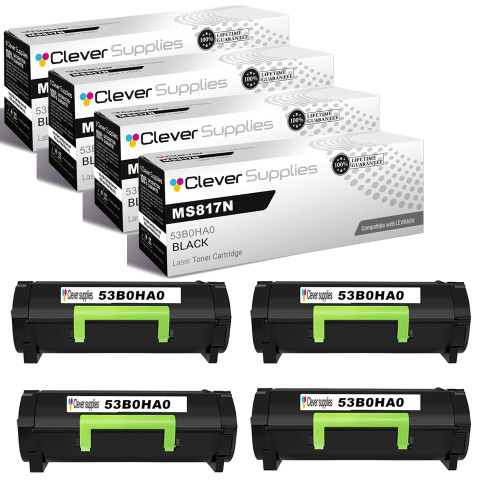
The cheapest page this family offers, inside its largest commitment — about a hundred thousand rated pages, a serious stretch of departmental printing between orders. The same four cartridges bought singly would come to $402.88.
Shop the 531H 4 Pack →
The smallest outlay on the shelf and its most expensive page — the box for a machine that prints now and then, or for a first order before packs have earned their place. It still carries the full 25,000-page high-yield rating; buying singly buys flexibility, not a lesser cartridge.
Shop the 531H Single →Every card above carries the same cartridge and the same two-printer fit, so the shelf asks only how much toner to hold at once. The table that follows prices that choice in cents.
What a page costs in each box
Each rate divides a box’s sale price by the combined rated yield of the cartridges inside it. One stocked code means one tier, so the rows can only be ranked by how many cartridges are bought together; the fit column reads the same on every row, because the fence described in the next section applies to the code itself, not to any pack size.
| Offer | Sale price | Rated pages per box | Per-page cost | Fits |
|---|---|---|---|---|
| 531H 4 Pack | $354.63 | 4 cartridges · ~100,000 pages | 0.35¢ | MS817 and MX717 only |
| 531H 2 Pack — the flagship | $185.35 | 2 cartridges · ~50,000 pages | 0.37¢ | MS817 and MX717 only |
| 531H Single | $100.72 | 1 cartridge · ~25,000 pages | 0.40¢ | MS817 and MX717 only |
The dearest row and the cheapest sit five hundredths of a cent apart — 0.40¢ against 0.35¢ before rounding — and three of those five are surrendered at the first step, from one cartridge to two. Counted per cartridge instead, the packs hold theirs at $92.68 inside a pair and $88.66 inside a four, against $100.72 for one bought alone. The spread is narrow enough that no row punishes its buyer; the honest grounds for choosing are cash committed today and reorders avoided over the year.
Fit: one cartridge, one pair of printers
Lexmark’s platform holds four models: the MS817 and MS818 printers and their MX717 and MX718 multifunction counterparts. Its Return Program cartridges are documented for all four (the extra-high rung excepted, as the ladder section explains). The Regular cartridges are drawn tighter — one model-pair apiece. The stocked 53B0HA0 is assigned, in the footnote to Lexmark’s own ordering table, in its supplies table and in the description line of its US price list, to the MS817 and the MX717 alone; its Regular sibling, the 53B0XA0, belongs to the MS818 and MX718 in mirror image. Of the four models, only one has a category page in this store: the MS817N, under the Lexmark MS Series. The MS818DN, MX717DE and MX718DE have no categories here and are named in this guide without links, as prose only.
Against that record, the store’s surfaces err in one direction only, and it is the safer one. Everything names the MS817N alone: the listing names, the category filing, the Compatible Printers block (a single link, to that one category), the shared introduction and the fit answers. Nowhere does any surface claim the MS818dn or the MX718de for this Regular code — the overstatement a careless template would have made, since the platform’s Return Program cartridges genuinely do fit those machines. The cost of the caution falls on the other documented fit: the MX717de is named nowhere in the family, so an MX717de owner finds no store surface that admits this cartridge fits their printer, and no category of their own to browse. The fit answers that reach for a wider claim garble it, each naming the MS817N twice, in two casings, as though it were two printers. This guide follows Lexmark: two models take this cartridge, and both are named on every card above.
One neighbouring family needs fencing off in the other direction. The MS810, MS811 and MS812 printers — whose tables share a user guide with these machines — are not 53B fits; Lexmark assigns them a different cartridge family, and the same holds for the MX810, MX811 and MX812 multifunctions. Shared documentation is not shared toner; this page offers nothing for those models.
One agreed rating, and the ladder behind it
On the stocked code’s yield, every witness tells the same story. The yield field on all three listings gives black at 25,000 pages; description prose repeats the number and extends it honestly into the pack totals, 50,000 pages in the pair’s box and 100,000 in the four’s; and Lexmark’s supplies table and cartridge pages declare the same 25,000 under ISO/IEC 19752, the standard the platform’s ordering notes cite by name. There is no split to reconcile and no figure in this guide taken from anywhere else.
Lexmark’s full ladder for the platform has three rungs, and its programs do not mirror each other. The standard rung, at about 11,000 pages, exists only as the Return Program 53B1000, documented for all four models — there is no Regular standard cartridge at any price. The high-yield rung, at about 25,000 pages, pairs the Return Program 53B1H00, again platform-wide, with the stocked Regular 53B0HA0, fenced to the MS817 and MX717. The extra-high rung, at about 45,000 pages, is fenced in both programs to the larger pair: the Return Program 53B1X00 and the Regular 53B0XA0 each serve the MS818 and MX718 only. Of the ladder’s five US codes, this store stocks exactly one, in the three pack sizes above; the other four have no listings in any configuration, and no listing in the family so much as names them.
The label on the spent cartridge is therefore worth reading carefully — on this platform it carries the fit as well as the size. A label reading 53B0HA0 is this shelf exactly. A label reading 53B1H00 names the Return Program twin: same rating, wider fit. If your machine is an MS817 or MX717, the stocked Regular code replaces it here; if your machine is an MS818 or MX718, the stocked code does not replace it, whatever the shelf’s shape suggests — your cartridges are the 53B1H00, the 53B1X00 and the 53B0XA0, and none of them is sold here. A label reading 53B0XA0 settles the question the same way: that code’s pair is the larger one, and this page is not its shelf.
Lexmark’s own price list, set beside the shelf
Every genuine figure in this guide comes from Lexmark’s own US price lists, published on lexmark.com and updated January 31, 2026, and each is labeled with the basis it stands on. In those lists, one genuine 53B0HA0 carries a US web price of $566.99 and an MSRP of $750.24. Page for page, the web price works out to 2.27¢ and the MSRP to 3.00¢, against 0.40¢ for the compatible single carded above — the compatible sits at well under a fifth of the genuine web price. The Texas DIR schedule that priced other families in this series carries no rows for this family’s codes at all, so it contributes nothing here and no DIR figure is printed.
Scale the comparison up and it stops being abstract. Ten thousand pages cost roughly $40 off this shelf one cartridge at a time, $37 in pairs and $35 in fours; priced from Lexmark’s web list, the identical ten thousand pages run to about $227. A department getting through that volume monthly faces a yearly genuine bill near $2,720 at web prices, set against some $426 buying the 4-pack here — roughly $2,300 a year left on the table.
Read the product pages alongside this section and their numbers will not match these — not because either side is inventing figures, but because the listings start every sum from list price rather than from the amount charged. Take the single: its text divides the $115.83 list price and arrives at roughly 0.46¢ a page. Divide the $100.72 a buyer actually pays and the answer is the 0.40¢ this guide uses. The note at the end of the page takes each listing’s version apart.
The imaging unit, and the cartridge in the box
Toner is not this platform’s only consumable. The image is formed on a separate imaging unit — Lexmark’s 520Z, sold as the Return Program 52D0Z00 and the Regular 52D0ZA0 — and the cartridges above contain no drum, so the unit’s lifespan enters neither their ratings nor their prices. Lexmark rates the unit at up to 100,000 pages on its own imaging basis (an average of three pages per job at about five percent coverage), which works out to roughly four of these cartridges’ rated lives. This store stocks no imaging unit for the platform, and no listing in the family mentions the unit at all — the word does not appear. Its genuine figures from the same US price lists, $64.99 web and $86.24 MSRP for the Return Program unit, are printed here so the platform’s second consumable can be planned for rather than met as a surprise.
What a machine carries out of the box is documented for one model. Lexmark’s datasheet for the MS817dn records a 10,000-page Starter Return Program cartridge in the box — a rating just below the standard retail rung’s 11,000 pages, and far short of the 25,000-page tier stocked here, so on that model the first replacement arrives near a standard cartridge’s life and the stocked cartridge is a long step up from it. No ships-with figure was retrieved from a Lexmark source for the MS817n or MS818dn in this guide’s research, and none is printed in their place.
Chips and firmware: silence in the listings, warnings in the manual
This family’s listings say nothing about chips at all. No chip specification field exists on any of the three, the word chip appears nowhere in their descriptions — this template carries none of the smart-chip boilerplate found elsewhere in the series — and firmware is mentioned nowhere either. The claim and the silence are reported exactly as found; nothing is filled in on the listings’ behalf.
Lexmark’s documented position for the platform sits in its user guide, in two parts. Its genuine-parts section warns that third-party supplies and parts may affect the performance, reliability or life of the printer and its imaging components, and that damage caused by them is not covered by the warranty. And its error list gives codes 32.13 through 32.37 a specific meaning: they indicate that a non-genuine Lexmark toner cartridge is installed — while installing a genuine cartridge not intended for the product can trigger the same unsupported-cartridge path, which is the manual’s own enforcement of the fit fences described above. Beyond those statements, no dynamic-security regime is documented for this platform, and none is described here.
What backs each cartridge
Matching the box to the machine you actually own
Answers for the MS817, MS818 and MX owner
Two of the platform’s four models: the MS817 and the MX717. Lexmark states the restriction three ways — a footnote on the cartridge’s row in its ordering table, its supplies table, and the description line in its US price list, which scopes the code to “MS817, MX717” in so many words. The platform’s Return Program cartridges fit all four models, but the Regular codes are paired off, and this one belongs to the smaller pair. The store’s surfaces name only the MS817N — narrower than Lexmark, since the MX717de is a documented fit named nowhere in the family — but nothing anywhere claims the two models Lexmark fences off.
No — and the distinction matters, because so much else about the platform is shared. The MS818dn takes the platform’s Return Program cartridges (53B1000, 53B1H00 and the extra-high 53B1X00) and the Regular extra-high 53B0XA0, which Lexmark scopes to the MS818 and MX718 pair. The stocked 53B0HA0 is scoped to the other pair. This store stocks none of your machine’s codes, in any pack size, so an MS818dn owner cannot be supplied from this page at all; the same answer holds, mirrored, for the MX718de.
In Lexmark’s catalog, both exist — and neither is stocked here. The standard rung is the Return Program 53B1000 at about 11,000 pages, the only standard cartridge Lexmark makes for this platform, documented for all four models; there is no Regular standard at all. Above the stocked tier sits the extra-high rung at about 45,000 pages, but both its codes, the 53B1X00 and the 53B0XA0, are fenced to the MS818 and MX718 — so for the two printers this page serves, the 25,000-page cartridge above is not merely the stocked option, it is the longest cartridge Lexmark offers them in either program.
For the MS817dn, Lexmark’s own datasheet answers it: a Starter Return Program cartridge rated at 10,000 pages, alongside the imaging unit — a starter just short of the standard retail rung, so the first replacement on that model arrives at roughly a standard cartridge’s life, and the stocked 25,000-page cartridge is the first long one the machine will hold. For the MS817n and MS818dn, no ships-with figure was retrieved from a Lexmark source in this guide’s research, and none is printed rather than guessed at.
No — on this platform the two wear parts live apart. The imaging unit is Lexmark’s 520Z (Return Program 52D0Z00, Regular 52D0ZA0), a printer-side part rated at up to 100,000 pages on Lexmark’s imaging basis: around four cartridges’ worth of printing. Because the toner cartridges carry no drum of their own, none of that span is inside the 25,000-page rating or the prices above, and each part runs down on its own clock. The store does not stock the unit and no listing mentions it; from Lexmark’s US price lists, the Return Program unit stands at $64.99 web and $86.24 MSRP, quoted so the cost can be planned for.
Two honest arithmetics, two different starting prices. This guide divides and subtracts the amounts charged at checkout; the listings perform the identical operations on list prices. The 2-pack shows the gap plainly: at its $213.15 list price the pair is $106.58 a cartridge with $18.51 saved, about 0.43¢ a page — while at the $185.35 charged, against $201.44 for two singles, the figures become $92.68 a cartridge, $16.09 saved and 0.37¢ a page. The single and the 4-pack repeat the pattern, and the 4-pack’s page adds a plain error of its own, taken apart in the note that follows.
Price and disclosure note: The figures on this page are checkout figures. Each was read off its product’s own storefront page, matched against the listing’s title on November 17, 2026, and checked live again immediately before the guide was prepared; above each sits a higher list price on the same listing, and if a promotion lapses the product page’s figure stands. SAVE badges are computed one way throughout: the pack’s sale price set against the same cartridges bought singly at sale prices — $201.44 for two, $402.88 for four — which yields $16.09 and $48.25. Genuine numbers carry their source with them: the genuine 53B0HA0’s $566.99 web price and $750.24 MSRP, and the imaging unit’s $64.99 web and $86.24 MSRP, are all from Lexmark’s US price lists as updated January 31, 2026, hosted on lexmark.com; the Texas DIR schedule holds no rows for this family’s codes and is not used. Yield needs no adjudication: the listings’ fields, their texts and Lexmark’s ISO/IEC 19752 declaration all land on about 25,000 pages for the stocked code, and the 11,000-page standard and 45,000-page extra-high figures rest on Lexmark alone. Fit is taken from the ordering tables in Lexmark’s platform user guide, corroborated by its supplies table and price-list descriptions. Against that record the store’s surfaces depart in three respects, recorded here. First, the money is reckoned from the wrong end: every savings and per-page sum in the listings starts from list prices. The single is worked out at about 0.46¢ a page from $115.83, where the $100.72 charged gives 0.40¢; the 2-pack claims $18.51 saved and $106.58 a cartridge at about 0.43¢, where sale prices give $16.09, $92.68 and 0.37¢; the 4-pack shows $101.96 a cartridge at about 0.41¢, where sale prices give $88.66 and 0.35¢. Second, one list-price sum fails even on its own terms. The 4-pack advertises a saving of $55.48; four singles at the $115.83 list price it uses come to $463.32, and $463.32 less the pack’s $407.82 list price leaves $55.50, not $55.48. Reckoned at sale prices, the saving is $48.25. Third, fit is understated. The MS817N is the only model any store surface names — in the listing names, the category filing, the single-link printer block, the shared introduction and the fit answers — yet Lexmark documents the code for the MX717de too, a model with no category in this store and no mention anywhere in the family; and the fit answers that try to widen the claim name the MS817N twice, once in each casing, as though two printers had been named. The opposite error is absent, and its absence is recorded: nothing in the family claims the MS818dn or MX718de for this Regular code, although the platform’s Return Program cartridges fit both and a copied template could easily have said so.
The three cards above are the family entire: three listings, three pack configurations of one code, no duplicates among them, each shown once. The rest of Lexmark’s ladder for this platform is stocked in no size at all — not the Return Program standard 53B1000, not the Return Program high-yield 53B1H00, not the extra-high pair 53B1X00 and 53B0XA0. The imaging unit (52D0Z00, 52D0ZA0) is context only, this store not selling it; its rating of up to 100,000 pages and its prices above are Lexmark’s, labeled as they stand in the US price lists. Ships-with evidence reaches one model: the MS817dn’s 10,000-page Starter Return Program cartridge, from Lexmark’s datasheet; nothing was retrieved for the MS817n or MS818dn, so nothing is printed for them. Chips occupy no space in this family: no specification field, no occurrence of the subject in any of the three descriptions, and firmware likewise nowhere. One SKU carries a defect: the flagship 2-pack’s misspells its pack word as “2Balck”; the other two SKUs are clean. No listing calls its product “genuine” or “authentic”. Behind each offer stands exactly the cover its listing promises — a year of warranty against defects in materials and workmanship, with returns free throughout that year.