




Here is a family this store shelves under somebody else’s name. Every listing for this cartridge calls it an IBM InfoPrint 1130 or 1140 supply, because IBM sold these engines under its own badges — yet the cartridge itself is Lexmark’s 12A6865, the Return Program high-yield for the T620 and T622 departmental lasers and the X620e multifunction built on the same platform, rated at about 30,000 pages. Lexmark’s ladder for these machines runs to five part numbers; this store stocks exactly one of them, as a single, a 2-pack and a 4-pack. Fit is where the record needs care: nothing the store publishes claims a fit Lexmark denies, but every surface it publishes — the product names, the category filing, the printer link blocks, the answers inside the listings — stops at the two IBM names and never mentions the nine Lexmark models Lexmark documents for this cartridge. This guide follows Lexmark’s roster, and prices each box at the sale figure a buyer actually pays.
Run any of the nine machines on this platform — a T620 in any of its four variants, a T622 in any of its four, or the X620e multifunction — and the cartridge question has one answer: the 12A6865, the only code this store lists for them. What remains is pack size. The 2-pack at $193.37 leads this guide, roughly sixty thousand rated pages at 0.32¢ each, because a departmental printer eats cartridges steadily enough that a spare on the shelf is worth more than the last hundredth of a cent. The 4-pack below it reaches 0.31¢ for offices that would rather order rarely; the single, at $104.72, carries the same full rating for a machine that prints lightly. Two facts earn their place up front. Lexmark sells four companion codes for these printers — a 10,000-page standard cartridge in each program, a label variant, and a Regular twin of this very cartridge — and this store stocks none of them; the Regular twin, unlike the twins of some other Lexmark families, has no shelf anywhere in the store to point you to. And the cartridge is the whole consumable story: its drum is built in, so no imaging unit waits to ambush the budget later — the platform’s only other supply event is a technician’s maintenance kit at 300,000 pages.
The shelf, whole: three boxes under two badges
Six listings carry this code, but they are two nameplates over one set of boxes: three configurations listed once as the IBM InfoPrint 1140 and again, at identical prices, as the 1130. The cards below show the 1140 set — the listings whose SKUs run in one uniform pattern — and show each configuration exactly once; the parallel 1130 set is the same three offers under the other badge and is not carded a second time. The flagship pair leads; the other two boxes sit in the grid beneath. A SAVE badge appears on the multi-packs only, and each is figured the same way throughout this guide: the cost of the same cartridges bought one at a time at sale prices, less the pack’s own sale price. The product pages run that comparison from list prices instead, which flatters every badge; the note at the foot of this page sets the two bases side by side.
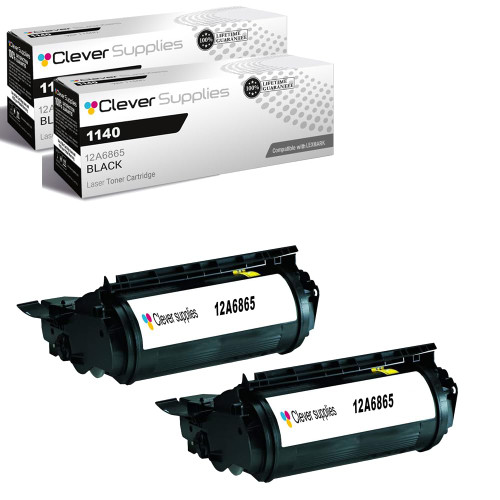
The arithmetic is the argument. Bought one at a time, two of these cartridges cost $209.44; the pair’s box is $193.37, returning $16.07 before the first page prints, and each cartridge inside works out to $96.69 against $104.72 alone. The step beyond it, to the 4-pack, buys only about one further hundredth of a cent per page — real money at fleet volume, but no reason for a single-printer office to hold four cartridges deep. One running and one waiting is how these machines are actually kept; this is the box that keeps them that way.
Shop the 12A6865 2 Pack →THE OTHER TWO BOXES
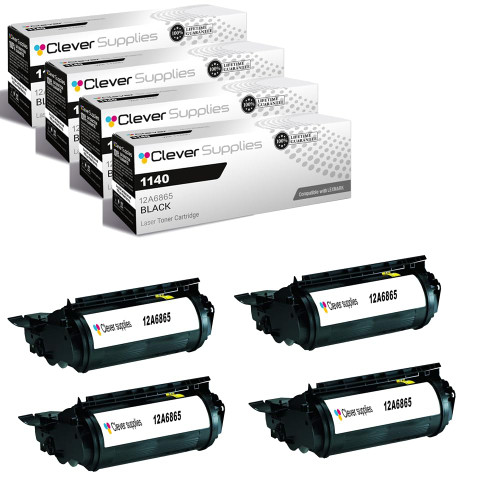
The cheapest page the shelf offers, bought with its largest single outlay — about a hundred and twenty thousand rated pages, enough to carry a hard-working department through a long stretch between orders. The same four cartridges bought singly would total $418.88.
Shop the 12A6865 4 Pack →
The smallest commitment on the shelf and its dearest page — the right box for a lightly used machine, or a first order on a printer new to the office. The full 30,000-page rating rides in it; nothing about the cartridge is reduced for being bought alone.
Shop the 12A6865 Single →Every card above is the same cartridge wearing the same rating, so choosing among them is a question of ordering rhythm — how seldom the office wants toner on its mind. The table below turns each box into its per-page figure.
Three boxes, priced by the page
A box’s rate is its sale price spread over the rated yield of everything inside it. With one code on the shelf there is no tier step to price — the rows climb by pack size alone — and the fit column repeats itself down the table, because Lexmark attaches no model restriction to this cartridge.
| Offer | Sale price | Rated pages per box | Per-page cost | Fits |
|---|---|---|---|---|
| 12A6865 4 Pack | $370.66 | 4 cartridges · ~120,000 pages | 0.31¢ | All 9 platform models |
| 12A6865 2 Pack — the flagship | $193.37 | 2 cartridges · ~60,000 pages | 0.32¢ | All 9 platform models |
| 12A6865 Single | $104.72 | 1 cartridge · ~30,000 pages | 0.35¢ | All 9 platform models |
Four hundredths of a cent separate the dearest row from the cheapest — 0.35¢ against 0.31¢ before rounding — and most of that gap closes at the first step, from single to pair. Counted per cartridge, the packs hold theirs at $96.69 in the 2-pack and $92.67 in the 4-pack, against $104.72 for one bought alone. The rows sit close enough that no choice here is a costly mistake; pick by how much printing stands between one order and the next.
Fit: nine Lexmark models the store never names
Lexmark’s record for this cartridge names nine models. Eight sit under the Lexmark T Series: the T620, T620dn, T620in and T620n, and the T622, T622dn, T622in and T622n. The ninth, the X620e multifunction, sits under the Lexmark X Series — its category here is titled “X620”, the trailing letter dropped, but it is the X620e’s page. Every name above links to that model’s own category page in this store. Lexmark attaches no restriction footnote to the cartridge for any of the nine; one cartridge serves the platform entire.
Against that roster, set what the store actually says. The six listings are named for the IBM InfoPrint 1130 and 1140. They are filed under those two categories and no others. Their Compatible Printers blocks link exactly those two pages. Their shared introduction declares the cartridge compatible with “Lexmark 1130 and Lexmark 1140 printers”, and their fit answers enumerate the same pair as if it were the whole platform. The nine Lexmark models appear on none of those surfaces, and the products are filed under none of the nine categories that exist for them — an owner browsing the T620’s category page finds no cartridge waiting there. The IBM names are not wrong: IBM’s own cross-reference makes the InfoPrint 1130 the T620 engine family and the 1140 the T622 family, so a cartridge that fits the engines fits the badges. They are simply two names where Lexmark documents nine models, and this guide prints the nine.
One rating, three witnesses — and a ladder of five
Yield, unusually for a cartridge of this vintage, needs no referee. The yield field on all six listings reads 30,000 pages for black. The descriptions repeat the figure and multiply it honestly into their box totals — 60,000 pages across a 2-pack, 120,000 across a 4-pack. And Lexmark’s North America supplies table rates the same cartridge at 30,000 pages under a footnote that declares the figure in accordance with ISO/IEC 19752. That last point matters: cartridges from this era often carry pre-standard ratings taken at roughly five percent coverage, but Lexmark declares this one under the ISO standard itself, so 30,000 pages is the rating on the modern basis, and every rate in this guide is worked from it. The listings’ own talk of standard text at about five percent coverage is the ISO test described loosely, not a rival figure.
The stocked code is one of five Lexmark built for this platform, arranged in two programs. The Return Program holds a standard cartridge, the 12A6860 at about 10,000 pages; the stocked high-yield 12A6865; and a label-applications variant, the 12A6869, at the same 30,000. The Regular program — cartridges sold outright, without the return license — holds the 12A6760 standard and the 12A6765, this cartridge’s own twin at the same rating. Of those four companions, this store lists none, in any pack size, and no product page in the family mentions any of them. The twin deserves a sentence of its own, because a spent cartridge may carry its number: in some other Lexmark families the Regular twin is stocked on a shelf of its own, but here the 12A6765 has no listing anywhere in the store — it is named in this guide so its owner knows the stocked Return Program code is the replacement on offer, not because there is a second shelf to send them to.
The label on the cartridge coming out of the printer settles which card above is yours. A label reading 12A6865 is this shelf exactly. A label reading 12A6765 names the unstocked Regular twin — same rating, same nine printers — and the stocked code stands in for it here. A label reading either standard code means the machine has been running 10,000-page cartridges; the stocked cartridge triples that rating and fits the same nine models.
What a genuine cartridge costs: there is no figure to quote
This guide prints no genuine price, because none exists that a buyer could rely on. The 12A6865 left Lexmark’s catalog years ago; its US store returned no checkout price for the part in this guide’s research, and the official US price list Lexmark publishes — the Texas DIR schedule that supplied genuine figures for other families in this series — contains no entry for any 12A6 part number at all. Lexmark’s product data for the cartridge survives in syndicated feeds and regional mirrors carrying full specifications but no US price. Figures lifted from marketplace listings or old catalogs would not be Lexmark’s price in any sense that matters, so none is quoted: no genuine price, no genuine per-page rate, and no claim of savings against genuine, here or anywhere else on this page.
What the shelf can honestly be compared against is itself. Ten thousand pages cost about $35 bought as singles, about $32 at the 2-pack’s rate and about $31 at the 4-pack’s. Stretched across a 4-pack’s whole rated life, the gap becomes plain money: 120,000 pages bought one cartridge at a time come to $418.88, against $370.66 for the four-pack box. Pack against single, at today’s checkout prices — that is the comparison this family supports, and the guide makes no other.
One unit to change — and a service call every 300,000 pages
There is no second consumable hiding behind this cartridge. The print cartridge is an all-in-one unit: the photoconductor drum rides on the cartridge’s underside — Lexmark’s Setup Guide warns the installer never to touch it — so the drum is renewed with every cartridge change, and Lexmark’s compatibility table lists no photoconductor or imaging unit for this platform at all. Nothing else has to be budgeted, stocked or timed against the toner; the unit that comes out spent is the unit that goes in new, print quality resetting with it.
The platform’s one other scheduled supply event belongs to the printer, not the shelf. At 300,000 pages the machine raises its scheduled-maintenance prompt for a kit of fuser assembly, charge roll and transfer roll — technician parts, ordered through Lexmark’s parts center. This store sells no kit or part for the platform, and no price is quoted here; the interval is named so it sits on the record. At this cartridge’s rating, that service call lies about ten cartridges away.
What the printer starts life with, this guide leaves blank on purpose. The Setup Guide shows a print cartridge shipping in the printer’s box and being installed during setup, but no Lexmark source retrieved for this guide states that cartridge’s part number or its yield. Rather than guess at a starter figure, none is printed.
Chips and firmware: this shelf makes no claim at all
Search the family’s six listings for the word chip and it does not appear — no chip field, no smart-chip boilerplate of the kind the store’s modern families carry, and no mention of firmware in either direction. That silence is itself the record, and this guide reports it as found. The platform is not historically innocent in the matter: the genuine Return Program cartridges of this generation carried Lexmark’s Prebate authentication chip, the device at the center of the Lexmark v. Static Control litigation — but that chip belongs to Lexmark’s genuine program and its terms, not to anything sold on this page.
Lexmark’s documented position, from the T620/T622 User’s Reference, is that it does not recommend third-party cartridges and cannot guarantee print quality or printer reliability with them, and that the print cartridge warranty is voided by unauthorized refilling. No firmware-blocking statement was found in the platform’s guides, and no dynamic-security regime of the newer kind is documented for these machines — none is described here, because none exists to describe.
What can be said of the cartridges carded above is the store’s standing fact: they are built with the latest-generation components from a supplier whose chipped products have a trouble-free record, they install and print without any chip transfer from the cartridge being replaced, and no promise is made here about firmware that does not yet exist — the one line this store never writes, stated on every guide in this series.
What backs each cartridge
Pick the box by the month’s volume
Answers for the T620, T622 and X620e owner
Nine models, per Lexmark: the T620, T620dn, T620in and T620n; the T622, T622dn, T622in and T622n; and the X620e multifunction. Lexmark’s North America compatibility table and its own product data for the cartridge name the same nine, with no restriction attaching to any of them, and every one of the nine has a category page in this store. One caution: the product pages answer this question with two names — the IBM InfoPrint 1130 and 1140 — because the listings are named and filed under the IBM badges. Those badges are genuine fits, but they are two names for the same engines, not the roster; the nine above are the roster, and the cartridge serves all of them.
Yes. IBM sold these engines under its own badges: its cross-reference chart makes the InfoPrint 1130 the T620 family and the InfoPrint 1140 the T622 family. The listings in this store are named for those badges and filed under their categories, which is how you likely arrived here. The cartridge is Lexmark’s 12A6865 either way, and it fits the IBM-badged machines on exactly the same terms as the Lexmark-named ones.
In Lexmark’s catalog, both. A standard rung rated at about 10,000 pages exists as the 12A6860 in the Return Program and the 12A6760 sold outright, and the stocked cartridge has a Regular twin, the 12A6765, at the same 30,000-page rating; a label-applications variant, the 12A6869, completes the ladder. In this store, none of the four has a listing in any pack size, and no product page mentions any of them. The twin in particular has no shelf anywhere in the store — there is no second place to send you — so the choice on this page runs by pack size rather than by tier or program.
No. On this platform the drum is part of the cartridge: it sits on the print cartridge’s underside, and changing the cartridge changes the drum with it. Lexmark’s compatibility table lists no photoconductor or imaging unit for the T620 line at all. The platform’s only other scheduled supply event is a technician-fitted maintenance kit at 300,000 pages — a service item from Lexmark’s parts center, not a consumable, and not something a toner order needs to cover.
A print cartridge ships in the box — the Setup Guide has the installer unpack and install it — but no Lexmark source retrieved for this guide states that cartridge’s part number or rated yield. Rather than print a starter figure that cannot be verified, this guide prints none; what can be said is that the first cartridge you buy at retail will be a full-rated one, at the 30,000 pages the stocked code carries.
Because the two sets of sums start from different prices. The product pages do their arithmetic on the struck-through list price; this guide does its arithmetic on the price checkout charges. The single’s page therefore divides $120.43 and reports about 0.40¢ a page, where dividing the $104.72 actually charged gives 0.35¢. The 2-pack’s page shows an $18.48 saving where the sale prices give $16.07. The 4-pack’s page claims $55.47 saved — a figure a cent adrift even on its own list basis, which gives $55.46 — where the sale prices give $48.22. The workings are set out in full in the note below.
Price and disclosure note: Prices here are checkout prices — the sale figure on each product’s own storefront page, matched title by title against the listing on November 17, 2026 and confirmed live once more before publication. Each listing also shows a higher list price; if a promotion ends, the product page governs. A SAVE badge is the gap between a pack’s sale price and the cost of its cartridges bought one at a time at sale prices — $209.44 for two singles, $418.88 for four — which is where the $16.07 and $48.22 badges come from. No genuine Lexmark price appears in this guide, for a simple reason: none could be verified. Lexmark’s US store returned no checkout price for a cartridge discontinued this long, and its official US price list — the Texas DIR schedule on lexmark.com — contains no entry for any 12A6 part number. With no genuine figure of record, the guide makes no genuine per-page rate and no savings-versus-genuine claim. On yield there is nothing to choose between: the listings’ yield fields read 30,000 pages, their texts repeat the figure and carry it into their pack totals, and Lexmark’s North America supplies compatibility table declares the same 30,000 pages in accordance with ISO/IEC 19752. The sibling rungs’ figures — 10,000 pages for the two standard codes, 30,000 for the label variant and the Regular twin — rest on Lexmark’s table alone, no listing stating them. Fit throughout follows Lexmark’s own documentation: its compatibility table and its product data for the cartridge. Measured against that record, the store’s own pages depart in four recorded respects. The first is fit: every surface in the family names only the IBM InfoPrint 1130 and 1140 — the listings’ titles, their category filing, their printer link blocks and their fit answers alike — where Lexmark documents nine models, and the products are filed under none of the nine roster categories, although every one of those categories exists in the store. The IBM names are genuine fits for the same engines; the departure is omission, not error. The second is price basis. Every savings and per-page figure in the six listings’ questions and About text is computed from list prices: the single is put at about 0.40¢ a page from its $120.43 list price, where the $104.72 sale price gives 0.35¢; the 2-pack claims an $18.48 saving ($240.86 of singles against a $222.38 pack) and $111.19 a cartridge at about 0.37¢, where sale prices give a $16.07 saving ($209.44 against $193.37) and $96.69 a cartridge at 0.32¢; the 4-pack is put at $106.57 a cartridge at about 0.36¢, where sale prices give $92.67 a cartridge at 0.31¢ and a $48.22 saving. The third departure is a single cent: the 4-pack texts claim the pack is $55.47 less than four singles bought at list, where four list singles total $481.72 against a $426.26 pack — a difference of $55.46, so the claim is wrong even on the basis it chose. The fourth is naming: all six descriptions open with a shared introduction headlining the 1130 cartridge, so the three listings named for the 1140 — including the three carded above — introduce themselves under the other badge’s name.
The card set above is complete, and it is drawn from one of the family’s two naming sets deliberately. The family holds six listings: the same three configurations listed once under the IBM InfoPrint 1140 name and once under the 1130, at identical prices. The 1140 set is carded because its three SKUs run in one uniform pattern; each configuration appears exactly once, and the parallel 1130 set is not carded a second time. The family’s one SKU defect sits in that uncarded set — the 1130 2-pack’s SKU reads “2Balck” — and no “genuine” or “authentic” product wording appears anywhere in the family. Of the rest of Lexmark’s ladder for this platform, nothing is stocked in any pack size: not the standard codes (12A6860, 12A6760), not the label variant (12A6869), and not the Regular high-yield twin (12A6765), which — unlike the twins of some other families in this series — has no shelf of its own anywhere in the store. No photoconductor or imaging unit exists for this platform — the cartridge is all-in-one — and the 300,000-page maintenance kit is a technician service item this store does not sell, so no part is quoted for it here beyond the interval. No Lexmark source retrieved for this platform states a ships-with or starter yield, so this guide prints none. On chips: no listing in this family carries a specification field for one, the word chip appears nowhere in its six descriptions, and firmware is mentioned nowhere. Behind every offer stands the cover its listing promises — warranty against defects in materials and workmanship for twelve months, and free returns for the whole of the first year.