




Begin with the fact the rest of this page is built around: HP designed the LaserJet 1150 to run on a single cartridge, the Q2624A — the 24A — and rated it at 2,500 pages. This store does not sell that cartridge. Not one listing offers it. Everything a buyer can actually order for the 1150 here wears a different code, Q2624X, and carries a 4,000-page rating that comes from the store, not from HP; no HP document rates any 1150 cartridge at 4,000 pages. Above that shelf floats a second store tier claiming 7,000 pages, listed twice under two codes of its own, with every one of its listings switched off. What follows prices the four buyable offers at the sale figures checkout charges, keeps the store’s rating labeled as the store’s wherever it is used, and sets HP’s 2,500 beside it so the gap between the two numbers is never hidden.
Short of time? The four-pack at $111.74 is the buy for anyone who prints steadily: it pools the shelf’s lowest per-page rate and takes the largest of three genuine pack savings. The two-pack at $63.91 and the three-pack at $87.83 sit between it and the single at $39.99, each undercutting its own count of singles by a stated amount. Every card on the page is the same Q2624X cartridge in a different count, and every per-page figure is worked from the store’s 4,000-page rating for that code — printed here as the store’s number, never dressed as HP’s. HP’s own figure for this printer’s cartridge is 2,500 pages, and it belongs to the Q2624A this catalog does not stock. A reader who wants the manufacturer’s cartridge and nothing else will not find it below; a reader who wants the 1150 fed today is choosing among four counts of one store-rated cartridge, and the choosing is straightforward.
Four cartridges in one box — the pack the arithmetic picks out
A one-printer platform rewards stocking up, and the four-pack is where this shelf’s arithmetic lands. Four singles at their sale price total $159.96; the pack is $111.74. The $48.22 between them is the largest saving in the family, and it earns its badge the strict way — sale set against sale, the only basis a buyer ever actually pays on. Pooled over four cartridges, the pack also prints the cheapest page the shelf offers: 0.698¢ against the single’s full cent. The panel beside the card deals with the tier that cannot be bought at any price, because a buyer browsing this family will meet its listings and deserves to know why none of them appears as a card.

Buying four at once suits the way a 1150 earns its keep: a small office printer that nobody wants to think about until the pages fade. Four complete renewals on the shelf means the next three cartridge changes are already settled, each unit independent of the others and spent one at a time. The pooled rate assumes all four are eventually used; on a platform with a single printer model and a single cartridge fit, that is the ordinary course of things rather than a gamble.
Shop the 24X 4-Pack →All four listings claim the same 7,000 pages for the same printer, and no HP source states that figure for any cartridge — it belongs to neither code, because neither code is HP’s. Since none of the four can be ordered, the tangle costs a buyer nothing but confusion; it is set out here so the confusion has an explanation. Should the tier ever be switched on, it would still arrive as a store-rated variant and would be labeled exactly that way.
The rest of the ladder, rung by rung
Below the flagship the shelf descends in even steps: three cartridges, then two, then one. Nothing changes but the count — the cartridge inside is the same Q2624X on every rung, with the same store-stated rating and the same all-in-one construction. What the rungs trade is money against commitment: each step down buys fewer renewals at a slightly worse rate, and the two middle rungs carry honest savings of their own, measured the same strict way as the flagship’s. The single at the foot of the ladder is the yardstick the other three are measured against, which is why it wears no badge — a cartridge compared with itself has nothing to save.
THREE MORE COUNTS OF THE SAME CARTRIDGE
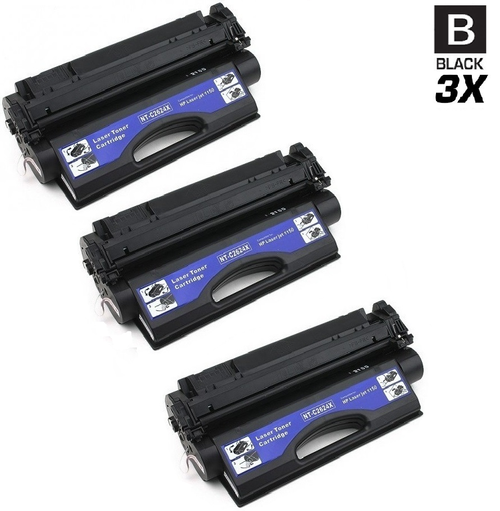
The middle stock-up: three complete renewals at a rate within a whisker of the flagship’s, for a printer whose cartridge changes are measured in months rather than weeks. Against three singles at $119.97, the pack hands back $32.14.
Shop the 24X 3-Pack →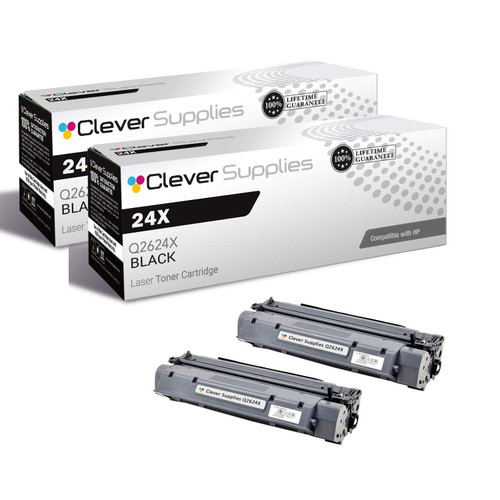
One cartridge for the printer and one for the shelf — the working-plus-spare arrangement in a single box. Two singles would total $79.98; the pair is $63.91, and the $16.07 difference is the smallest of the three pack savings, honestly come by.
Shop the 24X 2-Pack →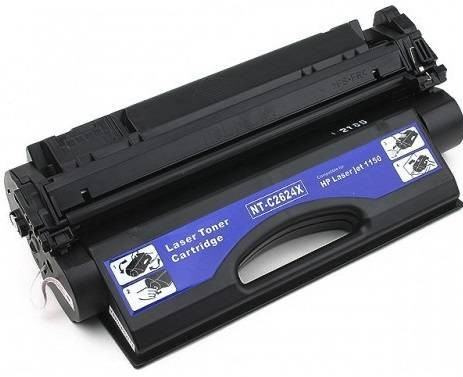
The family’s only buyable single, and the price every pack on this page is measured against. One complete renewal — toner and drum renewed in the same swap — at a round cent a page on the store’s rating.
Shop the 24X Single →The whole shelf on a single basis
Four buyable rows, each dividing a sale price by the store’s stated rating; the pack rows say “pooled” because their pages are spread across separate cartridges. A fifth row is carried as a record, not an offer — HP’s genuine cartridge, included because a buyer who checks HP’s documentation will meet it there first, and its figures deserve to be stated accurately. It has no price in this table because this store does not sell it:
| Offer | Sale price | Rated pages | Cost per page | Fits |
|---|---|---|---|---|
| 24X 4-Pack — the flagship | $111.74 | 4 cartridges · ~16,000 pages (store rating) | 0.698¢ pooled | LaserJet 1150 |
| 24X 3-Pack | $87.83 | 3 cartridges · ~12,000 pages (store rating) | 0.732¢ pooled | LaserJet 1150 |
| 24X 2-Pack | $63.91 | 2 cartridges · ~8,000 pages (store rating) | 0.799¢ pooled | LaserJet 1150 |
| 24X Single | $39.99 | 1 cartridge · ~4,000 pages (store rating) | 1.000¢ | LaserJet 1150 |
| 24A Genuine (Q2624A) — not stocked | Not sold here | 1 cartridge · ~2,500 pages (HP rating) | — | LaserJet 1150 |
Read the ladder from the bottom up and its shape is plain: the per-page rate improves with every added cartridge, from a full cent for the single down to just under seven-tenths of a cent pooled in the four-pack, and the three savings badges on the cards above are simply that slope expressed in dollars. One caution governs every number in the table: the rated pages are the store’s 4,000 a cartridge, not HP’s. On HP’s 2,500-page basis the same shelf would price out dearer per page — the yields section below puts the two rulers side by side and explains where the longer one came from.
The genuine cartridge contributes no price to this table. There is no page for the Q2624A in HP’s US store — it was discontinued long ago — so no manufacturer figure exists to set against the store’s, and none has been invented to fill the space.
One printer — and three variants that exist only in listings
HP’s manual for this platform lists a single configuration: the LaserJet 1150, connecting by USB or parallel, with networking available only through optional add-on cards rather than a factory network model. That one printer is the entire roster for every tier in this family, genuine and store-made alike, and the store gathers the family under its HP Q2624A category — named, with some irony, for the genuine cartridge that no listing under it actually sells. Against that single-model roster, every description in the family claims more: each states compatibility with a 1150dn, a 1150dtn and a 1150hdn alongside the 1150. HP never built any of the three; the suffix pattern belongs to other LaserJet lines, and no such machines exist to be fitted. The over-claim is recorded in the disclosure below; this page links to none of the three — the phantom variants even have store categories of their own, which this guide leaves alone.
The practical check is the one printed on the cartridge coming out of the machine. If the spent unit reads Q2624A — the genuine cartridge HP supplied — the cards above are its stocked successors, the same fit in the store’s higher-rated fill. If it reads Q2624X, the same answer holds. A code reading anything else belongs to a different family entirely: the LaserJet 1300, this printer’s sibling in the same HP manual, takes the Q2613 line and shares nothing with the shelf above beyond the book its documentation was printed in.
Whose number is 4,000? Not HP’s
Every per-page figure on this page is built from 4,000 pages a cartridge, so the figure’s parentage matters. It is the store’s. The listings’ spec fields state it, their prose repeats it, and the math here runs on it because it is the rating attached to the cartridges actually being sold — labeled as the store’s rating in every place it is used. HP’s number for this printer is different and smaller: the manual that covers the 1150 specifies a 2,500-page print cartridge for it, and its supplies table gives exactly one order number for the printer, Q2624A. That rating dates from the cartridge’s era: an average coverage of five percent a page, the yardstick in use before yield testing was standardized under ISO/IEC 19752 — and no HP source of any era states 4,000 pages for a 1150 cartridge. Set side by side, the store’s figure is 1.60 times HP’s: a buyer is being offered a longer ruler, and is entitled to know whose hand holds it.
Where might 4,000 have come from? The same HP manual covers a second printer, the LaserJet 1300, and the 4,000-page cartridge in that book is the 1300’s Q2613X. The store’s figure matches the sibling platform’s rating exactly. That is stated as a match and no more — this page does not assert the number was transplanted, only that it coincides with the rating of a different printer’s cartridge and appears in no HP document for this one. One further wrinkle deserves stating in full, because it cuts the other way and honesty runs in both directions: HP’s own regulatory paperwork does pair an X with this family. An HP IT Eco Declaration gives the print-supply identity as “Q2624A/X”, and an HP Declaration of Conformity lists “Q2624A-X” among its model numbers. So the X suffix is not foreign to HP’s files. But neither document presents an X cartridge as a distinct product, states a yield for one, or offers one for sale — the only rating HP ever published for the 1150’s cartridge remains 2,500. The dark tier’s 7,000, finally, has no source of any kind behind it: no HP document, and nothing beyond the listings’ own say-so.
Toner and drum in a single shell — and the listings say so correctly
The 1150’s cartridge was designed as a complete print unit: the imaging drum lives inside the same shell as the toner, and HP sells no drum part, drum code or drum schedule for this printer. A cartridge change therefore renews the image-forming path entire — there is no second consumable quietly aging behind the first, and no separate drum budget to plan. On this point the listings can be taken at their word, because their word was checked: the descriptions state that the drum is built in and that no separate drum unit needs budgeting for, and HP’s design bears them out. Not every family in this catalog survives that check; this one does, and the guide says so as plainly as it reports the families that fail it.
The cartridge’s chip asks nothing of the buyer either. Each unit arrives with the supplier’s current chip generation already in place — the standing practice for this store’s compatible cartridges, and one with an unblemished history: not a single chip complaint has been returned on a cartridge supplied this way. Fitting is plug-and-play in the literal sense — seat the cartridge, and the printer accepts it and reports its toner level; no chip is salvaged from the spent unit and none needs transferring. The assurance has an honest edge to it: it speaks for cartridges as supplied today and for the track record built up so far, and it does not pretend to guarantee anything against firmware HP has yet to release.
The terms that travel with every card
Four products are carded here, and the terms below apply to all four alike — stated once, in one place, instead of four times over.
Picking a rung
Questions from LaserJet 1150 owners
Not as a product HP ever sold. HP’s cartridge for the 1150 is the Q2624A alone — its code list and the printer’s manual name nothing else — and no HP source rates an X cartridge or prices one. The X suffix does appear in HP’s regulatory paperwork, in the combined identity “Q2624A/X”, but that pairing comes with no product, no rating and no price attached. The Q2624X carded here is the store’s variant of the same fit, and its 4,000-page figure is the store’s rating, printed as such throughout this guide.
The catalog simply carries no listing for it — every buyable offer in this family wears the store’s X code instead. The absence is thorough enough that the store’s family category is named “HP Q2624A” while holding none. A buyer set on HP’s own cartridge, at HP’s 2,500-page rating, has to look elsewhere; a buyer here gets the store-rated variant, in four counts, with the difference between the two ratings stated rather than smoothed over.
They exist as listings and as nothing else. The 7,000-page tier appears twice in the catalog — under the code Q2624XX, visible but with availability disabled, and under Q2624XJ, invisible as well — at two different price levels for the same claimed products. Inside the first pair, the stock codes say XJ while the names say XX; inside the second, one listing carries a two-pack’s stock code under a name stating no count, priced exactly like its single. None of the four can be ordered, and no source outside the listings themselves supports the 7,000 figure.
There is no 1150dn. HP built the LaserJet 1150 in a single configuration; the dn, dtn and hdn variants named in every listing’s compatibility line were never manufactured, and networking on a real 1150 came from optional add-on cards, not from a separate model. If your machine is a LaserJet 1150 — the only version there is — the cartridges on this page fit it. If the badge on the machine says anything more than 1150, it is a different printer and a different family.
It does not. Toner and imaging drum are sealed into the one cartridge, and HP offers no drum part for the machine at all — nothing with its own code, its own rating or its own replacement schedule. Each swap renews both together. The listings say the same, and on this point they were checked against HP’s design and are right.
Twelve months of each, starting at delivery: the warranty runs a full year, and returns stay free for the same year, on the terms each product page sets out. Those are the operative terms — a “Lifetime” warranty line appears in the boilerplate of some older descriptions in this family, but it contradicts those same pages’ own warranty answers, and the one-year terms are the ones this guide prints. Support runs weekdays, 9 AM to 5 PM Central, and orders ship from warehouses in Illinois, Pennsylvania, Georgia and California.
Price and disclosure note: Prices above are sale prices, taken from each carded product’s own page on November 18, 2026 as this guide was prepared; if one has since moved, the product page is the authority. Sale is used throughout because sale is what checkout charges. The listings’ own prose works from list instead — $45.99 for the single, $73.50 for the two-pack, $101.00 for the three-pack, $128.50 for the four-pack, and $46.12 for each of the dark tier’s second pair — and builds its price answers on those amounts; one dark listing even computes its per-page figure, “roughly two-thirds of a cent”, from its list price. No description’s text ever mentions the sale price. The three savings badges on this page are measured sale against sale: two singles total $79.98 against the two-pack’s $63.91, three total $119.97 against $87.83, and four total $159.96 against $111.74. Each yield figure arrives with its source attached: 2,500 pages for the genuine Q2624A, HP’s figure, measured on the five-percent coverage basis of its era; 4,000 pages for the Q2624X, the rating the store attaches to its own variant, matching the figure HP published for the sibling LaserJet 1300’s cartridge and stated nowhere by HP for this one; and 7,000 pages for the dark tier, which no source supports. No genuine price is printed for this family: HP’s US store has no page for the Q2624A, and nothing has been estimated to stand in for one. Fit follows the roster HP published, which contains one model: the LaserJet 1150. Then the catalog’s own disorder, item by item.
First, the missing genuine cartridge: HP’s only 1150 cartridge has no listing anywhere in the store, while the family category fronts the shelf under its name — a buyer who follows HP’s documentation to the letter finds no product that matches it. Second, the ratings: every figure on the buyable shelf is a store figure wearing an HP-style code, the 4,000 matching a sibling platform’s rating rather than any HP figure for this printer, and the 7,000 supported by nothing at all. Third, the doubled dark tier: the 7,000-page products are listed twice, under two invented codes, at two price levels, with every listing switched off — one pair’s stock codes contradicting its names, the other pair containing a listing whose stock code promises two cartridges under a name that states no count, priced identically to its single. Fourth, list-price arithmetic, as noted above: every price figure in every description is a list figure, while checkout charges the sale figure. Fifth, fit over-claimed across the family: every description names three printer variants HP never made, and three visible store categories stand for those same nonexistent models, with the family’s listings filed under them. Sixth, a warranty contradiction in the older descriptions: a boilerplate line reading “Warranty: Lifetime” sits in five of them, flatly against the one-year warranty their own question-and-answer sections promise; the four newer descriptions do not carry the line, and this guide prints the operative one-year terms. Seventh, filing in the wrong tree: the four newest listings — two of the four products carded here among them — sit under the store’s color LaserJet tree for a monochrome printer, absent from the family category and the monochrome series category alike, with the 1150’s model category duplicated inside the color tree; neither series parent page is linked here, both returning server errors in the live store. Eighth, stock figures that echo: the same recorded figure of 25 is read by five listings across the family, and 12 by two more, the same pools counted across single and pack, live and dark listings alike. Ninth, misspellings baked into the catalog: three product names spell the word “Cartirdge”, and the error is carried into the web addresses of two of the carded products, which are linked from this page exactly as they stand, misspelling and all. Not defects, for the record: no description in the family leaks production or prompt text, and the listings’ statements that the drum is built into the cartridge were checked against HP’s design and are true. One cosmetic artifact: each description leads with an image instead of text.
The buyable shelf is carried by four cards, each product appearing exactly once; the dark tier is dealt with in prose, where a tangle can be explained instead of merely displayed, and the genuine cartridge’s absence is stated where a buyer will meet it first rather than discovered where they would meet it last. The roster stops where HP stops: one printer, one genuine cartridge that is not sold here, and one store-rated variant standing in its place, named for what it is. Every rating is printed with its source attached — HP’s figure signed by HP, the store’s figures signed by the store, and the figure with no signature not offered for sale at all. Underneath sit the terms carried on the family’s own product pages — twelve months of warranty, twelve months of free returns, support on weekdays from 9 AM to 5 PM Central, and shipping from warehouses in Illinois, Pennsylvania, Georgia and California.