




Twelve Brother printers share one toner platform and one drum, and for eleven of them the story ends at the middle tier. The TN770 sits above that platform as its third and largest cartridge — rated by Brother at about 4,500 pages where the TN760 manages about 3,000 and the TN730 about 1,200 — yet Brother sells it for only four of the twelve machines. That single restriction rearranges everything about buying this cartridge: the first question is never which box to pick, it is whether your printer is allowed to use the box at all. This guide therefore opens with the fit check, names the four printers Brother approves and the eight it leaves out, and only then turns to the arithmetic — which, once the fit is settled, is short and satisfying: three boxes, no duplicates, and every saving on the page provable against a real single cartridge.
The short answer: TN770 belongs to the HL-L2370DW, HL-L2370DW XL, MFC-L2750DW and MFC-L2750DW XL — and to no other printer, whatever wider lists you may meet elsewhere. Owners of those four will find their default buy in the 2-pack at $35.99 (about 0.40¢ a page); heavier printing earns the 4-pack at $55.89 (about 0.31¢). Everyone else on this platform tops out at the TN760, and this guide will point you to the page that covers it rather than sell you a cartridge your printer cannot run.
Find your model first. If it reads HL-L2370DW, HL-L2370DW XL, MFC-L2750DW or MFC-L2750DW XL, this page is yours: the 2-pack at $35.99 covers ordinary use with a spare in reserve, and the 4-pack at $55.89 is the heavy printer’s version of the same idea. If your model is any other machine on this platform — a HL-L2350DW, a DCP-L2550DW, an MFC-L2710DW and their relatives — TN770 is not made for it; your ceiling is the TN760 at about 3,000 pages, and the section below shows you where that cartridge is covered in full.
Step one: is your printer one of the four?
Brother USA’s own page for the TN770 names exactly four printers under “For use with”: the HL-L2370DW, the HL-L2370DW XL, the MFC-L2750DW and the MFC-L2750DW XL. Every card further down this page fits those four machines and no others. The store’s own shelf agrees with Brother to the letter — each TN770 listing here is filed under exactly those four categories — so the cards and the manufacturer tell the same story, which is rarer in this catalog than it should be.
The eight platform-mates left off Brother’s TN770 list deserve naming, because their owners are the readers most likely to land here by mistake: the DCP-L2550DW, HL-L2350DW, HL-L2390DW and HL-L2395DW, and the MFC-L2690DW, MFC-L2710DW, MFC-L2717DW and MFC-L2730DW. These are not lesser printers being fenced out of a premium extra; Brother simply does not publish the TN770 for them, and a cartridge a manufacturer does not publish for your model is not a cartridge to experiment with. For those eight, the largest approved cartridge is the TN760 at about 3,000 pages — a genuinely good ceiling — and it is covered end to end, packs, drum bundles and all, in our Brother TN760 buying guide. That page, not this one, is the right read for two-thirds of this platform’s owners.
One wider list needs addressing directly, because it sits in this very store. The genuine TN770 listing on our shelf describes the cartridge as fitting nine platform models — several of the eight above included. Brother’s published list is four, the compatible listings on the same shelf name the correct four, and where any description and the manufacturer part company, this guide follows the manufacturer. If you arrived here from that genuine listing with a HL-L2390DW in front of you, the four-model list is the one to trust.
Past the fit check: three boxes, one cartridge
Once a printer passes the fit check, this family becomes the simplest shelf in the Brother wave. The TN770 is a single cartridge with a single rating — about 4,500 pages under ISO/IEC 19752 — and the store stocks it in exactly three boxes: one cartridge, two, or four. There are no duplicate listings wearing different titles, no near-identical offers to disentangle, and no bundle hiding a drum inside. What changes from box to box is purely the price of a printed page: about 0.58¢ from the single, about 0.40¢ from the 2-pack, about 0.31¢ from the 4-pack. Every saving quoted below is measured against the single’s shelf price of $26.03, so you can redo each sum yourself: two singles cost $52.06, four cost $104.12.

A 4,500-page cartridge already asks little of a buying schedule, and the second cartridge in this box is what turns “little” into “almost none”. Most owners of these four printers print in bursts — a contract run, a school term, a tax season — and bursts are exactly when an empty cartridge does its damage. The 2-pack prices that insurance at $9.96 over the single ($35.99 against $26.03) while cutting the per-page figure by nearly a third, which is why it leads this page: it is the box we would hand to the median owner of a HL-L2370DW or MFC-L2750DW without asking another question.
Shop the 2-Pack →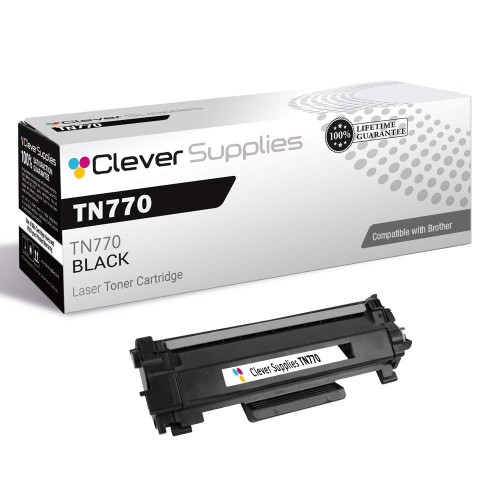

Choosing between the three is a question about your printer’s appetite and nothing else, because the cartridge inside never changes. A lightly used home machine may take two years to empty one TN770, and for it the single is the honest buy — money parked in spare toner earns nothing. A small office that prints daily lives at the other end: four cartridges at $13.97 apiece is the cheapest black printing this platform offers anywhere, and the 4-pack’s $48.23 saving against singles is real money rather than a rounding error. The 2-pack holds the middle, which is where most of these four printers actually live.
The whole shelf on one table
Three compatible offers and one reference row. The genuine Brother cartridge is included so the compatible figures have an honest frame around them; it is not carded or linked anywhere on this page, and its price below is the one on our own shelf — which happens to match Brother’s own store price for the cartridge to the cent.
| Offer | What is inside | Brother rating | Price | Cost per page | Against buying singly |
|---|---|---|---|---|---|
| TN770 2-pack | Two TN770 cartridges | About 9,000 pages in total | $35.99 | About 0.40¢ | SAVE $16.07 vs two singles |
| TN770 4-pack | Four TN770 cartridges | About 18,000 pages in total | $55.89 | About 0.31¢ | SAVE $48.23 vs four singles |
| TN770 single | One TN770 cartridge | About 4,500 pages | $26.03 | About 0.58¢ | — |
| Genuine Brother TN770 single | One genuine cartridge (reference only) | About 4,500 pages | $147.49 | About 3.28¢ | — |
The tier ladder behind the table, priced at Brother’s own store: the TN730 costs $55.79 for about 1,200 pages (about 4.65¢ a page), the TN760 $98.29 for about 3,000 (about 3.28¢), and the genuine TN770 $147.49 for about 4,500 (about 3.28¢ again). Read honestly, the genuine top tier buys you longer stretches between cartridge swaps rather than cheaper pages — the per-page figure at Brother’s prices is the TN760’s equal. What changes the per-page story entirely is the compatible shelf above, where the same 4,500-page rating starts at 0.58¢.
The drum stays the same — and stays separate
Moving up to the TN770 changes nothing underneath the cartridge. All three tiers of this platform — TN730, TN760 and TN770 alike — work over the same DR730 drum unit, which Brother rates at approximately 12,000 pages. A drum therefore outlasts roughly two and two-thirds TN770 cartridges, and a printer that has been running TN760s needs no new drum, no conversion and no fresh decision when its first TN770 goes in: the running gear is identical, only the toner box grew.
One shelf difference between this tier and the one below is worth stating plainly. The TN760 tier is sold in this store in toner-and-drum combination boxes; the TN770 tier is not — no TN770-plus-DR730 bundle exists here, in any pack size. When a drum message eventually appears, the drum is a purchase of its own (Brother’s own price for the DR730 is $129.49), and it is covered in full — what it is, when it is actually worn, and the cartridges it pairs with — on our TN760 guide for this platform, which treats the drum as a headline item rather than a footnote.
The practical consequence is small but real: budget the drum separately from the start, and do not let a fading page talk you into a toner order when the drum is the worn part. Print that stays pale or streaked after a fresh TN770 has gone in is the drum asking for attention, and at a 12,000-page rating most of these printers will ask at most once or twice in their working lives.
Chips: nothing claimed, and why
This page makes no chip claim for the TN770, and the census behind that restraint takes one sentence: across all three compatible listings in this family, the word “chip” appears not once — no fitted-chip statement, no recognition promise, no monitoring claim of any kind. A guide that invented one would be decorating a product with words its own listing never wrote, so the subject is closed here rather than padded out.
What can be said with a source behind it comes from Brother rather than from any listing. On its US help site, Brother states in writing: “Brother firmware updates do not block the use of third-party ink and toner cartridges in our machines.” That is the manufacturer’s own published position, and it is the only statement on this subject this page is willing to stand behind — alongside the things it can prove outright: which four printers these cartridges fit, what Brother rates them at, and what they cost on the shelf today.
Before you order: the TN770 checklist
Frequently asked questions
No — and this is the question this whole page exists to answer before checkout rather than after delivery. Brother publishes the TN770 for four machines only: the HL-L2370DW, HL-L2370DW XL, MFC-L2750DW and MFC-L2750DW XL. The HL-L2395DW sits on the same platform and shares the same drum, but its approved ladder stops at the TN760, rated at about 3,000 pages. That cartridge, its packs and its drum bundles are covered in our TN760 guide for this platform.
Brother does not publish a technical explanation alongside its fit lists, and this guide will not invent one. What is documented is the list itself: on Brother USA’s TN770 page, the “For use with” roster runs to the two HL-L2370DW models and the two MFC-L2750DW models, and the HL-L2350DW is not on it — while it appears in full on Brother’s TN730 and TN760 pages. Model names that differ by a few digits routinely conceal different product generations on this platform, and the safe reading of any fit question is the manufacturer’s roster for that specific cartridge, not the family resemblance of the badges.
It depends entirely on the rate at which the printer works. Four cartridges hold about 18,000 rated pages between them: a shared office machine printing 1,000 pages a month works through the box in about a year and a half and banks the full $48.23 saving against singles, while a home printer at 100 pages a month would still be on its second cartridge years from now, with the saving locked up in a cupboard. The per-page figure — about 0.31¢, the lowest on this shelf — is real either way; the question is how long you are willing to wait to collect it. Most owners land on the 2-pack for exactly this reason.
On this compatible shelf, the TN770 single works out to about 0.58¢ a page at its 4,500-page rating, falling to about 0.31¢ in the 4-pack. At Brother’s own prices the comparison holds a small surprise: a genuine TN760 at $98.29 over about 3,000 pages and a genuine TN770 at $147.49 over about 4,500 pages both land at about 3.28¢ a page — at the manufacturer’s counter, the bigger cartridge buys fewer interruptions rather than cheaper printing. The compatible shelf is where the per-page gap actually opens.
Neither. The DR730 drum serves all three tiers of this platform and is rated at approximately 12,000 pages, so a printer moving from TN760 to TN770 keeps its drum, its settings and its habits — the only change is a toner box that lasts about half again as long between swaps. Note that this store sells no TN770-and-drum combination box, so when the drum’s own turn comes it is bought on its own; our TN760 guide for this platform covers the drum in full.
The three compatible offers carded above carry this store’s own backing: a twelve-month warranty, and twelve months to return a compatible product that is not right for you. The genuine Brother cartridge quoted for reference carries Brother’s warranty instead, and genuine returns close at 30 days. Orders ship from the closest of our four warehouses — Illinois, Pennsylvania, Georgia or California — and the support desk is staffed Monday to Friday, 9 AM to 5 PM Central.