




A generation of Brother fax machines and workgroup printers from the turn of the century is still on duty in warehouses, clinics and back offices, and twenty-four of those models form their images on this one drum. Brother never retired the part: its own product page still sells the genuine DR400 today and prints the rating right in the title — approximately 20,000 pages. The compatible shelf here is a short, honest ladder of three boxes, a single drum, a 2-pack and a 4-pack, each listed exactly once. What follows prices that ladder at the figures checkout charges, puts the genuine drum beside Brother’s identical price for it, and corrects a habit all three compatible listings share — arguing their prices from the list figure instead of the selling one.
The ladder first. A lone compatible DR400 drum costs $44.11. The 2-pack lowers the per-drum figure to $36.07 and saves $16.08 over two singles; the 4-pack lowers it again to $32.05 and saves $48.25 over four. Brother’s genuine drum is stocked here at $227.29, which is also, to the cent, what Brother charges for it on its own site — no premium hides in this family’s genuine row, and the page says so plainly. Two warnings travel with the shelf. All three compatible listings quote list prices as though they were selling prices, so their prose overstates every price and every saving by roughly fifteen percent; the figures on this page come from checkout instead. And the two packs wear “Toner Cartridge” titles over boxes that hold drum units and nothing else — the cards below name each part for what it is.
Three boxes, three listings: a ladder with nothing doubled and nothing bundled
Catalog quirks shape many of these guides, so the plainest fact about this shelf deserves its own sentence: each offer here exists exactly once. There is no twin listing of the single to choose between, no duplicate of either pack, and no toner-and-drum combination box at any size — the store sells the drum three ways and the toner separately, full stop. What a shopper sees on the shelf is the whole shelf, and the three cards below are its three rungs: buy one drum, buy two at a lower unit price, or buy four at the ladder’s floor.
The one naming fault sits on the two packs. Their headlines announce toner cartridges, and their specification rows file the contents as a laser cartridge — yet both boxes hold drum units exclusively, and the questions their own help text answers are drum questions: how long the unit lasts, when its counter calls, how the swap is done. The single and the genuine listing carry correct drum titles. This page follows the contents rather than the headlines: every offer below is labeled a drum, because a drum is what the box delivers.
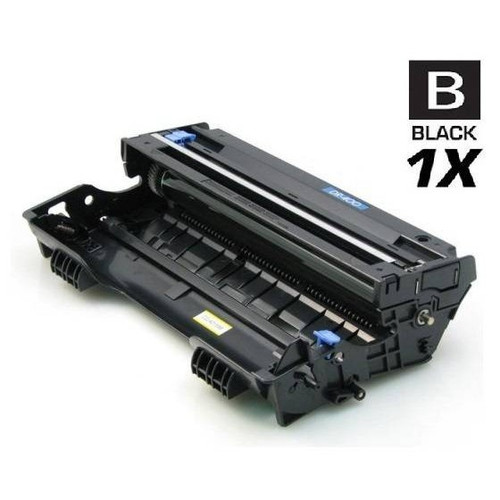
Most owners of these machines replace a drum the way they replace a roof tile: one has failed, one goes in, and the matter closes for years. This card prices exactly that errand. The two packs below serve a different calculation — a spare kept against the next warning, or a small fleet fed from one storeroom shelf — and their unit prices fall because of it. But the household with a single aging printer starts here, at $44.11, and measures everything else on the page against it.
Shop the Drum Single →
Inside the pair, each drum works out to $36.07 — $1.80 per thousand rated pages, around 0.18¢ a page — and the box trims $16.08 from the cost of two singles bought separately (SAVE $16.08). Between them the two units carry some 40,000 pages of drum life, spent a single 20,000-page life at a time: one working in the machine, one waiting in its carton. At $72.14 the pair passes the $49 free-shipping line on its own.
Shop the 2-Pack →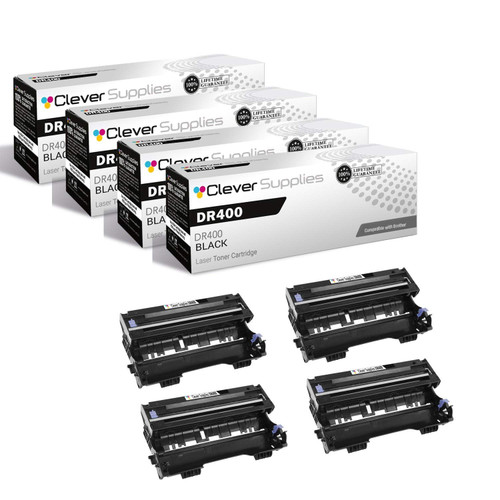
The ladder’s bottom rung: four drums at $32.05 apiece — $1.60 per thousand rated pages, roughly 0.16¢ a page — undercutting four singles by $48.25 (SAVE $48.25). Their lives add to some 80,000 pages of coverage in total, drawn down one drum at a time across years of service. Ordered alone at $128.19, the box clears the $49 free-shipping line comfortably.
Shop the 4-Pack →Four ways to buy this drum, set out in one table
Each rate in the fourth column spreads a price over the 20,000 pages Brother allows one drum. Where a box holds several drums, the coverage figure in the last column adds their separate lives together — the 80,000 pages in the third row is the sum of four drums’ allowances, never a rating carried by any single unit.
| Offer | Box price | Works out per drum | Price per 1,000 pages | In the box |
|---|---|---|---|---|
| Single drum (flagship) | $44.11 | $44.11 | $2.21 | One drum at the ≈20,000-page rating |
| Drum 2-pack | $72.14 | $36.07 | $1.80 | Two drums — about 40,000 pages of life between them |
| Drum 4-pack | $128.19 | $32.05 | $1.60 | Four drums — about 80,000 pages of life between them |
| Genuine Brother DR400 (reference) | $227.29 | $227.29 | $11.36 | One genuine drum — Brother’s own shelf asks the identical $227.29 |
Read down the compatible rows and the shape is a staircase with two steps: $44.11 a drum bought singly, $36.07 in the pair, $32.05 in the foursome, and then the ladder ends — no larger pack exists on this platform. The genuine row is priced on another scale entirely; its section below shows why that is a question of origin and cover rather than of anyone quietly marking the part up.
Every compatible listing here prices itself from the wrong column
Open any of the three compatible listings and its own arithmetic runs on list prices — the figures on the shelf tag before discount, not the sums a register asks for. The single’s yield answer states it outright: “At $50.73 for the unit, that works out to roughly a quarter of a cent per page for the drum itself.” The 2-pack’s savings answer builds the same way: “Two single drums would cost 2 × $50.73 = $101.46. This pack is $82.96, so you save $18.50, and the per-drum price drops to $41.48.” And the 4-pack repeats the pattern at full length: “Four singles at $50.73 come to $202.92. This pack is $147.42, so you save $55.50, and each drum effectively costs $36.86.”
Set against checkout, every one of those numbers runs high. The single actually sells at $44.11, which puts its true rate at about 0.22¢ a page. The pair sells at $72.14 — $36.07 a drum, against $88.22 for two singles, so the saving it truly delivers is $16.08. The foursome sells at $128.19 — $32.05 a drum, against $176.44 for four singles, a true saving of $48.25. The listings’ own pages even carry the correction inside themselves: a sentence pointing to this store’s TN460 toner guide sits in each pack’s savings answer quoting the sale-based figure, a few lines below the list-based one, and the single’s price claim stands two sentences above a similar pointer. A reader who finishes any of the three pages holds two accounts of the same box.
This guide keeps the account the till agrees with. Every price, saving and per-page rate outside this section is figured from selling prices, and the list figures quoted above appear nowhere else on the page.
Brother’s twenty-four machines — the list this page answers to
Brother publishes one fit list for this platform and repeats it without change on three separate pages — the DR400 drum page, the TN430 cartridge page and the TN460 cartridge page all name the same twenty-four machines, and each machine on it runs both toner tiers over the same drum. Every name below opens that model’s own category in this store.
DCP series: DCP-1200 · DCP-1400
HL series: HL-1230 · HL-1240 · HL-1250 · HL-1270N · HL-1435 · HL-1440 · HL-1450 · HL-1470N
MFC series: MFC-8300 · MFC-8500 · MFC-8600 · MFC-8700 · MFC-9600 · MFC-9700 · MFC-9800 · MFC-P2500
IntelliFax: IntelliFax-4100 · IntelliFax-4100e · IntelliFax-4750 · IntelliFax-4750e · IntelliFax-5750 · IntelliFax-5750e
Two cartridges feed these machines, and Brother measures both the older way, by coverage rather than by laboratory standard. The standard TN430 is rated at approximately 3,000 pages under its own footnote — “‡Yields approx. 3,000 pages @ 5% coverage on Letter size paper” — and the high-yield TN460 at approximately 6,000 under the matching line: “‡Yields approx. 6,000 pages @ 5% coverage on Letter size paper.” No test-standard label attaches to either cartridge, and none attaches to the drum, whose basis reads plainer still: “Drum yield is approx., and may vary by type of use.” One consequence deserves a line of its own: there is no TN400 cartridge. The 400 number belongs to the drum alone, and a search for a TN400 cartridge is a search for a part that was never made. Brother still sells both real cartridges ($83.99 and $118.29, the TN460 carrying its top-seller flag), but the compatible toner shelf in this store covers the high-yield tier only — the everyday partner here is the compatible TN460 single at $30.53, while the TN430 survives in this catalog solely as a genuine Brother listing at $95.92. Our Best Brother TN460 Toner Cartridges guide works through that ladder in full, and the platform gathers under the TN430 code category and the TN460 code category; no DR400 code category exists. Set against the drum, one unit’s life covers roughly 6.7 standard cartridges or 3.3 high-yield ones.
The fit lists printed on the product pages run longer than Brother’s twenty-four — considerably longer. Each compatible listing’s fit answer names thirty-nine models: the twenty-four above plus fifteen further names, regional and variant forms that Brother USA’s current drum and cartridge pages do not carry at all. The HL-1030 is the clearest case — a genuine earlier sibling of this platform, named by every listing in the family, and absent from all three of Brother’s present-day pages. The packs’ introductions name thirty models and toss in a “Laser Printers 1630” that corresponds to no machine Brother ever sold, while the genuine listing’s fit answer claims around forty models even as its own introduction stops nineteen names into Brother’s list. Some of those extra machines may well accept this hardware in other markets; nothing on this page relies on them. Brother’s twenty-four govern every recommendation here, and the FAQ below takes up the HL-1030 question directly.
A last piece of the listings’ inheritance is worth a sentence, because it shows how old the copy is: the single’s introduction promises “richer deeper colors” from a monochrome drum — a part that lays down black and only black. The guide repeats none of the introductions’ language; the specification blocks and answers underneath them, where they stick to drum life and drum counters, are the parts worth trusting.
Reading the printed page: worn drum, or merely an empty cartridge?
On machines of this age the sheet itself usually settles the question before any counter does. A drum whose surface has worn leaves evidence with a rhythm to it — the same blemish returning at the same interval down successive pages, a vertical streak that survives a cartridge change, or a gray shading behind text that once printed crisp. A cartridge that has simply run dry leaves no marks at all: output washes out evenly from top to bottom of the page, and a fresh cartridge restores it completely. The machines keep the two consumables on separate tallies, and when the display speaks, it names which tally has expired — a drum message is settled by a drum, never argued away by a toner reading.
The arithmetic of the platform shapes how an owner should stock. A drum’s allowance of roughly 20,000 pages stretches across about three to seven cartridges depending on tier, and on a fax-era machine printing a modest daily stack, that can mean years between drum changes — years in which the printer itself is also aging. For a lone machine, the sensible stock is the drum in use plus, at most, the pair’s spare. The 4-pack earns its storeroom space where several of the twenty-four models share one office and draw on a common shelf.
The genuine drum: priced at Brother’s own figure, to the cent
Brother still manufactures this drum and sells it from its own site at $227.29. This store’s genuine single costs $227.29. The two figures are not close — they are the same figure, and the comparison these pages usually have to make, store price against maker’s price, here ends in a draw. The genuine listing’s own text is equally straight about its arithmetic: it quotes its $227.29 selling price as a selling price and labels its $340.94 figure a list price, which is more than any of the three compatible listings manages. Brother sells the drum singly only, so no genuine pack exists to set against the compatible ladder.
Per thousand rated pages the genuine drum works out to $11.36 here (about 1.14¢ a page) — necessarily the same rate Brother’s own price produces, against $2.21 (about 0.22¢) for the compatible single. What the genuine premium over the compatibles buys is origin and cover: the maker’s own production line, the maker’s warranty, and a thirty-day return window at this store for genuine items. On the platform’s toner side the picture splits — the genuine TN460 also matches Brother exactly at $118.29, while the genuine TN430 is the family’s one above-Brother genuine, at $95.92 against Brother’s $83.99, a difference of $11.93. None of that changes what the genuine drum row is: a fairly priced maker’s part, quoted openly, for owners who want precisely that.
Chips: a subject this shelf never raises
Read all four listings end to end — the three compatibles and the genuine — and no chip is mentioned, specified or promised anywhere in their text, nor does any of them carry a field for one. The silence is structural rather than evasive. A drum unit contributes the surface an image is formed on; it holds no supply to gauge, sends no level reading and has nothing for electronics to keep count of. Accordingly this guide makes no recognition claim for the DR400. The one statement on record comes from Brother’s published support answers, and it is reproduced here exactly, with nothing of this page’s own added to it: “Brother firmware updates do not block the use of third-party ink and toner cartridges in our machines.”
The terms that stand behind the three offers
Five checks before a DR400 drum goes in the cart
Questions that surface when the drum warning lights
Approximately 20,000 pages. Brother states the figure on the drum’s own product page — “Yields approx. 20,000 pages” — and attaches its condition in the footnote: drum yield is approx., and may vary by type of use. Treat the number as the center of a range rather than a promise: heavy coverage, long jobs and a hard-working machine pull a real drum’s life either side of it.
The lower ones. The prices displayed on the listings — $44.11, $72.14 and $128.19 — are the selling prices checkout charges. The higher figures in the text are list prices, and every sum built on them inherits the inflation: the pair truly saves $16.08 against two singles rather than the sum its prose claims, and the single’s true rate is about 0.22¢ a page rather than the roughly quarter of a cent its answer derives from the list figure. Every figure on this page is worked from selling prices.
Brother’s current pages do not say that it will. The HL-1030 is a real earlier relative of this platform, and all four store listings include it in their fit lists — but Brother USA’s DR400, TN430 and TN460 pages today name twenty-four models, and the HL-1030 appears on none of them. This guide follows the maker’s published list and links only those twenty-four. If your machine is the HL-1030, settle the question against Brother’s documentation for your model and region before ordering, rather than resting on the listings’ longer list.
No — drum units are what arrive. The two packs took their headlines, and the “laser cartridge” line in their specification rows, from the toner shelf’s templates; their boxes hold drums and nothing else, and their own help text speaks only of drum life, drum counters and a drum’s 20,000-page allowance. The single and the genuine listing are titled for what they are. Judge each offer by its contents — this page does, and names all three accordingly.
No. The box holds four separate drums, each rated at approximately 20,000 pages and each fitted only when its predecessor’s counter runs out. Their lives laid end to end amount to roughly 80,000 pages of coverage across four swaps — a sum of four allowances, never a rating one unit carries.
There is not, and there never was. The 400 number belongs to the drum; the cartridges this platform actually runs are the standard-yield TN430 and the high-yield TN460. Anyone selling a “TN400” cartridge is selling a code that does not exist — check what is printed on the cartridge already in your machine, and it will read one of the two real codes.
Either tier, in any of the twenty-four machines — the drum underneath serves both identically. The practical differences are yield and supply. The TN430’s allowance is about 3,000 pages at 5% coverage and the TN460’s about 6,000, so the high-yield tier halves the cartridge changes across a drum’s life. And the compatible cartridges stocked here are TN460 only: the standard tier survives in this store solely as a genuine Brother listing, so a compatible standard cartridge is not a thing this shelf can sell you.
Because the tally the machine is reading still belongs to the drum you took out. These printers track drum life as a count held in the machine’s own memory, and new hardware alone does not zero that count — the reset step in Brother’s replacement procedure for the model does, and it belongs to every swap. Run the reset on its own, old drum still fitted, and all that clears is the message: the worn surface goes on marking every page it prints.