




Seven compact Brother color printers — the machines that run on TN223 and TN227 toner — hold their four cartridges in a row of four drum units, one sitting under each color. Collectively those units are the DR223CL, and they are the supply almost nobody shops for until the display counts one of them down. Each unit is rated by Brother at roughly 18,000 pages, so a drum decision arrives years apart — yet when it lands, owners meet a shelf that looks more tangled than it is: singles labeled by color, a black-only pair, a three-color set, and a complete renewal box. Brother itself sells just one drum under this name, and the same unit serves any of the four slots; the per-color labels on this store’s listings are shelf labels, not different parts. This page untangles the shelf, prices every shape it comes in, and shows how to work out which slot is actually asking for a drum.
The short answer: renew the whole drum row with the complete four-unit set at $86.11 — $21.53 per drum against $33.59 for a single, and the lowest per-page drum cost on the shelf. When only one slot is due, that slot’s single at $33.59 is the exact-fit purchase. The black 2-pack at $51.10 and the three-color set at $68.60 cover the in-between cases, and both are priced on this page.
Begin with the color the printer is complaining about. A drum warning names a position — black, cyan, magenta or yellow — and only that slot’s unit is worn; its three neighbors may have thousands of pages left in them. So the honest purchase is the size of the problem: one slot due means one single at $33.59. Two or more slots running down together, or a machine whose four units have aged side by side since new, points at the complete set at $86.11, where each drum costs a third less. The black slot works hardest on most of these printers, which is why it alone gets a 2-pack at $51.10; the three-color set at $68.60 exists for the day the color row wears out together and black has already been handled on its own cycle.
Seven printers ride on this set of drums
Brother’s DR223CL page and its TN223 and TN227 toner pages agree on the same seven machines, word for word: the HL-L3210CW, HL-L3230CDW, HL-L3270CDW and HL-L3290CDW, plus the MFC-L3710CW, MFC-L3750CDW and MFC-L3770CDW. Every model takes both toner tiers — the standard TN223 and the high-yield TN227 — and the drum arrangement never changes across the platform: four DR223CL positions, whatever cartridge size the owner runs.
Three lookalike generations stand close together in Brother’s compact color line, and each keeps its own drum. The printers one step older, built on TN221 and TN225 toner, sit on the DR221CL. The generation after this one, built on TN229 toner, sits on the DR229CL. Neither of those drums fits the seven machines above, and the DR223CL fits neither of theirs — the codes differ by a digit, the parts differ entirely. If your printer’s toner boxes read TN223 or TN227, this page is the drum page for it; any other code on the box sends you to a different drum.
A word about what a drum is doing here at all. In these machines the cartridge is a powder hopper; the drum beneath it is the imaging surface that receives each page’s picture and presses it onto the sheet. That division is why the two supplies run on such different clocks — a TN227 black cartridge is rated near 3,000 pages, while the drum under it is rated near 18,000, about six cartridges later. Judged against the standard TN223 black, the same drum spans roughly thirteen cartridges.
The drum shelf: singles by slot, then sets
One piece of honest housekeeping before the prices. Every compatible drum listing in this store is titled as a “Toner Cartridge,” although the box unmistakably holds a drum unit — open any of the nine listings and its own description talks about drums throughout. Only the genuine Brother listing is titled correctly. The cards below call each offer a drum unit, because that is what ships. The yardstick for everything that follows is the single unit at $33.59: two bought separately come to $67.18, three to $100.77, four to $134.36, and the pack prices earn their place only by beating those sums.
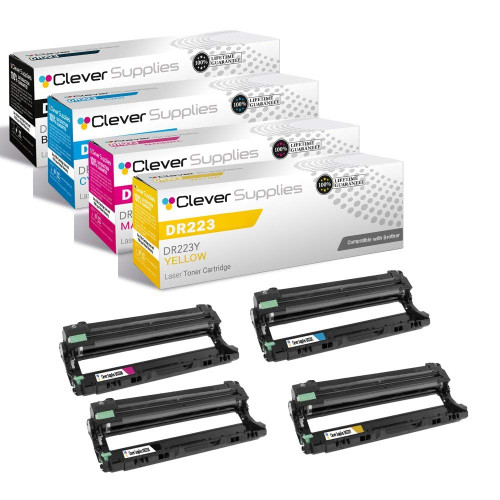
The four drums in a printer are usually the same age — installed together when the machine was new, turning together ever since — so the day one slot expires, its neighbors are rarely far behind. Renewing the row in a single order answers that reality at the shelf’s best unit price, and it clears the store’s $49 free-shipping threshold on its own. Owners who replace slots strictly one at a time will pay more per drum for the privilege; owners whose machines are approaching a first full renewal get the cleanest arithmetic here, which is why this set leads the page.
Shop the Complete Set →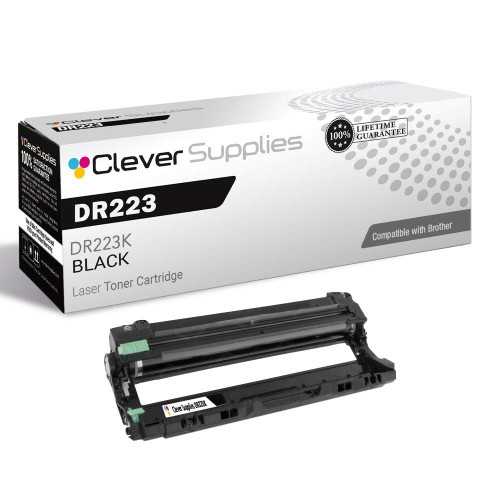


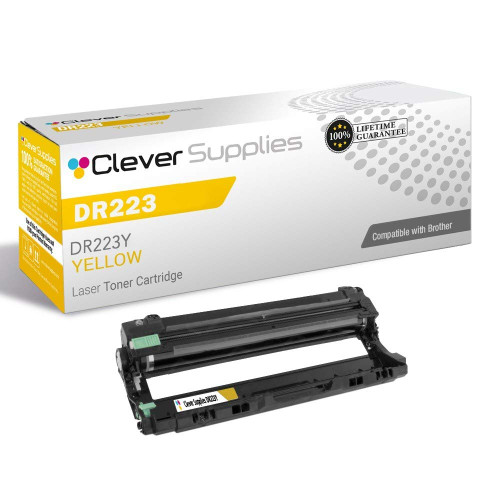
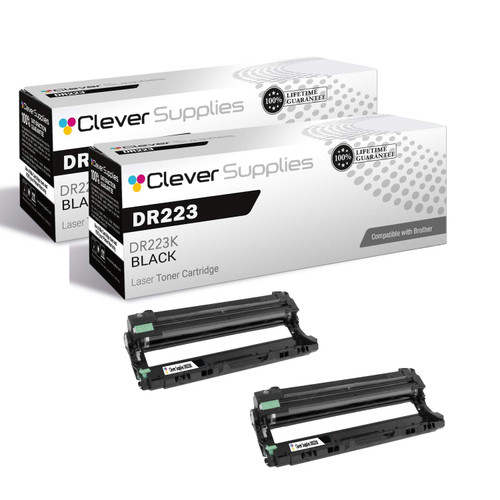

Notice what the shelf does not contain, because the absences shape the buying. There is no cyan, magenta or yellow pair — a color slot is served by its single or by a set, never by a two-pack. And there is no box in this family that mixes toner with drums: the two supplies are sold on separate shelves here, with the toner side priced in its own guide. What the drum shelf offers is exactly the ladder above — four identical-price singles, one black pair, one color trio, one full renewal — and every rung of it carries Brother’s own 18,000-page figure on the listing, unadjusted.
Every offer, one table
All seven offers fit all seven printers — fit never separates these rows. What separates them is coverage: how many of the four positions a box renews, what each renewed drum costs at that quantity, and what the drum row then costs to run.
| Offer | What is in the box | Rated drum life | Price | Per drum | Cost per 1,000 pages | Measured against singles |
|---|---|---|---|---|---|---|
| Complete 4-drum set | Four units — black, cyan, magenta, yellow | About 18,000 pages per unit | $86.11 | $21.53 | About $1.20 | SAVE $48.25 vs four singles |
| CMY 3-color set | Three units — cyan, magenta, yellow | About 18,000 pages per unit | $68.60 | $22.87 | About $1.27 | SAVE $32.17 vs three singles |
| Black 2-pack | Two units, both for the black position | About 18,000 pages per unit | $51.10 | $25.55 | About $1.42 | SAVE $16.08 vs two singles |
| Any single drum unit | One unit, in black, cyan, magenta or yellow | About 18,000 pages | $33.59 | $33.59 | About $1.87 | — |
The genuine Brother unit is deliberately not a row here: this table compares the compatible shelf against itself. The genuine drum is quoted further down, in its own section, next to Brother’s own price for it.
Two further listings sit on this shelf and appear in no card and no row, on purpose. A second listing of the same complete-set offer runs under the DR223CL title, but its description text describes the older TN221 generation’s printers and quotes a yield of 18,500 pages that Brother does not publish for this drum — the carded set above is the listing whose copy matches Brother’s figures. The other, titled as a five-unit set at $103.62, contradicts itself: its own questions-and-answers text describes four drum units, black, cyan, magenta and yellow, and never accounts for a fifth — while asking $17.51 more than the complete set for what its text describes as the same box. Until that listing’s contents can be verified, this page prices the four-unit renewal and leaves the five-unit title alone.
One part number underneath all four slots
Here is the fact that simplifies everything else on this page: at Brother, DR223CL is a single product. Brother sells the drum as one unit, speaks of it as “each drum unit,” and publishes no separate black, cyan, magenta or yellow drum anywhere in its catalog. The printer carries four of that same unit, one per color position, and a complete renewal simply means four units. The DR223K, DR223C, DR223M and DR223Y codes on this store’s listings are designations the shelf applies so a buyer can order by the slot they are filling — they describe where a unit is headed, not a distinct part inside the box.
Two practical consequences follow. First, a spare single is a spare for any position: the owner who keeps one unit on the shelf is covered whichever color’s counter runs out next, something no toner shelf can offer. Second, the slots age independently. The printer tracks each position’s drum life on its own, because an office that prints mostly text wears its black drum far faster than its yellow. Replacing a single slot is not a partial repair or a compromise — it is how this machine is designed to be maintained, one position at a time, as each counter reaches its end.
That independence is also why the sets are shaped the way they are. The complete set assumes the whole row is aging together, which is the common case for a printer bought new and used steadily. The three-color set assumes black has already been renewed once on its own faster cycle — a pattern anyone who prints documents in a color-capable machine will recognize. Neither assumption is built into the part itself; both are simply the shelf meeting owners where their machines actually are.
Which supply is failing — and in which color?
A color machine gives a diagnostic gift a monochrome one cannot: it can fail in one color at a time, and the color of the defect points at the slot behind it. Pages where a single color has gone pale or washed out, while the other three print at full strength, accuse that color’s toner first — powder runs out long before surfaces wear. Marks that repeat down the page at a steady interval, confined to one color’s areas, accuse that color’s drum instead: a tired or nicked imaging surface stamps the same flaw at the same spacing, page after page. Defects that appear in every color at once usually belong to neither supply, and are worth a different investigation before any drum money moves.
Before ordering, take the free step Brother builds into every one of these drum units: cleaning the corona wire. Each unit carries a small slider for exactly this; running it along the wire and back to its marked home position clears the contamination that most often impersonates a worn drum. Brother’s own guidance puts this cleaning ahead of replacement, and on a unit with pages left in it, it frequently retires the whole complaint in a couple of minutes.
When a replacement does go in, the job ends at the menu, not at the slot. Reset the drum counter for the position you changed, so that unit’s life starts counting from zero; the positions you did not touch keep their own tallies, undisturbed. Two errors mirror each other here. Forgetting the reset makes a new drum look old within weeks, because the printer goes on counting its predecessor’s pages. Resetting a counter during a routine toner change is the opposite mistake — it tells the printer a worn drum is new, and the truth surfaces later as print quality that no cartridge can fix.
Toner for these printers is a separate shelf
Nothing in this family bundles the two supplies together — no listing here pairs a drum with cartridges — so a drum order and a toner order stay two decisions. That separation is honest to how the machine consumes them: toner every few thousand pages, drums every eighteen thousand or so, rarely in the same week.
When the toner side is the errand, the platform’s cartridges, packs and four-color toner sets — both the standard TN223 tier and the high-yield TN227 tier — are priced and compared in the Best Brother TN227 Toner Cartridges guide. This page keeps to the drums those cartridges sit in, and to the day one of the four slots underneath them comes due.
The genuine Brother drum, with both prices on the table
The genuine DR223CL is stocked in this store as a single unit — correctly titled as a drum unit, as it happens — at $194.64, and it is in stock. Set against the compatible single’s $33.59, that is roughly 5.8 times the price for a unit carrying the same Brother-published rating of about 18,000 pages. And one comparison cuts the other way, printed here because it is true: Brother USA’s own store sells this drum for $160.29, which makes this store’s genuine price $34.35 higher than the manufacturer’s. A buyer set on the original part should know both numbers before choosing where to buy it.
The arithmetic widens at full-renewal scale, and it deserves stating as plain per-unit math, since Brother sells no genuine set of these drums: four genuine units bought one by one at this store’s price total $778.56, against $86.11 for the compatible complete set above. What the genuine premium purchases is Brother’s own manufacture and the manufacturer’s warranty; what it does not purchase is a longer rated life, which is identical. Terms differ by class in this store, too — genuine parts carry the manufacturer’s warranty and a 30-day returns window, where the compatible drums above carry a year of each. The genuine unit is described here for reference; the cards on this page lead to the compatible shelf.
No chip claims — because no listing makes one
Search all ten listings in this family, compatible and genuine together, and the word “chip” appears in none of them. Not once. So this guide makes no chip claim of any kind for the DR223CL: nothing about a fitted chip, nothing about recognition, nothing about what any gauge reads. The drum is an imaging unit, its listings discuss yield and fit and leave electronics unmentioned, and copy on this page follows the listings rather than decorating them.
The one statement in this territory that can be printed with its source attached is Brother’s own published position on third-party supplies: “Brother firmware updates do not block the use of third-party ink and toner cartridges in our machines. While we encourage using Brother Genuine ink and toner for optimal performance and print quality, our updates are designed to enhance functionality and security, not to limit consumer choice.” Everything else here rests on the same checkable footing — Brother’s seven-model roster, Brother’s yield wording quoted word for word in the note closing this page, and shelf prices read on the date shown at the top.
Before you order a DR223CL: five checks
What owners ask when a drum slot comes due
Both descriptions point at the same hardware. Brother sells DR223CL as one drum unit — a single part number, a single price — and each of these printers holds four of them, one beneath each toner color. A full renewal is four units. This store’s shelf reflects both views: singles labeled by the slot they are bought for, and sets that bundle the units together at lower per-drum prices.
Only if it is one of the seven. The neighboring generations look alike and take different drums: machines on TN221 or TN225 toner use the DR221CL, and machines on TN229 toner use the DR229CL. The reliable test is the toner code printed on your cartridges — TN223 or TN227 means the DR223CL on this page; anything else means a different drum, however similar the printer’s case appears.
Brother’s rating is approximately 18,000 pages for each unit, published with the plain caveat that the figure may vary by type of use — long runs, heavy coverage and media choices all move the real number. In the supplies owners actually count, one drum outlasts about six high-yield TN227 black cartridges, or roughly thirteen standard TN223 blacks. Color slots usually last longer in calendar time simply because most pages lean on black.
No. Each position wears on its own schedule and is tracked on its own counter, so replacing just the slot the printer names is complete maintenance, not a shortcut. The reason the complete set leads this page is economics and timing, not necessity: drums installed together tend to expire within reach of each other, and inside the set each unit costs $21.53 instead of $33.59. Replace one when one is due; renew the row when the row is due.
Because black is the slot that wears twice. Text and office documents lean on the black position so heavily that stocking its next drum beside the current one is a common pattern; a color position, replaced far less often, is served by its single when it comes due — or by the three-color set when the whole color row is renewed at once. The shelf’s shapes follow the wear, and no color pair exists in this family to card.
One step: reset that position’s drum counter in the machine’s menu, so the new unit’s life is counted from zero. Leave the other three counters exactly as they stand — each belongs to a different unit with a different amount of life left. If a drum warning for the changed slot persists afterward, pull the assembly out and seat it again firmly; an incompletely seated unit is the usual reason, ahead of any fault in the part.