




Some buying guides spread themselves across a whole platform. This one narrows to a single bay of a single machine. The 106R01219 is the high-capacity magenta cartridge for the Xerox Phaser 6360, rated at 12,000 pages — the largest magenta fill Xerox built for this printer, and the only magenta cartridge of any size that Clever Supplies stocks for it. The Phaser 6360 drinks from four toner bays, and its full cartridge map runs to eight codes across two capacity tiers, yet the shelf behind this page holds exactly one box: one magenta cartridge, sold on its own, with no pack sizes built around it and no second color sharing the listing. That narrowness is the guide’s subject. What follows works out what this one rung costs per page at the price checkout really charges, how long a fill of this size lasts at different monthly volumes, what the 12,000-page figure is actually measured against, and where the cartridge sits inside a platform map whose other seven codes are handled elsewhere or not stocked at all. If the cartridge rolling out of your machine’s magenta bay carries this code, everything you need is on this page; if it carries a different one, the map section below will tell you which shelf you actually belong on.
Short answer: buy the single cartridge at $73.64. It is the only box this family sells, it holds 12,000 rated pages of magenta, and at the charged price the fill works out to roughly 0.61¢ per rated page — against $349.99 for the genuine Xerox cartridge on the manufacturer’s April 1, 2015 price list. The carton clears the $49 free-shipping threshold by itself, with $24.64 to spare, so no filler item and no second box is needed to ship it free. Check two things before ordering: the code on the cartridge you are replacing reads 106R01219, and your machine is a Phaser 6360 in one of its four configurations — 6360N, 6360DN, 6360DT or 6360DX.
Why does a whole guide hang on one magenta cartridge? Because on a color workgroup printer, magenta is rarely the bay an office plans around — black gets the attention, and the color bays get replaced in a scramble when a report prints with a pink cast or the panel calls for toner mid-job. The 106R01219 is the fill that ends the scramble for this color: 12,000 rated pages, two and a half times the 5,000-page magenta cartridge the machine was delivered holding, at a charged price of $73.64. There is no pack decision to agonize over and no tier decision either, because this store stocks no smaller magenta for the 6360 and no larger one exists. The only real questions are whether your volume justifies the big fill — the rhythm section below answers that with page counts rather than adjectives — and whether the code on your spent cartridge matches. Everything else on this page is the evidence behind those two checks.
One box, one color, one decision
Most shelves in this program offer a ladder: a single, a pair, a deeper pack, each with its own arithmetic. This shelf is a single rung. The store’s catalog carries the cartridge on two postings that describe the same physical box at the same price; rather than pretend they are two products, this guide cards the box once, under its Clever Supplies posting, and leaves the duplicate unlinked. The card below pairs the photograph from that posting with the sale price its checkout charges. One correction matters before the numbers: the listing’s own text works out its per-page figure from a base price of $84.69, which is not what a buyer pays. The charged price is $73.64, and every figure on this page — the card, the tables, the comparisons — is rebuilt from that amount, because a supply budget planned against a price nobody is charged is fiction.
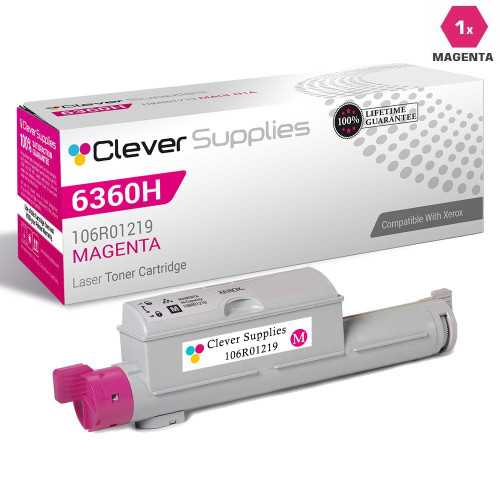
What arrives is exactly one cartridge. The plural wording in the 6360H product name is catalog language carried over from multi-packs elsewhere in the range, not a count of what is inside; the listing’s own questions-and-answers say so plainly, and the carton holds a single magenta unit. Inside, the cartridge is built from all-new parts — the listing describes new internal components including a smart chip — so it seats in the magenta bay and reports its level to the printer the way the original does. At $73.64 for 12,000 rated pages, the arithmetic lands at about 0.61¢ a page. Set that beside the genuine cartridge’s $349.99 on Xerox’s April 1, 2015 price list and the gap is $276.35 for the same rated fill — the compatible box costs a little over a fifth of the manufacturer’s list price for the identical page rating.
See the Single Magenta CartridgeThe whole shelf on two lines
A one-box shelf makes for a short table, so the second line is given to the comparison that actually informs the purchase: the genuine Xerox cartridge carrying the same code and the same rating. The genuine figure is a list price from a dated document, quoted with its date because a 2015 list price is a reference point, not a live quote — treat it as the benchmark the compatible box is measured against, not as an amount anyone is being asked to pay today.
| Box | Cartridges | Rated pages | Price | Cost per rated page |
|---|---|---|---|---|
| Compatible Single (this guide) | 1 magenta | 12,000 | $73.64 sale | ≈0.61¢ |
| Genuine Xerox 106R01219 | 1 magenta | 12,000 | $349.99 list, April 1, 2015 | ≈2.92¢ |
Read the last column as the family’s whole economic argument. Both cartridges promise the same 12,000 rated pages from the magenta bay; one charges about sixty-one hundredths of a cent for each of those pages and the other charges nearly two dollars and ninety-two cents’ worth per hundred pages — roughly 4.8 times as much per page. Nothing else on the shelf competes with that comparison, because nothing else on the shelf exists: there is no two-pack to undercut the single’s unit price and no smaller magenta to tempt a lighter user. Buyers who want a spare on the shelf simply order the single twice, at the same per-cartridge price, and the second carton ships free just as the first did.
Magenta economics: what this color costs per page
A color page is never printed by one cartridge. Every sheet that leaves a Phaser 6360 in color draws on all four bays at once, in proportions set by the page itself — a magenta-heavy chart spends this cartridge faster than a page of black text with a small color logo, which barely sips from it. That is why the honest way to price a single color is per rated page of that color’s own work: the 12,000-page rating counts pages printed at the rating’s stated coverage, and dividing the charged price by that count gives the cost of the magenta layer across an average run of work. For this box the division is $73.64 by 12,000, which lands at 0.6137¢ — call it 0.61¢ of magenta on every rated page. The listing’s own text quotes roughly 0.71¢, and its arithmetic is not wrong so much as priced from the wrong number: it divides the $84.69 base price instead of the $73.64 a buyer is actually charged. Fifteen percent separates the two figures, and on a supply line an office reorders for years, planning against the higher one quietly inflates the color budget.
The replacement rhythm follows from the same division, run in the other direction. An office putting 500 color pages a month through the machine spends this fill in about two years. At 1,500 color pages a month the cartridge lasts roughly eight months; at 3,000 a month, about four; a genuinely busy floor at 6,000 color pages a month should expect a change each couple of months. Set those spans against the machine’s own ceiling — Xerox rates the Phaser 6360 at up to 40 pages a minute with a 100,000-page monthly duty cycle — and the pattern is clear: even at volumes that would strain the printer, the high magenta is a quarterly-or-better event rather than a standing chore. Compare the starter experience: the magenta cartridge the machine arrived holding is rated at 5,000 pages, so at 1,500 color pages a month it gives out in a little over three months. The first time an office replaces magenta with this high fill instead, the interval more than doubles, and the reorder conversation for this color drops from a quarterly habit to a twice-a-year one.
One more comparison belongs in any honest budget: the genuine cartridge. Xerox’s Commercial Price List effective April 1, 2015 prices the original 106R01219 at $349.99, which divides to about 2.92¢ per rated page. An office that runs four of these fills a year spends $294.56 on compatible magenta against $1,399.96 at that list price — a difference of more than eleven hundred dollars a year on one color of one printer, before the other three bays are even considered. That is the scale of decision this single box represents, and it is why a fragment family with one carton still earns a full guide: the cartridge is small, but the recurring spend it governs is not.
What the 12,000-page figure is measured against
Every yield number in this guide carries a condition, and this page states it wherever the number appears: Xerox rates this cartridge at 5% area coverage. That phrase deserves unpacking, because it is the entire basis of the rating. Five percent area coverage describes a page on which toner covers about one twentieth of the printable surface — think of a business letter with a modest logo, a few lines of bold heading and a small chart. Print pages like that, page after page, and a fill rated at 12,000 should deliver something close to 12,000. Print pages where color floods half the sheet — full-bleed photographs, dense presentation backgrounds, saturated marketing flyers — and each page spends several times the toner of the rated page, so the same cartridge may give out after a few thousand sheets. Neither outcome contradicts the rating; the rating simply assumes the lighter diet, and an office whose work runs heavy should budget by its own page mix rather than by the headline figure.
It is worth being precise about what kind of claim this is. For this platform, Xerox’s own documents state the 5% area coverage basis and nothing further — the brochure, the evaluator guide and the 2015 price list all express the yield on that footing, and no standardized test declaration stands behind the number for this cartridge. This guide therefore prints the rating the way the manufacturer documented it: a coverage-based figure, honest as far as it goes, and most useful as a comparison between cartridges rated on the same basis. All eight codes on the Phaser 6360 map share that footing, so the tier comparisons in the next section are apples to apples. What the figure is not is a promise about any individual office’s output — your pages, your coverage, your count. The meter on your own machine, read against the date you loaded the last cartridge, will always tell you more about your true yield than any document can.
Eight codes on the Phaser 6360 map
The Phaser 6360’s toner system is a tidy grid: two capacity tiers across four colors, eight codes in total, numbered in a single run. The standard tier fills each bay at 5,000 pages for the three colors and 9,000 for black, which works harder on a typical office mix. The high tier lifts every color to 12,000 pages and black to 18,000. Reading the grid tells you exactly where this guide’s cartridge sits — the middle cell of the high row, magenta’s top rung — and it also tells you what this store does and does not sell from the grid, which matters because a cartridge from the wrong cell will not serve your machine no matter how similar its number looks.
| Tier | Cyan | Magenta | Yellow | Black |
|---|---|---|---|---|
| Standard | 106R01214 · 5,000 pp · not stocked | 106R01215 · 5,000 pp · not stocked | 106R01216 · 5,000 pp · not stocked | 106R01217 · 9,000 pp · its own guide |
| High | 106R01218 · 12,000 pp · not stocked | 106R01219 · 12,000 pp · this guide | 106R01220 · 12,000 pp · its own guide | 106R01221 · 18,000 pp · not stocked |
Three consequences follow from the grid. First, there is no standard-capacity magenta for sale here at any price: if the cartridge you removed reads 106R01215, this high fill is the magenta this store offers you, and it drops into the same bay with more than twice the rated pages. Second, the unsold cells are genuinely absent, not hidden deeper in the catalog — the standard cyan, magenta and yellow and the high cyan and black do not appear on this store’s shelves, so a buyer hunting for 106R01218 or 106R01221 here will not find them. Third, the two stocked neighbors each stand on their own: the standard black 106R01217 and the high yellow 106R01220 are covered by separate guides written for those fragments, and nothing about this magenta page’s pricing or advice transfers to them. One grid, three stocked cells, five absences — knowing which cell you are buying for is the whole of compatibility on this platform.
Four nameplates sharing one magenta bay
Xerox sold the Phaser 6360 in exactly four configurations, and the differences between them are about paper handling and connectivity rather than the print engine. The 6360N is the networked base model. The 6360DN adds automatic two-sided printing. The 6360DT pairs duplexing with expanded paper capacity, and the 6360DX tops the range with the fullest paper handling of the four. Underneath those distinctions sits the same machine: the same engine running at up to 40 pages per minute, the same 100,000-page monthly duty cycle, and the same four toner bays taking the same eight codes. A 106R01219 that serves a 6360N in a two-person office serves a 6360DX on a busy floor without any variation in the cartridge itself.
That shared bay is why this guide links a single machine category rather than four. The configurations are one printer wearing four badges, and the store’s Phaser 6360 category gathers the family in one place. Two cautions ride along with the roster. The badge on your machine’s front panel is the authority — a Phaser badge with a different number, however similar the styling, belongs to a different platform with a different cartridge map. And this guide makes no claim about monthly volume recommendations: Xerox’s documents state the duty cycle quoted above, but no recommended monthly volume for this platform was verified from them, so none is printed here rather than guessed.
The fill your machine arrived with, and the first change
Not every printer ships with a token amount of toner meant to be replaced within weeks. The Phaser 6360 left the factory holding full standard-capacity cartridges: 5,000 rated pages in each color bay and 9,000 in the black. For magenta that means the cartridge a new machine started life with was a complete 106R01215, good for a rated 5,000 pages before the panel asked for more. Many 6360s still in service are several fills past that first one, but the starter matters because it sets the baseline an office unconsciously expects: if your sense of “how long magenta lasts” was formed by the cartridge in the box, it was formed by a 5,000-page fill. The high cartridge on this page holds 2.4 of those fills. Owners who stepped up at the first change often report the odd experience of the second cartridge outlasting their memory of the first by a wide margin — that is not a better batch or a lighter workload, it is simply the arithmetic of the tier change, and it is the main practical difference between the two magenta codes on the map.
The parts that wear out on longer clocks
Toner is the consumable an office thinks about, but it is not the only one inside the machine. The Phaser 6360 also carries an imaging unit, code 108R00645, rated at roughly 35,000 pages; a transfer roller, code 108R00646, on a similar roughly 35,000-page life; and a fuser, code 115R00055, rated at 100,000 pages. Those clocks run far slower than any toner bay’s — a fuser outlasts eight of this page’s magenta fills — which is why they surface as maintenance events rather than supply orders. They are named here so a buyer reading a panel message about an imaging unit knows it is a real part of this platform and a separate purchase from toner, and so nobody mistakes a transfer-roller warning for a cartridge fault. This store does not sell any of the three, so none is carded or priced on this page; when one of those messages appears, the part comes from elsewhere, and the toner shelf stays what it is — one magenta box, doing one job.
Before you order a single-code cartridge
A one-cartridge family leaves little room for ordering mistakes, but the few that exist are worth ruling out. Start with the spent cartridge itself: the code printed on it is the order’s foundation. If it reads 106R01219, this page’s box is its direct replacement. If it reads 106R01215, you are replacing the standard magenta, and this high fill is the stocked step up — same bay, same machine, more than double the rated pages. If the code belongs to another color’s cell of the map, stop: cyan and yellow cartridges are physically keyed to their own bays, and a magenta cartridge cannot substitute for either. Color position matters as much as the code, so match both before the carton is opened.
Two smaller points complete the check. The product name’s plural wording has already been flagged on the card, but it bears repeating at the point of order: one cartridge arrives, and an office that wants a working spare orders the single twice rather than expecting a pair inside one carton. And on the cartridge’s electronics, the listing describes an all-new build including a smart chip, so the cartridge is made to be recognized by the printer and to report its toner level as it empties; that is the claim as the listing states it, and this guide adds nothing beyond it — in particular, no cartridge page here can promise how any future firmware change might treat any compatible cartridge, and none does.
The terms standing behind the box
This is a Clever Supplies compatible cartridge, and it carries the store’s compatible-product terms: a one-year warranty and a one-year return window, the same cover that stands behind the store’s other own-brand cartridges. Orders ship from whichever of the store’s four warehouses — in Illinois, Pennsylvania, Georgia and California — puts the box on the shortest route to you, and because the single clears the free-shipping threshold alone, the price on the card is the whole delivered cost of the order before any tax. Questions before or after ordering reach customer service between 9 AM and 5 PM Central, the hours the store publishes for its support line. None of these terms varies by color or tier; the magenta fragment inherits them whole, exactly as the black and yellow fragments of this platform do.
Reading the magenta warnings before they stop a job
A color printer rarely fails without notice. Long before the magenta bay is empty, the Phaser 6360 begins reporting the cartridge’s remaining life on its panel, and the earliest sign in the output itself is usually a shift in the printed page: reds that lean orange, skin tones that lose their warmth, charts whose magenta bars print thinner and paler than the legend promises. Those symptoms mean the bay is nearly spent, not that the machine is broken — a color is a blend, and when one ingredient fades, every blend containing it drifts. The practical habit this suggests is simple: when the panel first reports the magenta cartridge low, treat that message as the ordering trigger rather than the emergency. A replacement ordered at the first warning arrives while the old cartridge still has working pages in it; a replacement ordered when the printer refuses to run is ordered under pressure, with a deadline attached.
The size of this fill changes that calculation in the buyer’s favor. With a 5,000-page standard cartridge, a busy office passes through the low-toner window several times a year for this one color, and each pass is a small chance to be caught out. With 12,000 pages in the bay, the window opens far less often, and the reorder rhythm settles into the twice-a-year pattern the economics section described. Keeping one sealed single on the shelf removes the risk altogether: the warning appears, the spare goes in, and the reorder happens the same day with no job waiting on a delivery. Because the single ships free on its own, there is no postage penalty for ordering the replacement as a separate, unhurried transaction rather than bundling it with other supplies.
Who the big magenta fill suits — and the honest exception
A high-capacity cartridge is the right buy for most owners of this machine, and the reason is structural rather than promotional: this store stocks no smaller magenta for the Phaser 6360, so the choice is not really between a standard fill and a high one. It is between this cartridge and sourcing the standard 106R01215 somewhere else. For any office printing color every week, the high fill wins on every axis that matters — a lower cost per rated page than the genuine cartridge by a wide margin, a replacement interval measured in seasons, and no compatibility question, since both codes serve the same bay. Workgroups sharing one 6360, offices producing client-facing reports and proposals, and anyone whose color volume has grown since the machine was installed all belong squarely in this cartridge’s audience.
The honest exception is the genuinely occasional color printer. A machine that wakes up for a few dozen color pages a month will take years to spend 12,000 rated pages, and toner sitting in a bay that long is money parked rather than money working — the cartridge will still print when called on, but the owner has prepaid for capacity they may never use if the machine is retired or replaced first. Even there, the arithmetic is gentler than it looks: the whole fill costs $73.64, less than many offices spend on a single service call, and the alternative standard cartridge is not sold here in any case. But a guide that only argues one side is a sales leaflet, so the exception stands on the record: if your color volume is truly a trickle and the machine’s own future is uncertain, the size of this fill is the one thing to weigh before ordering. Everyone else can stop weighing — on a platform with one stocked magenta, the decision the shelf offers is simply when, not which.
Questions buyers ask about the 106R01219
Is this the standard or the high-capacity magenta?
The high-capacity one. The 106R01219 is rated at 12,000 pages; the standard magenta for this platform is the 106R01215, rated at 5,000. The two share a bay and a machine, so the high cartridge is a direct step up from the standard fill, not a different fit.
Why does the listing’s per-page figure differ from this page’s?
Because the two pages divide different prices. The listing works from its $84.69 base price and lands near 0.71¢ per rated page; checkout charges $73.64, and dividing the charged amount by the same 12,000 pages gives roughly 0.61¢. The rating never changed — only the price basis did.
How many cartridges are in the box?
One. Despite the plural wording in the 6360H product name, the carton holds a single magenta cartridge — the listing’s own answers say so directly. Offices that keep a spare on hand order the single twice; there is no multi-pack of this code on the shelf.
My machine is a 6360DX. Does the cartridge change?
No. The 6360N, 6360DN, 6360DT and 6360DX are one engine in four configurations, and all four take the same magenta cartridge. The suffix changes paper handling and duplexing, not the toner bay.
Can I get the other colors for my 6360 here?
Partly. The standard black and the high yellow are stocked and have their own guides; the standard colors and the high cyan and high black are not stocked in this store at all. The map section above lays out all eight codes so you can see exactly which cells are filled.
How long should one cartridge last my office?
Divide 12,000 by your monthly color volume. At 500 color pages a month, about two years; at 1,500, roughly eight months; at 3,000, about a quarter. Heavy-coverage work — dense charts, full-page color — shortens every one of those spans, because the rating assumes pages at 5% area coverage.
Does the cartridge carry a chip?
The listing describes the cartridge as built from all-new parts, including a smart chip, so it is made to register with the printer and report its level as it runs down. That is the claim as the seller states it; this guide repeats it without extending it into any promise about future firmware.
How this guide was assembled
The facts on this page rest on three Xerox documents for the platform: the Phaser 6360 brochure, the Phaser 6360 Evaluator Guide, and the Xerox Commercial Price List effective April 1, 2015, which was read directly for this code and carries the genuine cartridge at $349.99 — the only genuine price quoted here, and never quoted without its date. The store’s catalog lists this cartridge twice; the two postings describe one identical box at one identical price, so the box is carded once, under its Clever Supplies posting, and the duplicate posting is neither linked nor counted as a second product. Every per-page figure was recomputed at the $73.64 sale price, because the listings compute theirs at base. No MICR variant of this cartridge is sold in this store, so there is nothing of that kind to card, link or price here.
The summary is short because the shelf is short. The Phaser 6360 is a durable color workgroup printer with an eight-code toner map, and for its magenta bay this store offers exactly one answer: a 12,000-page high-capacity cartridge at $73.64, roughly 0.61¢ per rated page, shipping free on its own. If your spent cartridge carries this code, the decision is already made — the only step left is ordering it before the panel’s warning turns into a stopped job.