




Thirteen Brother machines from the first generation of networked office lasers — the HL-5140 line and its MFC and DCP relatives — still sit on office floors doing unglamorous, essential work. Every one of them runs on the same hardware pairing: a TN540 cartridge at standard yield, a TN570 at high yield, and a DR510 drum underneath, rated by Brother at roughly 3,500 pages, 6,700 pages and 20,000 pages respectively, each measured at 5% coverage on Letter paper. Brother has since discontinued both of its own toner cartridges for this platform, which makes the shape of the aftermarket shelf worth understanding before you buy. The compatible side of this store carries the TN570 only — singly, in pairs and in fours — while the TN540 survives here purely as a genuine listing. The drum shelf has its own quirk: it opens at a 2-pack, because no compatible DR510 single is sold. What follows prices all of it openly, genuine rows included, so the gaps can be judged rather than guessed.
The short answer: find your model among the thirteen named below, then take the TN570 2-pack at $40.01 — about 13,400 rated pages, and $16.07 cheaper than the same two cartridges bought one by one. A machine in heavier rotation earns the 4-pack at $63.94, where the cost settles near 0.24¢ a page. If you arrived looking for a compatible TN540, end the search here: none is stocked, and the genuine TN540 at $113.05 prints at roughly 3.23¢ a page, the most expensive page anywhere on this page.
Start with the model badge, not the cartridge code: all thirteen machines below accept either cartridge size, so fit is settled the moment your model appears on the list. From there the pricing does the steering. The TN570 2-pack at $40.01 suits most owners, joining about 13,400 rated pages to a $16.07 saving over two separate singles. Offices that empty a cartridge every month or two should look at the 4-pack at $63.94 and its 0.24¢ page. And when the printer asks for a drum rather than toner, remember the entry point: the DR510 2-pack at $58.64 is the smallest compatible drum order this family allows.
Thirteen office machines, one cartridge fitting, two fill levels
Pull up Brother’s product pages for the TN540, the TN570 and the DR510 side by side and a single compatibility list repeats across all three, name for name. The printers are the HL-5140, HL-5150D, HL-5150DLT, HL-5170DN and HL-5170DNLT. The multifunction line adds the MFC-8120, MFC-8220, MFC-8440, MFC-8640D, MFC-8840D and MFC-8840DN, and the copier side contributes the DCP-8040 and DCP-8045D.
Because the three Brother lists match exactly, no model in the thirteen is fenced into the smaller cartridge or barred from the larger one. The choice between sizes is therefore never about permission — it turns entirely on how much the machine prints and what each printed page ends up costing, which is what the ladder further down works through.
Store listings for this family sometimes name additional machines beyond Brother’s thirteen. Where a listing and Brother disagree, this guide sides with Brother: the thirteen categories linked above are the whole of the confirmed fit, and anything outside them is a listing’s claim rather than a verified one.
One code deserves a warning of its own: the TN540 and the TN550 are both standard cartridges rated near 3,500 pages, yet they belong to entirely different platforms — different machines, different drums — and a TN550-family cartridge will not fit any of the thirteen models above.
Three TN570 boxes carry the whole compatible toner shelf
Brother designed two cartridges for these machines: the standard TN540 at roughly 3,500 pages and the high-yield TN570 at roughly 6,700, each figure taken at 5% coverage on Letter paper. Compatible production followed only the bigger of the two, so the shelf below is a TN570 ladder in three heights — one cartridge, two, or four. Two singles bought apart total $56.08, and four total $112.16; those sums are the measuring stick for the packs, and every comparison on this page stays inside the TN570 tier. The TN540 gets its own section further down, because its absence from the compatible shelf is the fact most likely to catch a returning owner off guard.
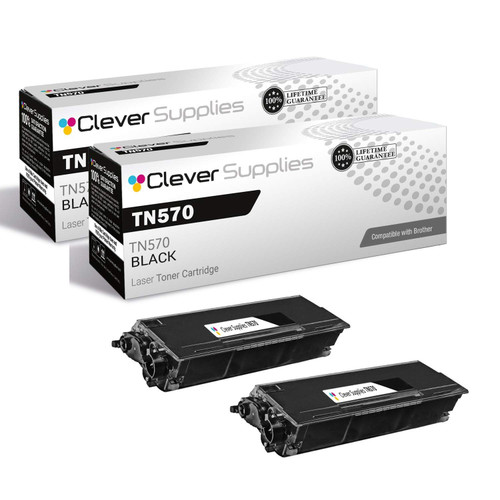
These thirteen models earned their floor space in shared offices, where a printer can sit quiet for a week and then absorb a month-end run in an afternoon. A 6,700-page cartridge disappears quickly under that pattern, and the pair answers it directly: $16.07 stays in the budget compared with two separate singles, while the per-page cost drops by more than a quarter. Put it beside the genuine standard cartridge priced further down — $113.05 for roughly 3,500 pages — and this box delivers nearly four times the rated pages for a little over a third of the money. That is the arithmetic that puts it first.
Shop the 2-Pack →
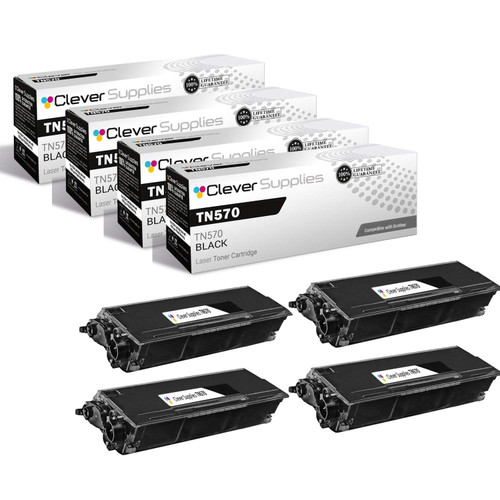
The cartridge itself never changes between boxes — only how many arrive at once, and what each page costs as a result. A backup MFC in a records room might take the better part of a year to work through one TN570, and for that machine the single keeps spending matched to actual use. A shared HL-5170DN on a busy corridor justifies the 4-pack’s 0.24¢ without much debate, and the $48.22 it holds back against four singles bought separately is the largest single saving this page offers.
A correction the record needs: both pack listings describe this cartridge as a 7,000-page unit — the figure sits in their yield fields, and in text totals of 14,000 pages for the pair and 28,000 for the four. Brother’s own rating for the TN570 is 6,700 pages, so the totals this page works from are 13,400 and 26,800, and every per-page figure, the 4-pack’s 0.24¢ included, is computed from 6,700. The listings’ larger number is an error in those listings, not a rating.
Every offer for this platform, priced side by side
The five compatible offers occupy the upper rows; beneath them sit the three genuine listings, shown for scale and linked nowhere — they are context, not cards. Read the genuine standard row slowly: at $113.05 and about 3.23¢ a page, the genuine TN540 costs more for every page it prints than any compatible offer in the rows above, the TN570 single among them — and the gap is not a narrow one.
| Offer | What you get | Yield, as Brother rates it | Price | Cost per page | Against buying singles |
|---|---|---|---|---|---|
| TN570 2-pack | Two TN570 cartridges | About 13,400 pages in total | $40.01 | About 0.30¢ | SAVE $16.07 vs two singles |
| TN570 4-pack | Four TN570 cartridges | About 26,800 pages in total | $63.94 | About 0.24¢ | SAVE $48.22 vs four singles |
| TN570 single | One TN570 cartridge | About 6,700 pages | $28.04 | About 0.42¢ | — |
| DR510 drum 4-pack | Four DR510 drum units | Near 80,000 pages combined | $101.19 | About 0.13¢ | $16.09 less than two 2-packs |
| DR510 drum 2-pack | Two DR510 drum units | Near 40,000 pages combined | $58.64 | About 0.15¢ | — |
| Genuine Brother TN540 single | A single genuine cartridge (reference only) | About 3,500 pages | $113.05 | About 3.23¢ | — |
| Genuine Brother TN570 single | A single genuine cartridge (reference only) | About 6,700 pages | $130.17 | About 1.94¢ | — |
| Genuine Brother DR510 single | A single genuine drum unit (reference only) | Near 20,000 pages | $239.99 | About 1.20¢ | — |
Drum rows rest on Brother’s approximate 20,000-page DR510 figure, which Brother itself cautions will shift with the kind of work the machine does. The drum shelf gets a full section of its own below, after the TN540 discussion.
The TN540 question: why the standard cartridge is genuine-only here
Plenty of these machines were unboxed with a TN540 inside, so the owner who returns for a refill usually asks for that code first: standard yield, roughly 3,500 pages, the cartridge the printer arrived with. The answer deserves to be stated without padding: this store stocks no compatible TN540 at all — not as a single, not in any pack. The one TN540 listing on the shelf is Brother’s genuine cartridge, priced at $113.05.
Unusually, the gap costs the buyer nothing, because the economics point the other way. The genuine TN540 works out near 3.23¢ a page. The compatible TN570 single — carrying close to twice the rated pages — costs $28.04, roughly a quarter of the genuine standard cartridge’s price, and prints near 0.42¢ a page; the 4-pack reaches 0.24¢. Adopting the high-yield tier means changing cartridges about half as often. It does not, at any point, mean paying more for the privilege.
One more fact frames the genuine rows honestly: Brother has discontinued both of this platform’s toner cartridges and publishes no current price for either, so no Brother-side toner price exists to compare the shelf against — the genuine listings here are remaining stock, priced as they stand. And no figure anywhere on this page measures a TN570 pack against a TN540 price; each saving is reckoned inside its own tier, against that tier’s single, full stop.
The DR510 drum: pairs and fours, never a single
All thirteen machines image their pages through one shared drum design, the DR510. Brother puts a new drum’s expected life at approximately 20,000 pages, adding in its own wording that drum yield is approximate and may vary by type of use — the figure carries no test-standard label, and this page attaches none. Measured in toner, a single drum spans about three TN570 cartridges, or roughly five and two-thirds TN540s, so a drum purchase lands only a handful of times in a machine’s working life and repays being made deliberately.
The compatible drum shelf is short and starts higher than most buyers expect: a 2-pack and a 4-pack, and nothing smaller. Per drum, the pricing steps from $29.32 inside the pair down to $25.30 inside the four, and the 4-pack costs $16.09 less than two 2-packs covering the same four drums — a pack-against-pack comparison, since no compatible single exists to anchor anything else. No box on this shelf bundles toner and drum together, either; the two halves of the machine are always ordered separately.
Check the wording on the drum packs before judging them by it: each pack’s store title calls it a “Toner Cartridge.” That phrase is a leftover from how the listings were created, not a statement about what ships. Inside are DR510 drum units — nothing else — which is why the cards on this page name them as drums.
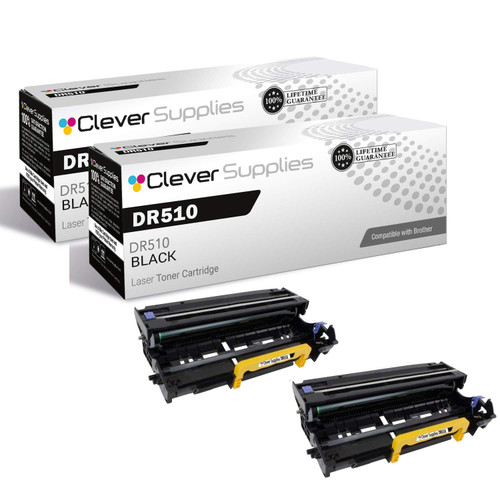
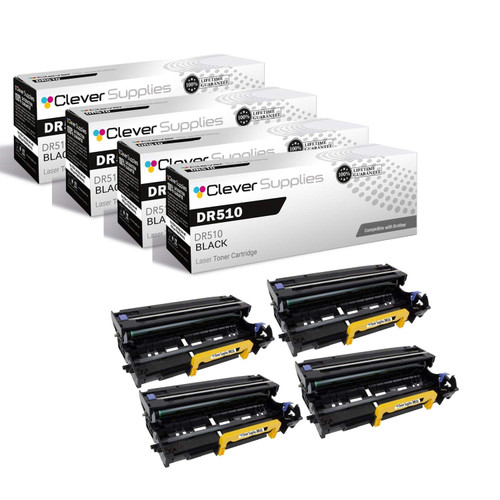
A lone machine with a tired drum is served by the 2-pack, with the second unit waiting as a spare for the next drum change years later. The 4-pack earns its place where several of the thirteen models draw from one supply cabinet and drums rotate on a schedule — $25.30 a unit inside it is the lowest drum price this shelf reaches. Either way, order with the contents clear in mind: whatever the packs’ store titles say, drums are what arrive, and a machine asking for toner needs the cartridge cards in the ladder section instead.
Chips and firmware updates, stated without decoration
Read all five compatible listings in this family end to end and a certain word never appears: “chip.” No listing asserts a fitted chip, promises toner-level reporting, or makes any recognition claim whatsoever. A guide that wrapped these cartridges in a chip narrative the listings themselves never tell would be making things up, so this one makes no chip claim of any kind.
Brother itself has addressed the underlying worry on its US support site: “Brother firmware updates do not block the use of third-party ink and toner cartridges in our machines.” Beyond that sentence, this page rests on things a reader can check directly — Brother’s published thirteen-model roster, the 5% coverage basis Brother prints for the platform, and shelf prices read on the date shown at the top.
Five checks before a TN570 order leaves the cart
Questions owners of these machines actually ask
Yes. The two cartridges share one fitting at two fill levels — roughly 3,500 pages from the TN540, roughly 6,700 from the TN570 — and each of the thirteen machines on Brother’s roster takes either size. Moving up changes nothing but how often the cartridge gets swapped, and on this shelf the TN570 is also the only one of the two stocked as a compatible.
Because none is stocked — compatible production for this platform concentrated on the high-yield cartridge, leaving the standard tier to Brother’s genuine listing at $113.05, roughly 3.23¢ a page. Since every compatible TN570 box prints for a fraction of that per page, the page leads with the larger cartridge instead of treating the gap as something to apologize for.
Brother’s figure. Brother rates the TN570 at approximately 6,700 pages at 5% coverage on Letter paper. The 7,000 in the pack listings — it sits in their yield fields and inflates their totals to 14,000 and 28,000 — overstates that rating. Every number on this page, the 4-pack’s 0.24¢ per page included, is worked out from Brother’s 6,700.
Let the machine decide, not the yield. The TN540 belongs to the thirteen models named on this page, all running on the DR510 drum. The TN550 serves a different set of printers built around the DR520 drum, and the two cartridges cannot be exchanged. Read the code printed on the cartridge you are replacing, or find your model in the roster above — either settles it in seconds.
Not in compatible form — the drum shelf here opens at the 2-pack for $58.64, with the 4-pack at $101.19 priced $16.09 below what two 2-packs would cost. A single drum does exist as Brother’s genuine unit, quoted on this page for reference at $239.99; that is the only one-at-a-time drum route for this platform.
It depends which shelf the item came from. Buy any of the five compatibles and the store’s own cover applies: a one-year warranty, plus a full year to return a compatible item that proves to be the wrong fit for your machine. The genuine listings quoted for reference carry Brother’s manufacturer warranty instead, with a 30-day return window. Orders leave from whichever of the four warehouses — Illinois, Pennsylvania, Georgia or California — is nearest, and the support desk is staffed on weekdays from 9 AM to 5 PM Central.